
Octavia Tried to Tell Us: Parable for Today’s Pandemic by Monica Coleman

In national quarantine and sheltering-in-place or is it “safer-at-home,” all I could think about was that we were living in a scene from the late Afrofuturist writer Octavia Butler’s book Parable of the Sower. So I texted my friend, Afrofuturist writer Tananarive Due and said: hey let’s do a webinar on this.  And this turned into weekly – then monthly – free webinars on the wisdom we can glean from Octavia Butler as we live through these political days.

Here, I share a recent workshop and dialogue that lifts up Octavia’s Parable of the Sower and highlights themes of prophecy, dystopia, theology and a way forward in times like these.

If you are interested in engaging more intimate work centered on Octavia’s work, visit OctaviaWebinar.com for more information.


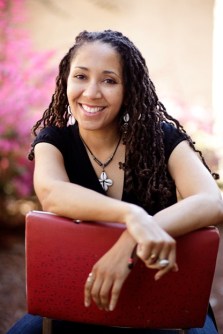
Dr. Monica A. Coleman is Professor of Africana Studies at the University of Delaware.  She spent over ten years in graduate theological education at Claremont School of Theology, the Center for Process Studies and Lutheran School of Theology at Chicago. Coleman has earned degrees from Harvard University, Vanderbilt University and Claremont Graduate University. She has received funding from leading foundations in the United States, including the Ford Foundation, the Andrew W. Mellon Foundation, and the Woodrow Wilson Fellowship Foundation, among others.

Answering her call to ministry at 19 years of age, Coleman is an ordained minister in the African Methodist Episcopal Church and an initiate in traditional Yoruba religion.

Dr. Coleman offers workshops, lectures and books for your organization, university or church. She warmly connects with people as she shares principles for growth and liberation. Read her story here.

Robbed by Monica A. Coleman

“Life is robbery.”

I re-read this Alfred North Whiteheadquotation to my students in the last weeks as we read through Adventures of Ideas. We were taking a welcome break from the philosophically demanding Process and Reality.

I explained that this is one of Whitehead’s more frequently cited sentences because he succinctly and poetically describes his position that life entails loss, and you can’t go back and get what you lose.

I said the same thing to one of my girlfriends as we chatted in my kitchen a couple of weeks ago. I was cooking and catching up with a friend I had not seen in nearly twenty years. As we chronicled our lives from the intervening decades, my friend said: “I have a religious question.”

In moments like these, I curse the fact that even my closest friends think that I have some special kind of knowledge as a minister and professional theologian. I took a deep breath because that phrase usually precedes some difficult, heart-wrenching question that has no satisfying answer.

Continue reading “Robbed by Monica A. Coleman”

The Barren Woman Bible By Monica A. Coleman

As I mourn the loss of my miscarried babies, it’s easy to see that the Bible’s stories of barren women were written by men.

I know that men wrote the Bible. That’s no surprise to anyone who has had a brush with feminism or biblical scholarship. But there are times when one is more aware of this than at other times. As I mourn the loss of my miscarried babies, I think of how the Bible tells the stories of barren women.

When I read about Sarai, Leah, Rachel, Hannah and Elizabeth, the story is always the same. The woman cannot have children.

Like a choose-your-own-adventure novel, the story goes like this:

Option A: You give your husband your maidservant, who then gives him a male child or two or three, and then, later, God opens your womb so you can bear a male child yourself.

Option B: You pray to God about how much you want children, and then, later, God opens you womb so you can bear a male child yourself. Continue reading “The Barren Woman Bible By Monica A. Coleman”

Sacrament By Monica A. Coleman

The following is a guest post written by Monica A. Coleman, Ph.D., scholar and activist committed to connecting faith and social justice. An ordained elder in the African Methodist Episcopal Church, Coleman has earned degrees at Harvard University, Vanderbilt University and Claremont Graduate University.  Coleman is currently Associate Professor of Constructive Theology and African American Religions and Co-Director of the Center for Process Studies at Claremont School of Theology in southern California. She is also Associate Professor of Religion at Claremont Graduate University.

This article was originally posted on the Beautiful Mind Blog.  Be sure to check in there and follow Monica’s journey.

“You have to believe in it. It won’t work if you don’t have some faith that it will work.”

These are the words my friend said to me years ago when I realized I could no longer manage my depressive condition without medication. Friend to friend, depressive to depressive, minister to minister . . . he told me to have faith.

I knew how to have faith in God. We prayed and preached about that for a living. I was not used to having faith in a pill. Continue reading “Sacrament By Monica A. Coleman”

I’m Back and Writing About Loss By Monica A. Coleman

The following is a guest post written by Monica A. Coleman, Ph.D., scholar and activist committed to connecting faith and social justice. An ordained elder in the African Methodist Episcopal Church, Coleman has earned degrees at Harvard University, Vanderbilt University and Claremont Graduate University.  Coleman is currently Associate Professor of Constructive Theology and African American Religions and Co-Director of the Center for Process Studies at Claremont School of Theology in southern California. She is also Associate Professor of Religion at Claremont Graduate University.

This post was originally posted on the Beautiful Mind Blog.  Be sure to check in there and follow Monica’s journey.

If you’ve been following my blog, you’ve noticed that I’ve been really quiet lately. Like all summer lately. What’s up with that? Well, part of the challenge of writing about depression is that it’s hard to write when depressed, and, well, depression happens. Continue reading “I’m Back and Writing About Loss By Monica A. Coleman”