

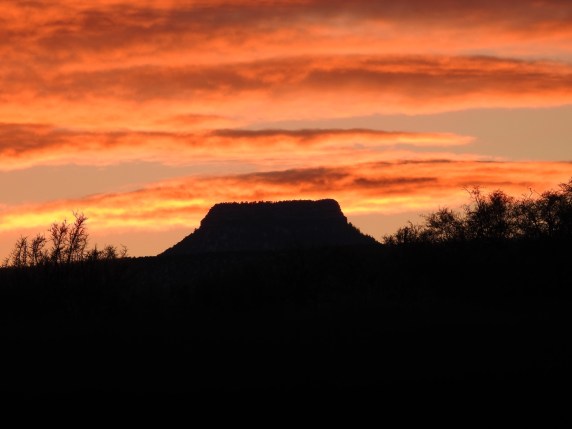
 She climbed steep hills
and rubble to reach the meadow.
The flat – topped mountain peered down
at the woman
gathering stones
as if they were diamonds.
Amber, moss, pearl white,
rose red and orange,
gray and ebony – a luminescence
emanated from each,
almost as if the moon had
infused each flake and boulder
with her translucent light.
The Pedernal absorbed
her child-like wonder
and gifted her
with stones
that told a story
of a sea of shells and plants
that once lived there
before people.
Stones speak to
those who love them.
Notes on the Pedernal:
In Abiquiu, New Mexico there is a flat – topped mountain that is called the Pedernal that can be seen from most directions and has been painted and photographed from every angle. Indigenous peoples considered this mountain to be sacred. The mythical (Navajo) Changing Woman was born on this mountain, and it is said that she lives there still. Each year she is born in the spring, emerges as a young woman during the summer, becomes a mother in the fall, and turns into an old woman during the winter season, only to be born again. In the East she is Earth Woman, in the South Mountain Woman, in the West she is Water Woman and in the North she is Corn Woman. Changing Woman embodies Nature’s as a whole and since the Navajo trace their lineage through a matrilineal line she is the Mother of all the People.
The first way Changing Woman saves the world is by birthing the twins, the male aspects of herself. This embodied female/male energy is capable of taking action on behalf of all the people, ridding the world of monsters. It is important to note that the twins require the help of Spider Grandmother’s wisdom, guidance and protection because Spider Grandmother is Changing Woman’s older wisdom aspect, a continuation of her mother – line.
The second and most critical way Changing Woman saves the world from “monsters” is because she secures the matrilineal line for the People. The matrilineal system traces descent through maternal roots. Men who marry move to the wife’s residence (matrilocal) and become part of the maternal family. Mothers, aunts, and grandmothers bring up the children, protecting, guiding, and teaching the children the ancestral family stories. This system unites Navajo society and creates the social structure of the culture connecting generations through kinship.
Although in present day Navajo culture Patriarchy has eroded women’s power the four tenets (harmony, beauty, balance, peace) remain part of the judicial system of the Navajo people.
The multicolored stone called chert and its darker twin, flint, are structural (quartz) parts of this mountain. These stones were once collected to craft the finest arrowheads for hunting.
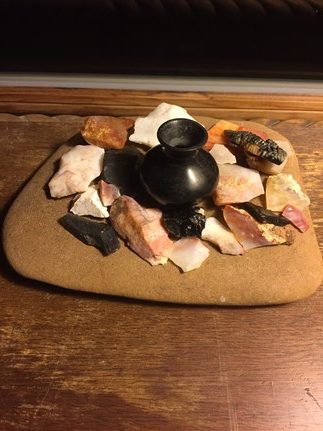
This collection of chert fragments lies on my desk along with a vessel made by an Indigenous woman. These stones remind me of the power of Changing Woman and how she continues to work through my life even as I return to the North, my homeland.
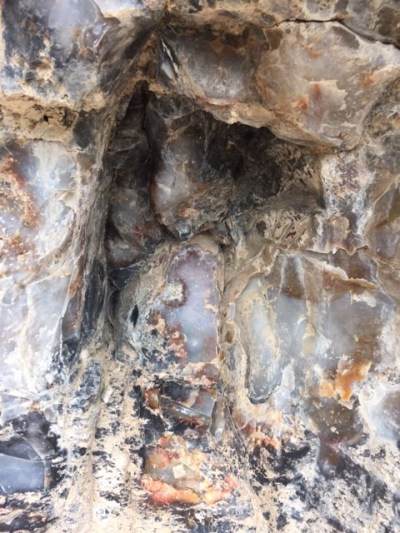
The mountain absorbed
her child-like wonder
with pleasure,
and gifted one
who climbed to her summit
with a stone
that told a story
of a sea of shells and plants
that once lived here.
Stones speak to
those who love them.
In the myth Changing Woman never dies; she grows old and young again with the seasons. In the East she is Earth Woman, in the South Mountain Woman, in the West she is Water Woman and in the North she is Corn Woman.
Changing Woman embodies Nature’s as a whole and since the Navajo trace their lineage through a matrilineal line she is the Mother of all the People.
According to Navajo mythology the first way Changing Woman saves the world is by birthing the twins, the male aspects of herself. This embodied female/male energy is capable of taking action on behalf of all the people, ridding the world of monsters. It is important to note that the twins require the help of Spider Grandmother’s wisdom, guidance and protection because Spider Grandmother is Changing Woman’s older wisdom aspect, a continuation of her mother – line.
The second and most critical way Changing Woman saves the world from “monsters” is because she secures the matrilineal line for the People. The matrilineal system traces descent through maternal roots. Men who marry move to the wife’s residence (matrilocal) and become part of the maternal family. Mothers, aunts, and grandmothers bring up the children, protecting, guiding, and teaching the children the ancestral family stories. This system unites Navajo society and creates the social structure of the culture connecting generations through kinship.
Although in present day Navajo culture Patriarchy has eroded women’s power the four tenets (harmony, beauty, balance, peace) remain part of the judicial system of the Navajo people.
Working notes:
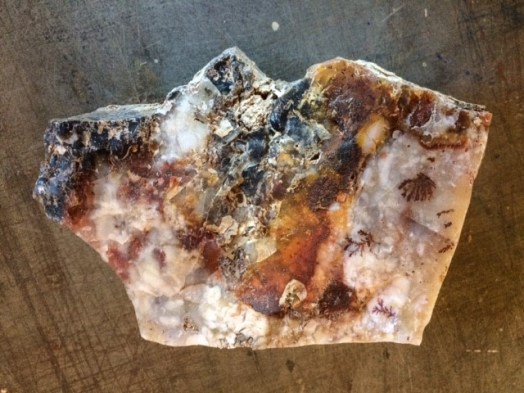
In Abiquiu, New Mexico the flat – topped mountain we call the Pedernal can be seen from most directions and has been painted and photographed from every angle. Indigenous peoples considered this mountain to be sacred. The mythical (Navajo) Changing Woman was born on this mountain, and it is said that she lives there still. Each year she is born in the spring, emerges as a young woman during the summer, becomes a mother in the fall, and turns into an old woman during the winter season, only to be born again. The multicolored stone called chert and its darker twin, flint, are structural (quartz) parts of this mountain. These stones were once collected to craft the finest arrowheads for hunting.
I have a passion for all stones but especially chert because of its colors. Chert and flint are microcrystalline varieties of quartz. Their crystals are so tiny that chert and flint fracture more like glass than quartz crystals. Skilled Native peoples chipped chert and flint pieces into arrowheads, spear points, scrapers, and other tools. The only difference between chert and flint is color: flint is black or nearly black, while chert tends to be white, gray, pink, or red and can be plain, banded, or preserve fossil traces.
Sara is a naturalist, ethologist ( a person who studies animals in their natural habitats) (former) Jungian Pattern Analyst, and a writer. She publishes her work regularly in a number of different venues and is presently living in Maine.
 Feminism and Religion