Through a Dark Forest: Fairy Tales as Women’s Stories


My first brush with raw and authentic fairy tales took place nearly thirty years when I was teaching English to Japanese children in Munich, Germany, where I lived from 1989 – 2000.

Intending to stock up on children’s literature, I discovered the a whole section of the Munich City Library was devoted to fairy tales from different cultures. It contained literally thousands of volumes, some of them ornate and leather-bound, as beautiful to hold as they were to read. I loved the Russian fairy tales the best, for they were the most haunting and evocative for me.

The fairy tales held me in thrall and would not let me go. They got under my skin and rooted themselves in my writing and my life. I was hooked.

Fairy tales are the domain of women. In past centuries, the traditional European storytellers were women sitting at their hearths and spinning at their spinning wheels–spinning a yarn, if you will. Telling old wives’ tales.

The original fairy tales were not romantic children’s stories. Only very recently with Walt Disney have these raw and very ominous stories been reduced to little more than cute cartoons. Until the 17th century, fairy tales were adult entertainment, the way of passing a dark winter’s evening. Many older fairy tales are quite bawdy. Allocation of fairy tales to the nursery took place in the 18th century when the educated upper classes rejected the irrational and supernatural aspects of the tales in favor of a more rational and scientific world view, thus dismissing these tales as nonsense and only good for amusing young children.

Yet, as the enduring popularity of Clarissa Pinkola Estes’ Women Who Run with the Wolves attests, fairy tales are meaningful and relevant for contemporary women seeking deep guiding archetypes and images of female strength.

These centuries-old stories bristle with wild and sometimes terrifying women who possess amazing powers. The witches and sorceresses who inhabit the dark forests of fairy tales offer a stark and startling contrast to the innocent maiden protagonists.

What I find most fascinating about fairy tales is not the young girl’s encounter with the prince, but with the witch. Baba Yaga in the Russian tradition and Frau Holle in the German tradition are both sorceresses of intimidating dimensions.

Baba Yaga eats human flesh and flies around in a cauldron. Her house dances on hen’s feet. Frau Holle lives in a house in a beautiful underground meadow and she showers young girls with either pure gold or filth, depending on how they have served her.

Both these figures are ancient archetypes of female sovereignty that had their origins as pagan goddesses. Baba Yaga was once a great mother goddess of the Slavonic peoples. According to ethnographer Sonja Ruettner-Cova, Frau Holle was originally a solar goddess and a weather goddess. When she shook out her featherbed, it snowed.

Ironically Baba Yaga and Frau Holle have lived on in fairy tales even after the old myths and religions that honored them were banished, precisely because fairy tales have been dismissed as children’s stories. The tales’ deep magic lies hidden in their deceptive simplicity.

The naive young girl must go into the woods on the darkest night to face Baba Yaga. She must leap down a well to find her way to Frau Holle’s house and serve her for a year and a day. Once the young heroine encounters the sorceress, she will be completely and utterly transformed–a girl no longer but a woman with secret powers of her own.

Fairy tales are full of images of women who both challenge and empower other women.

The culmination of the heroine’s journey a deep inner rootedness. It is finding and claiming that house in the forest deep in your soul.


Mary Sharratt is on a mission to write women back into history. Her most recent novel Ecstasy is about the composer Alma Schindler Mahler. If you enjoyed this article, sign up for Mary’s newsletter or visit her website.
 

No Man Can Spin Gold (Part 2) by Barbara Ardinger

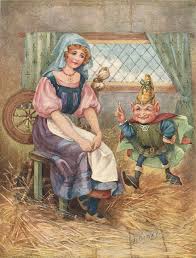
RumpelstiltzskinPerdita was in a panic. She looked this way and that, but all she saw was a towering pile of straw. She sat down to breathe deeply and think deeply. While she was breathing and thinking, the little man held is peaked green hat in his hands and marched anticlockwise around the room, whistling a jolly marching song she’d never heard before. He marched around the room three times.

Finally Perdita said to herself, Who knows what can happen in a year? That’s a long time. I can promise anything now. And then, well, I know I’ll be able to think of something to do. I’ll study all year! Aloud she said, “Kind Sir, you are miraculous, for no man can spin gold, and yet—here you are, spinning gold! You can have what you ask for.

And so the little man smiled a smile that showed all his teeth and sat down at the wheel and—whirr, whirr, whirr—the whole roomful of straw was soon spun into the finest gold thread imaginable, twice as fine as the finest silk thread the merchants sold at the harvest festival.

As soon as the Queen arrived back at her palace the next day, her Nephew introduced his betrothed to her. The Queen was much older than Perdita thought she would be, and she was as wise as she was old. She took Perdita into her private chamber and asked her several questions. She learned more about Perdita than the girl realized, also about her mother and stepfather and young traveling scholars. Nevertheless, the Queen gave her royal blessing to the marriage, for she wanted her Nephew to be married to someone with a quick mind, good manners, and some ambition so the land would be well cared for after her death.

The wedding took place on the day following the summer solstice, and guests were invited from lands all around. Perdita’s mother and stepfather were invited, too, and they were both given new clothes to wear. The stepfather tried to have a private conversation with the Queen, but the major-domo led him into the map room and showed him some extremely dependable treasure maps.

After the wedding banquet of roast peacock and candied goldfish and artichoke hearts and rosewater dumplings, the Queen and Perdita’s mother walked together in the gardens and talked of many things. Pretty soon, after the stepfather had memorized several of the treasure maps and borrowed enough money to rent a ship and set off to claim his treasure, the mother was invited to move into the palace, where her healing and domestic arts would be appreciated.

A year and a day later, Perdita gave birth to a daughter who was the most beautiful baby in the whole land. The royal birth was celebrated with fireworks and parades and festivals and rituals in the temples that lasted three whole days without pause. Perdita’s mother was appointed chief nursemaid and immediately hired a wet nurse who had the creamiest milk in the whole land.

On the third night after the baby’s blessing and naming day, Perdita was alone in her chamber, brushing her long, curly hair, when she heard a noise behind her.

“Well then. I have come for the baby.”

“What?” Perdita pretended not to recognize the little man. “And just who are you? And what are you doing in my private chamber? Get out immediately or I shall call the guards.”

“You know who I am. You know why I’m here.”

“Yes, yes, I confess it. I do.” She allowed a tear to roll down her cheek. “Oh, but please don’t take my baby. I have never loved anyone before, and I love this baby more than anything I have ever possessed. Here—take my jewelry. All of it. Take my jeweled toys. Take the tapestries from the walls. Take my richly embroidered clothes. Take my royal robes. Take my golden coronet. Take these books I’ve read. Take anything you want, but please, Kind Sir, oh, please don’t take my daughter.”

“We made a bargain. I have spun the gold for you. No man can spin gold, but I can, and I spun for three nights. Because of my spinning, you are now the heiress of the throne of this land. You must keep your part of the bargain.”

“No, no!” Perdita cried, glad that the baby was in her mother’s watchful care. “I cannot give up my daughter! She is more precious to me than gold.” And Perdita began to cry, to really cry, and her crying was so heart-rending that the little man finally began to take pity on her.

Continue reading “No Man Can Spin Gold (Part 2) by Barbara Ardinger”

No Man Can Spin Gold (Part 1) by Barbara Ardinger

PerditaIn a land not too far away there once lived a widow who was so poor and who worked so hard day and night to make a bare living that she had almost no time to teach her daughter the things a girl needs to know to be a proper wife. The girl, whose name was Perdita, had learned how to do a few useful things around the house, but when she laid the fire she always mixed green wood with the dry, when she made the soup she always forgot the salt and pepper, and when she swept she inevitably forgot to sweep under the bed. When she sewed she always pricked her fingers and left little red spots on the fabric, and when she spun she always made huge knots and horrible tangles in the new thread. Although she wasn’t very good at these important homely tasks, she had somehow learned to read and study numbers and she had even learned about Panglossian optimism. Her parents had no idea how this learning had come to her, unless it had something to do with the scholars who regularly passed through the town and with whom Perdita spent a lot of time. In her own opinion, the girl more than made up for her lack of useful skills with her brilliant mind and quick tongue…not to mention her beauty.
One day, although her mother had ordered her to finish the washing and hang the clothes in the sun to dry, Perdita left them soaking in the tub and went out and about with her mother’s second husband. On the road they happened to meet the Queen’s eldest Nephew. Now since the Queen had borne no daughters and was now too old to do so, everyone knew that one of her Nephews would inherit the throne when she died. As soon as he spotted the young man, Perdita’s stepfather saw an opportunity.

“Here’s your opportunity,” he murmured to the girl. “Do what you can to attract this fellow. If you do, things will go well for you and your mother.”

Perdita saw an opportunity, too. An opportunity to raise herself socially and find a life that was not so filled with laundry and other mind-numbing hard work. So she tossed her curls and swung her hips, she gazed up at the Royal Nephew, and soon she had his attention, for this young nobleman was interested in the things that have always interested the upper-class men. During their ensuing conversation, Perdita said coyly, “I may have a poor mother, but I’m quite clever, you know. I can read and write. I can cook and clean. I can sew and spin.

“I’m interested in girls who can do useful things,” said the Queen’s Nephew. “Are you good at all things you do?”

“Oh, yes, I am very, very good,” the girl replied demurely. “I have a great many talents.”

“And,” said her mother’s second husband, “some of this girls talents no one has uncovered yet.”

“I see,” said the young man with a wink. “And may I learn what your hidden talents are, my dear?”

“Why,” said Perdita with a pretty blush, “why I can…I can

“She can spin straw into gold,” said the stepfather. Who do you know who can do that?”

“No one at all.” The Royal Nephew took Perdita’s hand. “It’s well known that no man can spin straw into gold.

And she works very fast,” said the stepfather. “See how soft her hands are! Her fingers are as nimble as my own. Even though we’re not even related by blood, I have taught her all she knows!”

“Indeed,” the Royal Nephew said, “nimble…” And after he thought for a moment, he added, “My dear, would you like to come to my Aunt’s palace with me and show me—show us your talents?”

So with an unnecessary push from her stepfather, Perdita, who was sure she would be moving into the best of all possible worlds, went to the palace with the Queen’s Nephew. But the Queen was not there, for she was visiting one of her Sister Queens in a nearby land. When the Royal Nephew asked Perdita to show him how she spun straw into gold, she batted her eyelashes at him and, remembering what she’d seen other girls do, shrugged her linen bodice just a little bit off one shoulder. A little while later, when the Royal Nephew asked again about spinning straw into gold, she shrugged her bodice a little bit off her other shoulder. When he asked a third time about spinning straw into gold, however, she finally understood that he expected a reply.

She had to think fast. “Oh,” she said disingenuously, “oh, I only do it at night, when the moon is full, and I can never do it if anyone is watching. I can spin straw into gold only when I am left absolutely alone with my work.” She was feeling quite sure that the Royal Nephew would never leave her alone, especially with her soft linen bodice falling off both shoulders.

But Perdita hadn’t noticed that the moon was full that very night, and when the Royal Nephew offered to let her stay in the palace, she was loath to refuse the invitation. I’ll think of a way out of this predicament, she said to herself. I always do, for I’m very clever.

The young nobleman was keenly interested in gold, as nobles always are, and so he ordered a room at the far, far end of the farthest corridor to be filled one third full with straw. Then he got his aunt’s best spinning wheel and put that in the room, too.

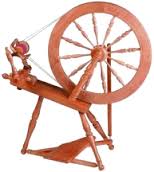
Spinning wheel“Here is a fine and private room,” he said to Perdita, “and I guarantee that no one will disturb you. Just spend the night here and show me how you can spin straw into gold, and I’ll give you a lovely reward in the morning.” And he winked at her.

What could the girl do? She watched the Royal Nephew close the door. She heard the key turn in the lock. She began to walk about the room. At last she sat down beside the wheel. But she didn’t have the least idea about how to spin straw into gold, for she couldn’t even spin flax into decent linen thread without getting huge knots and horrible tangles in it. She began to cry. “I’m lost!” she wailed. No one is here to advise me. No scholar I’ve ever met has considered this situation. No man can spin straw into gold, but I can’t, either. Oh, woe is me.”

“Well now.”

Suddenly she heard a voice, and when she peeked between her fingers, she saw a little man wearing a peaked green hat and a long brown jacket and wide brown trousers. He had a long white beard and big strong hands.

“Good evening,” he said. “Why are you crying?”

“I’m supposed to spin straw into gold, but I don’t know how.”

Continue reading “No Man Can Spin Gold (Part 1) by Barbara Ardinger”