
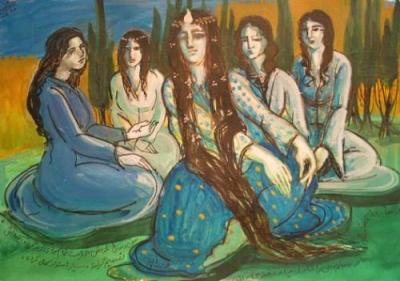
She performs ablutions, prays, and mends shoes for years, only to don her death shroud upon her back and place a symbolic tombstone upon her head. With death cloaking her compassionate body, she begins to twirl, invoking the name of the Beloved within her heart. She is a whirling dervish and her name is Fatima. The daughter-in-law of the esteemed Sufi poet, Rumi, joins with the myriad other Holy Women Icons with a folk feminist twist that I write about each month: Virginia Woolf , the Shulamite, Mary Daly, Baby Suggs, Pachamama and Gaia, Frida Kahlo, Salome, Guadalupe and Mary.
Fatima is best understood when placed in an historical context. So, I begin with a very brief history of the whirling dervishes, while also offering glimpses into women’s roles in the Mevlevi Order. The primary Islamic sect that proclaims that dancing is a way of connecting with the divine—for both men and women—is the Sufi Order. Over eight hundred years ago, Mevlâna Jalâluddîn Rumi inspired faithful Muslims to whirl in harmony with all things in nature. The whirling dervishes of Turkey unite the mind, heart, and body, and help to usher peace into the world through their dance by dedicating their lives to service and compassion. After Rumi’s death on December 17, 1273, his followers responded by whirling. These followers of Rumi are known as the Mevlevi Order, or more popularly, the whirling dervishes. Until around the fourteenth century women were included in the practice and leadership of turning. As Muslims in Turkey became more and more conservative, however, women were forced to the sidelines and not allowed to whirl. And even with the secularization of the country with the reign of Mustafa Kemal Ataturk, women were still denied access to the turning path because Ataturk essentially made whirling illegal in an attempt to take away as much religion from Turkish life as possible. Ataturk banned tekkes, or dervish homes, in 1925 as he secularized the state. By the 1970s the Turkish government allowed turning once again, but only if it was a performance and not a prayer. There were even reports of an old dervish being arrested because they saw his lips mouthing “Allah” as he turned in a theatre performance for tourists. Continue reading “Painting Fatima by Angela Yarber”


 Whenever we talk of Muslim women, two dominant discourses reach our ears. The first is about women of the past who may serve as role models, such as Aisha, Fatima, and Khadija (ra). This perspective, which I call the historical approach, presents an ideal woman with qualities we should strive to develop, values that make life possible with more comfort and a deepening of our imam (faith). These values include wisdom, loyalty, courage, justice, perseverance, faith, independence, and generosity.
 Feminism and Religion