Nature and the Body Were Never the Enemy

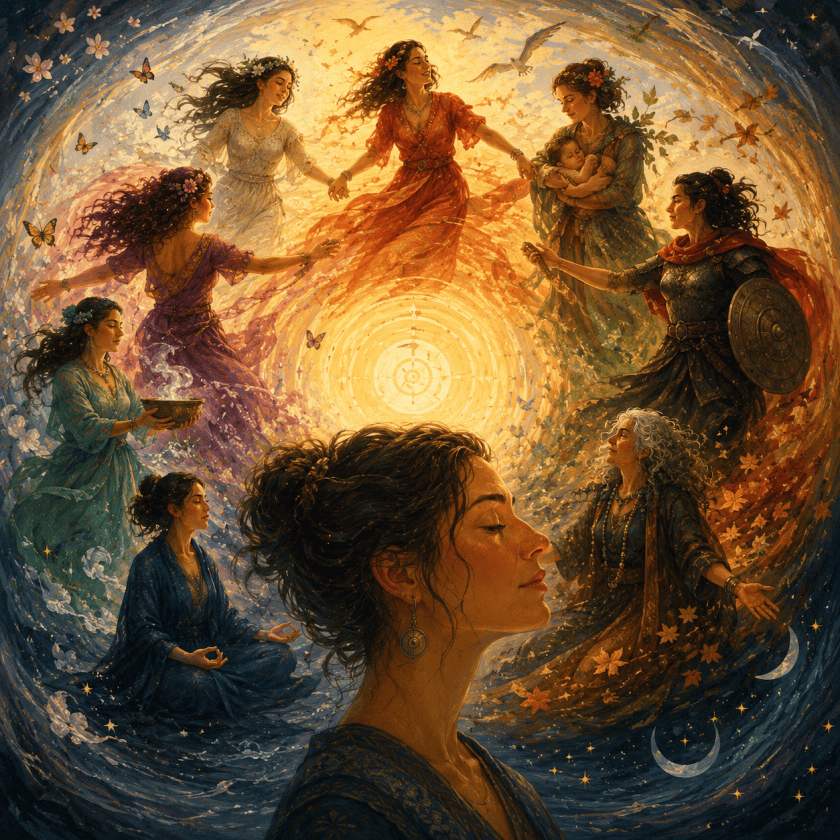
Reflecting on the contradictions of modern life, this essay explores how both wilderness and female embodiment became culturally suspect within Western thought. Drawing on themes of estrangement, relational ontology and kinship, it considers how practices of attention, presence and nature connection may help us return to a deeper sense of belonging.

Continue reading “Nature and the Body Were Never the Enemy”

Nature as a Regulating Intelligence by Paul Robear

Moderator’s Note: This appeared recently on the site the Cuyumungue Institute, now called the Cuyu Institute (see below for more information). You can see the original here.

Have you ever noticed that in certain natural environments your body begins to change before your thoughts do?

For me, my breathing deepens and something in my system settles – often before I’ve even fully registered where I am.

It’s not something I’m doing consciously. In fact, it seems to happen more fully when I’m not trying at all.

I’ve come to feel that it goes beyond the idea that nature helps us relax. It’s that our bodies are responding to something – something deeply organized, consistent, and connected to a quiet intelligence.

It’s easy to say that nature is calming, but that doesn’t quite capture what is happening. What I’ve come to feel is that nature is not simply soothing… it is regulating. It carries a kind of inherent intelligence, a living order that the body recognizes and responds to without needing instruction.

Continue reading “Nature as a Regulating Intelligence by Paul Robear”

Embodiment as Positive Resistance

I nearly cancelled my recent trip to the United States. The political climate felt tense, the global atmosphere uncertain, and travelling across the Atlantic seemed questionable for several reasons.

Friends encouraged me to go anyway, suggesting that meeting people in person would offer a different perspective from the one shaped by media narratives. And of course, it wasn’t headlines I was meeting, but people, in a human reality that persists beneath larger systems. Thankfully, my trust in relational experience outweighed my hesitation, and I returned from my travels with renewed inspiration.

I’m writing this essay because many people I met spoke with an apologetic tone about being American. They expressed disbelief, embarrassment or anger about their conspicuous yellow haired chief. I just want to acknowledge the warmth, generosity, care and humanity I encountered wherever I went.

The entire experience confirmed what I have long sensed in my work with movement, ritual and community: that embodied presence, especially in uncertain times, is such a remedy for heart and soul. What I encountered was meaningful human contact, even in a politically divided country.

Continue reading “Embodiment as Positive Resistance”

Shamanism in the MRI Scanner by Eline Kieft

Medical tests are an inevitable part of modern life. One experience that tends to heighten anxiety is an MRI scan. The claustrophobic tube, the pounding mechanical noise and the requirement to remain perfectly still for extended periods can create intense sensory overload.

At some point I became aware of the similarities with a shamanic journey, and found a way to transform this ordeal into a ritual of connection and support. With mindful presence and inner attunement, you can imagine the tube as a tunnel to the archetypal realms. The rhythmic, mechanical hum replaces the drumbeat. Spirit becomes a companion alongside modern technology.

I hope you’ll never need it, but should you be scheduling an MRI scan, this is an invitation to meet it with a sacred intention. You might connect with a power guide, receive unexpected insights, or simply meditate on a sense of peace while your body is being scanned. Participate, actively, in something that can feel “done to you” and turn it into a soulful inquiry into your inner world while the medical staff do their thing…

Continue reading “Shamanism in the MRI Scanner by Eline Kieft”

Goddess Architectures: How Cultures Shape Sacred Feminine Power

In this essay, I address a gap in goddess spirituality, between a rhetoric of celebrating the body, and lack of truly embodied practice. I reflect on the archetypal language commonly used in goddess spirituality, tracing its roots in Greek mythology and depth psychology while questioning its cultural limits.

By introducing the notion of “goddess architectures”, I explore how ecological, social and cosmological contexts shape symbolic structures, and how sacred feminine power can be named, distributed, embodied or obscured across cultures. Finally, I propose movement as a way back to lived experience beyond symbolic and linguistic frameworks.

Goddess Spirituality into the Lived Body

Over the past thirty years of researching and practising goddess spirituality, I noticed a persistent discrepancy. While this field speaks about honouring the body as sacred, in practice it often feels like rhetorical lip service. The language of embodiment is present, but remains disconnected from the body on many levels. 

Continue reading “Goddess Architectures: How Cultures Shape Sacred Feminine Power”

Moving through the Midlife Threshold

Goddess Qi Gong as a New Compass

There is a deep and insidious taboo around ageing that leaves so many of our experiences as women unspoken, as if the physical, emotional, hormonal and mental shifts of growing older should be suffered alone and hidden behind doors.

What if we can turn midlife into a positive initiation that we share together? Would it be possible to learn to read our body and psyche differently? Might practising conscious movement literally help us move through this phase? And what would happen if we re-orient ourselves towards the many faces of the Goddess?

Continue reading “Moving through the Midlife Threshold”

The Second Skin: Lipstick, Lies and Lead part 2 by Sabahat Fida

part 1 appeared yesterday

It is mind-boggling to consider how standards for women’s bodies have been normalized over time. Centuries ago, practices like binding women’s feet in ancient China or forcing the use of corsets to narrow the waist which are now universally condemned as cruel and uncivilized. Throughout history, women have been subjected to extreme and often harmful beauty standards.  Foot binding created tiny “lotus feet,” causing lifelong pain and disability, while in Europe, tightly laced corsets compressed ribs and displaced organs to produce an exaggerated hourglass figure. In parts of Southeast Asia, neck rings elongated the neck but weakened muscles over time, and in Africa, South America, and Asia, lip and ear stretching permanently altered tissue as a marker of beauty or status. Pale skin was prized in ancient Egypt, Asia, and Europe, often achieved through toxic powders containing lead or arsenic, while teeth were filed, blackened, or inlaid to meet local ideals. Women were also expected to meticulously shape or remove hair and conform to strict weight norms, whether forced thinness or fattening, depending on the era. Across centuries, these practices reveal a clear pattern: women’s bodies were controlled, altered, and harmed in the name of beauty ,  a coercion that, in many ways, continues today through cosmetic interventions and socially enforced aesthetic standards.

Continue reading “The Second Skin: Lipstick, Lies and Lead part 2 by Sabahat Fida”

The Second Skin: Lipstick, Lies and Lead part 1 by Sabahat Fida

A woman’s body has become a site of commodification to such extreme that even her most basic necessities are not spared. Products meant for hygiene or comfort ; razors, deodorants, tampons, shampoos  are packaged, scented, and coloured in ways that signal femininity, pushing them into a hyper-aesthetic zone of the departmental store. This creates a glaring economic contradiction: men’s products, often identical in function, are sold cheaper, while women pay a premium simply for their gender. But the exploitation is not merely financial. By demanding that her essentials adhere to socially approved standards of beauty, the market sends an unambiguous message: a woman’s needs, her very body, are only legitimate when they are commodified, beautified, and consumed in accordance with society’s expectations. The Pink Tax is thus not just a matter of inflated prices, it is a subtle enforcement of control, conditioning women to invest continuously in an ideal that is neither natural nor negotiable.

But this exploitation extends far beyond commercialized markets and seeps into the routines of everyday life. A tailor may charge different rates for the same shirt depending on the gender it is intended for, while a simple haircut at a salon can cost women far more than men, despite the identical service. Men’s consumption remains largely practical, functional, and unembellished, whereas women are expected to pay for aesthetic compliance at every turn. This raises the question: is the female market driven merely by trends or gullibility, or is it a reflection of deeper societal pressures — an unspoken demand that a woman’s body and appearance must conform to rigid standards of femininity in order to be socially acceptable?  Is the answer  in the very language and design of advertising  Taglines like “You’re worth it” or “Strong is beautiful” which  carry a psychological imperative, subtly instructing women to compare, conform, and continually invest in their appearance as a measure of worth ? These subliminal marketing strategies are deeply rooted in social comparison theory, objectification and fear appeal/protection motivation theories.

Continue reading “The Second Skin: Lipstick, Lies and Lead part 1 by Sabahat Fida”

A Taoist View of Intention (Yi)

Choosing How We Show Up with The Inner Compass of Mind, Eye and Heart

What does it mean, to set an intention? In this piece, I explore the Taoist concept of Yi, the integration of mind, eye and heart as a practice of coming into alignment with life.

This essay invites a nuanced relationship with intention, away from the modern hype around manifestation, and instead rooted in choice, care and conscious participation in life.

Klara Kulikova, Unsplash

A common concern around the word ‘intention’, especially in spiritual or self-help contexts, is its suggestion that thinking the right thoughts or holding the right mindset, will miraculously give you what you want.*) When it doesn’t, the implied message is that you somehow fell short: you weren’t positive enough, not aligned, or evolved enough for it to work. In short, the burden of failing is placed on you, without recognising the complexity of life. Rest assured, that’s not the kind of intention I’m writing about here.

Continue reading “A Taoist View of Intention (Yi)”

Let’s Have The Talk – What Does “The Birds and The Bees” Actually Mean: By Zoe Carlin

Recently, I have thought about a common idiom that has been used to refer to sexual reproduction, the birds and the bees. I became curious why animals that appear in most gardens were used as an example to explain where babies come from, until I did some research. It turns out that since the birds lay eggs, that is their representation of the female body and the bees represent the sperm due to pollination. It is a very subtle, overlooked message that can be disguised as being more age-appropriate to young children. However, I decided to dig a bit deeper. Ed Finegan, a USC professor of linguistics and law, has stated that this phrase has existed a lot longer than one might think. There is evidence of it being used in a somewhat sexual context going back to at least two authors, Samuel Coleridge Taylor (1825) and an entry from John Evelyn’s The Evelyn Diary (1644). 

In Work Without Hope, Samuel Coleridge Taylor quotes, “All nature seems at work . . . The bees are stirring, birds are on the wing . . . and I the while, the sole unbusy thing, not honey make, nor pair, nor build, nor sing.” This separation of the birds and bees is indicating the loneliness and sadness of missing out on a potential romantic connection. When going even further back in time to 1644, it was noticed in the Evelyn Diary that there was an entry discussing the interior design of St. Peter’s in Rome: “That stupendous canopy of Corinthian brasse; it consists of 4 wreath’d columns, incircl’d with vines, on which hang little putti [cherubs], birds and bees.” This description is illustrating that there is a possible sensual or sexual meaning of the architecture in St. Peters.

Continue reading “Let’s Have The Talk – What Does “The Birds and The Bees” Actually Mean: By Zoe Carlin”