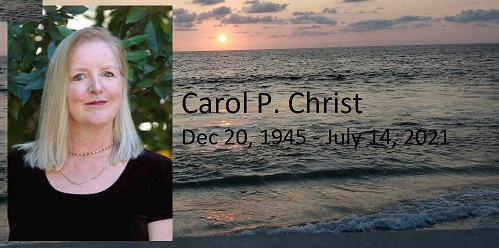
Legacy of Carol P. Christ: Of Human Life*

This post was originally published on July 2nd, 2012like many of Carol’s other posts, it is eerily poignant for today.

Watching the last episode of the Australian series Brides of Christ in which Catherine leaves the sisterhood of the convent because of her disagreement with Humanae Vitae brought me right back to the Yale Roman Catholic chapel and the folk mass I attended regularly.  In 1968 just after the publication of Humanae Vitae, priest and co-graduate student Bob Imbelli preached a sermon on the doctrine of conscience, arguing that though it was incumbent on Catholics to think carefully about the papal encyclical on birth control, it was also the responsibility of every Catholic to follow her or his conscience on the matter.  In the episode, Sister Catherine encourages a Roman Catholic mother of six who has already self-induced more than one abortion to take the pill, but the woman decides she cannot go against the church’s teachings.  Catherine allows an editorial against Humanae Vitae to be published in the school newspaper even though she knows it will probably lead to the expulsion of one of her favorite students.

Continue reading “Legacy of Carol P. Christ: Of Human Life*”

Legacy of Carol P. Christ: Of Human Life*

This was originally posted on December 30, 2011

Watching the last episode of the Australian series Brides of Christ in which Catherine leaves the sisterhood of the convent because of her disagreement with Humanae Vitae brought me right back to the Yale Roman Catholic chapel and the folk mass I attended regularly.  In 1968 just after the publication of Humanae Vitae, priest and co-graduate student Bob Imbelli preached a sermon on the doctrine of conscience, arguing that though it was incumbent on Catholics to think carefully about the papal encyclical on birth control, it was also the responsibility of every Catholic to follow her or his conscience on the matter.  In the episode, Sister Catherine encourages a Roman Catholic mother of six who has already self-induced more than one abortion to take the pill, but the woman decides she cannot go against the church’s teachings.  Catherine allows an editorial against Humanae Vitae to be published in the school newspaper even though she knows it will probably lead to the expulsion of one of her favorite students.

Continue reading “Legacy of Carol P. Christ: Of Human Life*”

On the Transmission of Life by Natalie Weaver

Natalie Weaver

Among the more controversial Roman Catholic documents is Humanae Vitae, the 1968 encyclical of Pope Paul VI on birth control.  This encyclical famously instructs against the use of artificial contraception methods in the regulation of birth.  This position is based on the theological warrant that the natural law of God’s reproductive design requires human sexuality, if it is to be moral, to be always nuptial, companionable, and open to new life.  The encyclical anticipates a number of reasons why people will object to this teaching, including: population problems, family and personal limitations, economic concerns, and so on.  It also anticipates that some will suggest procreative and unitive ends must be seen diachronically in the context of the fullness of nuptial sexuality, such that sexuality would be understood holistically rather than as a series of individual sexual acts.  Despite its acknowledgement of these concerns as legitimate, the encyclical argues that grave harm flows from the distortion of natural law and leads inevitably to the degradation of sexual dignity and nuptial integrity (for example, in making free sex more available to young people outside of marriage or cheapening male regard for women on account of women’s sexual objectification).  The encyclical thus opts for an approach that evaluates sexual morality in terms of individual sexual acts.

The perspective of the document has been critically unpacked for decades, and its instruction is in the very least unconvincing to many Catholic couples.   I find in my teaching that Catholic college students today are unfamiliar with the document’s language and rationale, even though they may know the basic instruction that Catholics aren’t supposed to use birth control.   Since this issue is both topical currently due to the healthcare legislation and since birth regulation is a requisite discussion in my course on sexual ethics, I have the students read the encyclical itself.  Now, this is a hard task because I know by and large what the student reactions will be.  Their most favorable reaction is generally that the document has no instructional or binding value for them.  Their least favorable reaction is that the document makes poor sense of the human situation today, especially because human sexual expression reaches well beyond the Church’s vision of normative, heterosexual, marital union. Continue reading “On the Transmission of Life by Natalie Weaver”

Of Human Life* By Carol P. Christ

Watching the last episode of the Australian series Brides of Christ in which Catherine leaves the sisterhood of the convent because of her disagreement with Humanae Vitae brought me right back to the Yale Roman Catholic chapel and the folk mass I attended regularly.  In 1968 just after the publication of Humanae Vitae, priest and co-graduate student Bob Imbelli preached a sermon on the doctrine of conscience, arguing that though it was incumbent on Catholics to think carefully about the papal encyclical on birth control, it was also the responsibility of every Catholic to follow her or his conscience on the matter.  In the episode, Sister Catherine encourages a Roman Catholic mother of six who has already self-induced more than one abortion to take the pill, but the woman decides she cannot go against the church’s teachings.  Catherine allows an editorial against Humanae Vitae to be published in the school newspaper even though she knows it will probably lead to the expulsion of one of her favorite students.

I had forgotten that Pope Paul VI issued the prohibition on birth control against the clear majorities of the Roman Catholic commissions instructed to study the matter.  In the episode, Sister Catherine, told by her bishop that she can no longer express her own opinions on birth control, tries to explain to her students that Roman Catholics cannot use birth control because it is against “natural law.”  This provokes one of the students to ask if people are not supposed to use birth control because animals don’t use it.  This question sparked an “ah-ha” moment for me.  Hmm, I thought, while “man” has invented birth control, “women” cannot use it because we are meant to remain “like the animals.” This debate really is about the question of whether women are human! Continue reading “Of Human Life* By Carol P. Christ”