
The Barren Woman Bible By Monica A. Coleman

As I mourn the loss of my miscarried babies, it’s easy to see that the Bible’s stories of barren women were written by men.

I know that men wrote the Bible. That’s no surprise to anyone who has had a brush with feminism or biblical scholarship. But there are times when one is more aware of this than at other times. As I mourn the loss of my miscarried babies, I think of how the Bible tells the stories of barren women.

When I read about Sarai, Leah, Rachel, Hannah and Elizabeth, the story is always the same. The woman cannot have children.

Like a choose-your-own-adventure novel, the story goes like this:

Option A: You give your husband your maidservant, who then gives him a male child or two or three, and then, later, God opens your womb so you can bear a male child yourself.

Option B: You pray to God about how much you want children, and then, later, God opens you womb so you can bear a male child yourself. Continue reading “The Barren Woman Bible By Monica A. Coleman”
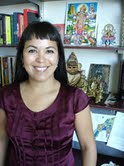
Birthing God at the Edges of Life, Death, and Beyond: Reflections on Mary, Motherhood, and Kali Part III By Tracy Sayuki Tiemeier

Tracy Sayuki Tiemeier, Ph.D., is Assistant Professor of Theological Studies at Loyola Marymount University in Los Angeles, CA. She teaches and researches in the areas of women and religion, interreligious dialogue, comparative theology, Asian and Asian American theology, and Hindu-Christian studies. Tracy also co-chairs the Los Angeles Hindu-Catholic Dialogue.

When I began my studies of Hinduism, I marveled in a dizzying array of gods and goddesses. While non-Hindus assume that Hinduism is polytheistic because of the multitude of gods and goddesses, the reality is far more interesting and complex. Hinduism really isn’t one religion, but a cluster of them. For some, there is one personal, divine God or Goddess, and all other gods and goddesses are either different forms of the ultimate divine or are lower, created beings (like angels). For others, there is one divine reality, but it isn’t a personal God or Goddess. For them, the different deities illustrate or symbolize different aspects of the divine, but are not themselves the one Ultimate Reality. What all Hindus recognize, however, is that there is one Ultimate, Divine Reality and that that divinity pervades all things. But that divine Oneness is so profound, so deep, so real, that no one image can capture the divine essence. Thus, even as Hindus are more monotheists than polytheists, they resolutely celebrate the multiplicity that inevitably comes when finite humans imagine the infinite divine. Continue reading “Birthing God at the Edges of Life, Death, and Beyond: Reflections on Mary, Motherhood, and Kali Part III By Tracy Sayuki Tiemeier”

Birthing God at the Edges of Life, Death, and Beyond: Reflections on Mary, Motherhood, and Kali Part II By Tracy Sayuki Tiemeier

Tracy Sayuki Tiemeier, Ph.D., is Assistant Professor of Theological Studies at Loyola Marymount University in Los Angeles, CA. She teaches and researches in the areas of women and religion, interreligious dialogue, comparative theology, Asian and Asian American theology, and Hindu-Christian studies. Tracy also co-chairs the Los Angeles Hindu-Catholic Dialogue.

Mary, her purity, and her role as Virgin Mother have become the primary language for talking about women and women’s place in the Church. The late Pope John Paul II held up Mary, both virgin and mother, as the perfect model for women. For the Pope, women’s sexuality and spirituality are united in a vision of woman’s personhood as that of nurturing self-gift. The calling of physical and spiritual motherhood is connected to women’s more receptive and nurturing nature. Men lead the Church, as Christ did, while women receive Christ and others in their homes and in the world, as Mary did. Mary’s receptive openness to God is manifest from the beginning in her consent to Jesus’ conception. Such receptivity is both biologically natural and spiritually essential. Mary as Virgin Mother shows both women and men the value and depth of the receptive, self-giving reality of womanhood. Continue reading “Birthing God at the Edges of Life, Death, and Beyond: Reflections on Mary, Motherhood, and Kali Part II By Tracy Sayuki Tiemeier”

“Now Sarah, Abraham’s wife, bore him no children”: On Experiencing Infertility By Gina Messina-Dysert

Gen 16: 1 reads “Now Sarah, Abraham’s wife, bore him no children.” The simplicity of this statement fails to communicate the complicated and devastating situation Sarah faced. The woman who became the matriarch of the Judeo-Christian tradition was barren, unable to fulfill the one duty that gave her worth within her community.  While women were already devalued by society, the social status of a woman struggling with infertility was even further diminished.

Sarah is a woman I have come to identify with. I share her plight of infertility and feel a hopelessness that can only be fully understood by women in a similar situation. Like Sarah I have been desperate to become a mother and although it is the 21st century, as a woman I have felt pressure to do so. Feelings of inadequacy and lack of worth have been overwhelming at times as family members and friend have felt it necessary to not only acknowledge my struggle but also offer commentary on what exactly they think is wrong with me. Continue reading ““Now Sarah, Abraham’s wife, bore him no children”: On Experiencing Infertility By Gina Messina-Dysert”