The Legacy of Carol P. Christ: A Radical Conclusion: We Are Our Own Authorities

This was originally posted on August 11, 2014

Carol Christ in Lesbos

Elisabeth Schussler Fiorenza articulated a widely held tenet of feminist theology when she stated that feminism places a question mark over all inherited texts and traditions. This means that feminists cannot and must not accept any teaching or traditional way of performing religious acts simply because “the Bible [or the Koran or the minister or the priest or the rabbi or the imam or the guru] tells me so.”

Instead, feminists must question every text and tradition and the words of every religious leader to see whether or not they promote the full humanity of women. The implication of this is that we must acknowledge and take responsibility for becoming our own authorities—as individuals and in communities.

A tongue –in-cheek letter that began circulating on the internet in 2000 under the title “Why Can’t I Own a Canadian?” makes the point that even those who claim to be adhering to every “jot and tittle” of the Holy Book are in fact choosing to accept some aspects of tradition while rejecting others.

The letter begins:

Dear Dr. Laura,

Thank you for doing so much to educate people regarding God’s Law. I have learned a great deal from your show, and I try to share that knowledge with as many people as I can. When someone tries to defend the homosexual lifestyle, for example, I simply remind him that Leviticus 18:22 clearly states it to be an abomination. End of debate.

I do need some advice from you, however, regarding some of the specific laws and how to best follow them.

The author of the letter continues:

Lev. 25:44 states that I may indeed possess slaves, both male and female, provided they are purchased from neighboring nations. A friend of mine claims that this applies to Mexicans, but not Canadians. Can you clarify? Why can’t I own Canadians?

Continue reading “The Legacy of Carol P. Christ: A Radical Conclusion: We Are Our Own Authorities”

The Legacy of Carol P. Christ: Good Theology is Feminist Theology

The was originally posted on July 21, 2014

carol christ

Judith Plaskow and I are just now completing the draft of the manuscript of the book we have been working on for the past 2 ½ years. It has a new title: Two Views of Goddess and God for Our Time.* I have been thinking of little else for the past few weeks. An editor who is considering our book said that she was hoping we could address our book to an audience larger than the feminist theology community. Thinking about this, a light dawned: if feminist theology is right that traditional theology denies the full humanity of women, then good theology must be feminist theology. Our work is not tangential to the theological mainstream, but is at its center.

This is the book in its final form.

We have revised the Introduction and Conclusion to the book with the assumption that our work should appeal not just to other feminists, but to a wide range of intelligent readers and thinkers. The fact that we were asked to participate in a dialogue about the nature of God in Tikkun magazine’s Summer 2014 inspires us to hope that we are right that feminist theology is becoming part of the progressive theological mainstream.

Continue reading “The Legacy of Carol P. Christ: Good Theology is Feminist Theology”

Legacy of Carol P. Christ: JUSTICE AND PREJUDICE IN THE “PROPHETIC TRADITION”

This was originally posted July 14, 2014

carol christ

Besides being advocates of social justice, the prophets of Israel were advocates of “exclusive monotheism,” exclusively “male monotheism,” “religious othering,” and “religious prejudice.” 

Many progressive Jews and Christians find inspiration in prophets because of their insistence that their God cares about the poor and “the widow at the gate.” For progressive Christians, Jesus stands in the prophetic tradition, and the core of his message is “concern for the poor.” For progressive Jews the prophetic tradition is the root of their concern for human rights.

Those who locate their spirituality and concern for social justice in the prophets can point proudly to Martin Luther King and the many priests, ministers, and rabbis, as well as ordinary Christians and Jews who marched with him as exemplars of the prophetic tradition.

But the prophetic tradition also has a nasty underside.

Continue reading “Legacy of Carol P. Christ: JUSTICE AND PREJUDICE IN THE “PROPHETIC TRADITION””

Legacy of Carol P. Christ: TWO MEANINGS OF ANTHROPOMORPHISM

This was originally posted on May 26, 2014

carol christ

“The error of anthropomorphism” is defined as the fallacy of attributing human or human-like qualities to divinity. Recent conversations with friends have provoked me to ask in what sense anthropomorphism is an error.

The Greek philosophers may have been the first to name anthropomorphism as a philosophical error in thinking about God. Embarrassed by stories of the exploits of Zeus and other Gods and Goddesses, they drew a distinction between myth, which they considered to be fanciful and false, and the true understanding of divinity provided by rational contemplation or philosophical thought. For Plato “God” was the self-sufficient transcendent One who had no body and was not constituted by relationship to anything. For Aristotle, God was the unmoved mover.

Jewish and Christian theologians adopted the distinction between mythical and philosophical thinking in order to explain or explain away the contradictions they perceived between the portrayal of God in the Bible and their own philosophical understandings of divine power. While some philosophers would have preferred to abolish myth, Jewish and Christian thinkers could not do away with the Bible nor did they wish to prohibit its use in liturgy.

Continue reading “Legacy of Carol P. Christ: TWO MEANINGS OF ANTHROPOMORPHISM”

Legacy of Carol P. Christ: IS EVIL PART OF THE NATURE OF REALITY AND DIVINITY?

This was originally posted on March 31, 2014. We are posting this on Sunday instead of Carol’s usual Monday in order to accommodate other scheduled posts this week.

carol-christ

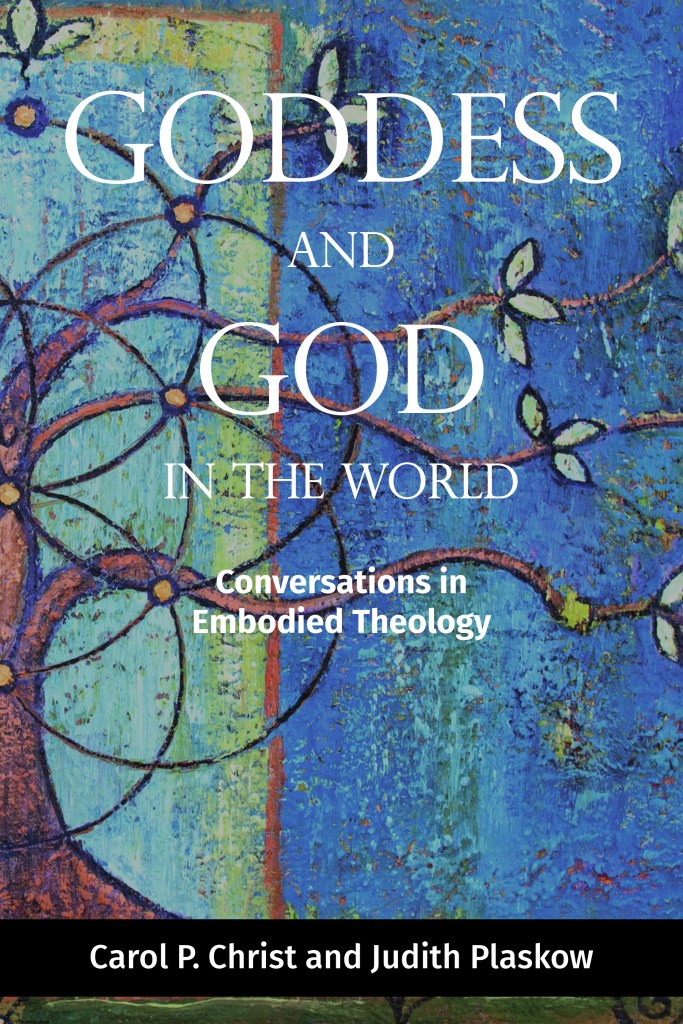
 What is the origin of evil? Is it innate in human nature or even in the nature of the universe? Judith Plaskow and I discuss this question in our forthcoming book Goddess and God in the World and this is a chance to listen in our conversation.

I am responding to Judith’s allegation that in imagining Goddess as loving and good I am fantasizing an ideal deity who exists apart from the evil-and-good world that we know. Judith speaks of an “evil impulse” in human beings which she considers to be innate in human beings and in the nature of reality. Judith says that my “defense” of the goodness of God comes down to “the traditional free will defense.” She also questions my view that human beings can 

I argue that it does not because the traditional free will defense imagines an omnipotent God who existed before the creation of the world. Then I continue:

I think what you meant to say is that like those who invoke the traditional free will defense of the omnipotent God, I attribute humanly chosen evil entirely to human beings—and not to Goddess or God.

Continue reading “Legacy of Carol P. Christ: IS EVIL PART OF THE NATURE OF REALITY AND DIVINITY?”

From the Archives: Passover and the Exodus: A Feminist Reflection on Action, Hope, and Legacy by Michele Stopera Freyhauf

This was originally posted on March 26, 2015

Freyhauf, Durham, Hahn Loeser, John CarrollLast week, Supreme Court Justice Ruth Bader Ginsburg was in the news again, but not for reasons you would expect.  She, along with Rabbi Lauren Holtzblatt, penned a feminist essay about the Exodus title “The Heroic and Visionary Women of Passover.”  Finding this story was exciting, especially because I am so drawn to the Exodus story (the intrigue and curiosity of which caused me to return to school and study, as one of my main areas of focus, Hebrew Scriptures – along with Archaeology and Ancient Near Eastern History).  Now women’s roles in this story are being elevated thanks to Justice Ruth Bader Ginsburg and Rabbi Holtzblatt.

Before I discuss the message and the importance this message brings, I think it is important to know an important fact about Justice Ginsburg.  Ginsburg is not observant, but does embrace her Jewish identity.  When her mother died, she was excludedRuth_Bader_Ginsburg_official_portrait[1] from the mourner’s minyan because she was a woman; an event in Judaism that is meant to comfort the mourner, brings a sense of community, and is considered obligatory – a means of honoring our mother/father.  This important event left an impression and sent a loud message that inspired and influenced her career path – she did not count – she had no voice – she had no authority to speak.  No wonder her life and career focuses so much on women’s rights and equality.

As many of us know, the story of Exodus is focused on two things 1) Moses and 2) liberation from the bonds of servitude and enslavement; women are rarely discussed.  In the essay co-authored by Ginsberg, women are described as playing a crucial role in defying the orders of Pharaoh and helping to bring light to a world in darkness.  In the Exodus event, God had partners – five brave women are the first among them, according to Ginsburg and Holtzblatt.  These women are: Continue reading “From the Archives: Passover and the Exodus: A Feminist Reflection on Action, Hope, and Legacy by Michele Stopera Freyhauf”

Legacy of Carol P. Christ: Maiden, Mother, Crone: Ancient Tradition or New Creative Synthesis?

This was originally posted on August 8, 2016

Carol P. Christ by Michael Bakas high resoultion

The image of the Goddess as Maiden, Mother, Crone is widespread in contemporary Goddess Spirituality. The Triple Goddess honors three ages of women, in contrast to the wider culture that: affirms young women as sex objects while shaming them as sluts; celebrates mothers on Mother’s Day, while providing few legal and economic protections for mothers; and ignores older women.

Though Goddess feminists have created rituals for menstruation and birth, I suspect that a greater number of rituals have celebrated “croning.” The reasons for this are twofold. One is that women have time and space to reflect on the meaning of life in middle age. The other is that aging women are not honored and respected in the wider culture–creating a need for rituals that do just that. Many women I know have spoken of the empowerment they felt in their croning rituals.

On the other hand, many women I know have not been particularly interested in a croning ritual.

Continue reading “Legacy of Carol P. Christ: Maiden, Mother, Crone: Ancient Tradition or New Creative Synthesis?”

Archives from the FAR Founders: The Courage to be a Self and a Part by Xochitl Alvizo

This post was originally published on November 1, 2o23. It is about a chapter I was working on at the time. That piece was recently published in Catholicism: End or Beginning? by Mary Daly, and edited by Meg Stapleton Smith.

A blurb about the talk can be found on WATER’s homepage: https://www.waterwomensalliance.org//. And if you would like to join as well, please register here: https://www.waterwomensalliance.org/watertalk-registration/.

I thought it a good time to repost since the first public discussion of our volume will take place next Wednesday, March 11, 2026 at 1PM (EST) on Zoom. Mary E. Hunt will be hosting Meg Stapleton Smith for a WATERtalk. I and other contributors will also join the conversation.

~~~~~~

I just submitted to the editor the final draft of a chapter I’ve been working on for about two years (no joke). Sometimes when I really care about a subject, it can take me a long time to process, reflect, and write on the subject (I shared a bit about this project on FAR early this year)—but this one might have taken the cake in terms of how slow a process it ended up being. Still, it is now submitted and in the hands of the publishing company, Oxford University Press, for the next step in the process.

Continue reading “Archives from the FAR Founders: The Courage to be a Self and a Part by Xochitl Alvizo”

The Legacy of Carol P. Christ: Toxic Masculinity: “Masculinity Must Be Killed” by Carol P. Christ

This was originally posted on June 20, 2016

Carol Molivos by Andrea Sarris 2A few days ago I watched the movie An Unfinished Life starring Morgan Freeman, Robert Redford, and Jennifer Lopez. Though it was recommended as a sensitive psychological drama, and though on the surface level it criticizes (male) violence against women and animals, on a deeper level, it confirms the association of masculinity with violence, suggesting that violence is the way men resolve their problems with each other.

At the beginning of the film, Robert Redford, who lives on a ranch in Montana, picks up his rifle with the intention of shooting a bear who mauled his friend Morgan Freeman. This act of violence is stopped by local authorities who arrive to capture the bear. However, the bear is not removed to a more remote area, but rather is given to a local make-shift zoo where it is kept in a small cage. At the end of the movie, Redford frees the bear after Freeman realizes that it should not be punished for injuring him. The bear is last seen crossing a mountain ridge in the distance.

Redford is grieving the death of his only son who died in an automobile accident while his son’s wife (played by Jennifer Lopez) was driving. After being beaten by her current boyfriend, Jennifer Lopez escapes with her daughter and ends up on Redford’s doorstep, announcing that her daughter is Redford’s granddaughter.  Redford, who believes Lopez is responsible for his son’s death, grudgingly allows them to stay.

When Lopez’s boyfriend tracks her down in Montana, Redford drives him out of town, threatening to kill him with his rifle. When the boyfriend comes back, Redford shoots out the tires of his car, smashes the car’s windows with his rifle, and beats the boyfriend bloody before putting him on a bus out of town.

The movie asks us to condemn the boyfriend’s violence against Lopez and Redford’s desire to kill the bear, but it also asks us to condone and even to celebrate Redford’s violent acts against the boyfriend. After all, in this case, justice is done. Right?  Continue reading “The Legacy of Carol P. Christ: Toxic Masculinity: “Masculinity Must Be Killed” by Carol P. Christ”

Legacy of Carol P. Christ: IS GODDESS “WITH US” OR “IN CONTROL” OF EVERYTHING? THE “THEOLOGICAL MISTAKE” OF DIVINE OMNIPOTENCE

carol-christ

This post was originally published on Feb. 24th, 2014.

How do we make sense of loss, great loss, and everyday disappointment? Some would tell us that “everything has a purpose” or that whatever happens “must be the will of God.”  I have found that these answers to questions raised by life as we know it often do more harm than good.  Yet they have a sticking power–we hear them all the time, sometimes even from other feminist seekers.

From the beginning feminists in religion rejected “the God out there” who rules the world from a throne in heaven. Most of us have insisted that “God” is more “in” the world than “beyond” or “outside it.” However we have not always been consistent in our convictions. When feminists are confronted with untimely death or great evil or just not getting what we think we want, we can sometimes be overheard to wonder, “Why did God (or Goddess) let that happen?” This question is based in the assumption that God or Goddess is omnipotent and rules the world from outside it. This is the theological idea I intend to question today.

The “zero fallacy” is a term philosopher Charles Hartshorne used to explain the “theological mistake” known as divine omnipotence.  Hartshorne pointed out that if God is omnipotent, then God has “all” or “100%” of the power. If this is so, then human beings and all other beings have “zero” power.  But if we have zero power, then do we even exist?  Continue reading “Legacy of Carol P. Christ: IS GODDESS “WITH US” OR “IN CONTROL” OF EVERYTHING? THE “THEOLOGICAL MISTAKE” OF DIVINE OMNIPOTENCE”