Renewal, Reflection, & Resonance by Paul Robear

The Power of Introspection in Personal Transformation by Paul Robear of the Cuyamungue Institute

Self-reflection helps us understand who we are, what we believe in, and why we think or act the way we do. It is a key element of self-improvement. I have found that by reflecting regularly, I greatly increase my chances of making healthy changes that support growth in my life.

Throughout my life, I’ve felt a yearning to better understand my own strengths and weaknesses. From an early age, I was drawn to moments of pause and deep reflection. These pauses became opportunities to notice what within me was ready to be renewed. I think of this as the space where we begin to hear the resonance of our own inner wisdom.

To give shape to this inner journey and to make it simple and memorable, I began framing it around three guiding words, each beginning with the letter “R.” Over time, these words became touchstones for clarity and meaning in my practice of introspection.

Renewal: A Quiet Beginning: Renewal is usually quiet, subtle, and deeply personal. Just as nature renews itself in cycles, our lives also hold rhythms of renewal. These moments invite us to release what no longer serves us and to open to fresh possibilities. Renewal is not about reinventing ourselves, but about remembering our capacity for growth and allowing space for it to emerge.

Continue reading “Renewal, Reflection, & Resonance by Paul Robear”

The Cuyamungue Institute, part 2 by Janet Maika’i Rudolph

This is part 2 of a blogpost based on an interview I did with Laura Lee at the Cuyamungue Institute. Yesterday’s post concluded with the concept of natural body positions and how these inspired the founder, Dr. Felicitas Goodman. She was also inspired by yoga postures. Laura describes Dr. Goodman’s thinking.

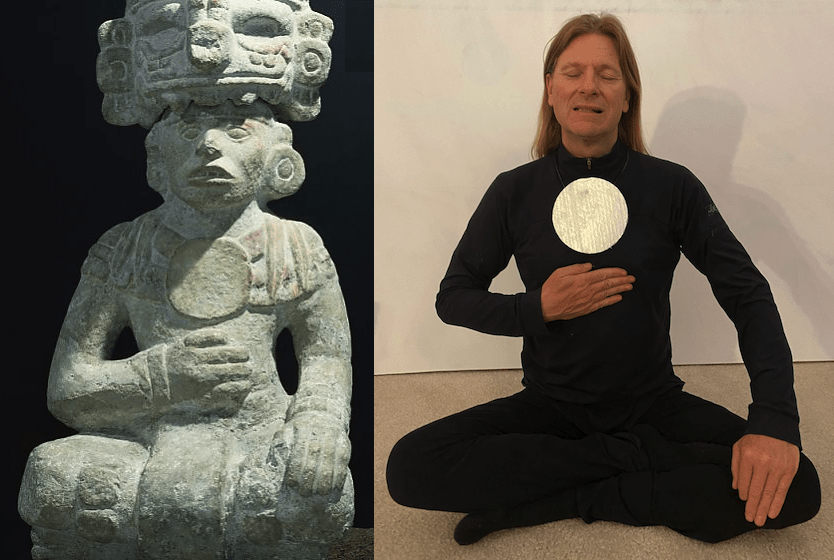
With yoga postures, even sitting in them for five minutes, we can note some interesting physiological reactions. Non-invasive tests were done such as galvanic skin response, breath rate, motility of the intestines, with just sitting in a yoga posture. Interestingly, many of our postures that we see from around the world look like yoga postures. These can be sitting cross legged or kneeling with your hands and arms in a specific configuration in your lap. Goodman had the idea, ‘I should add that to my ritual.’ She started to experiment with postures. And indeed, that pushed it from, let’s have a trip with some drumming, to, oh my gosh — now here we’re touching the hem of something larger than ourselves.

Continue reading “The Cuyamungue Institute, part 2 by Janet Maika’i Rudolph”

The Cuyamungue Institute, part 1 by Janet Maika’i Rudolph

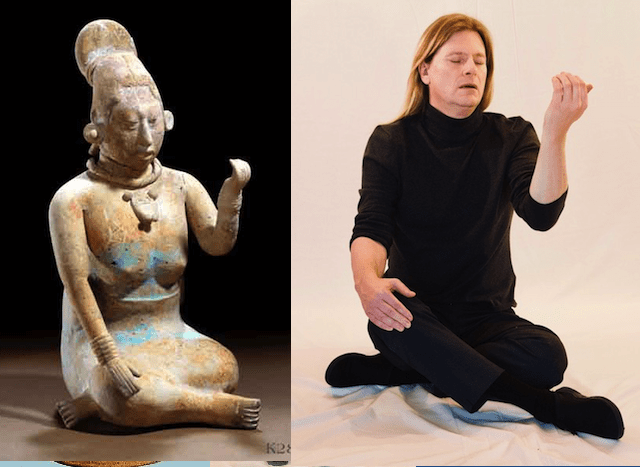
Director Paul Robear in a pose based on this artifact from Chichen Itza

The Cuyamungue Institute was founded in 1978, in Santa Fe New Mexico by Dr. Felicitas Goodman. It is based on work that Dr. Goodman was doing with ritual trance poses as a means to encourage ecstatic states, gain knowledge, and have otherworldly communications and experiences.  The poses Dr. Goodman studied are based on early statues and images found in various cultures. She became aware that these poses of ancient sculptures and drawings were often ritual instructions that people could replicate. By holding these positions in a ritualist manner, she found that people had these common or related experiences which she characterized loosely as healing, divination, metamorphosis, and/or spirit journeys.  This 2-part blogpost is about her journey and what she discovered. It is based on an interview I did with Laura Lee, who along with her husband Paul, are directors of the Cuyamungue Institute.

Continue reading “The Cuyamungue Institute, part 1 by Janet Maika’i Rudolph”