Turning One by Sara Frykenberg

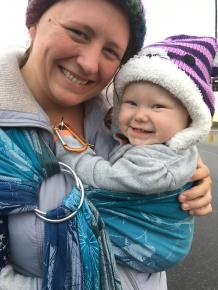
14724657_10154061354658546_8918956387379465095_nThis month I turn one as a mother. My daughter, consequently, is also turning one—a first birthday I am excitedly planning. Specifically, I want to make Hazel a rainbow cake with lots of colored layers and white frosting. I’m not even sure she’ll be able to eat the cake (avoiding lots of sugar for a one-year-old and all), but among those family pictures I treasure, my mother held a cake for her little ones. I want to be like my mother. I am going to make a cake.

But planning my daughter’s party, I realized that I am also going to have a kind of birth-day anniversary. Other moms have told me that it takes a year to really process the experience of giving birth. While I did consider the significance of my “birthing community,” in a blog last fall, I realized a couple of weeks ago that I wasn’t done understanding what I, what mothers, and what life givers of all kinds go through to bring life into the world. Continue reading “Turning One by Sara Frykenberg”
Breaking the Stained Glass Ceiling? Conflict in Religious Histories by Meagen Farrell

Meagen Farrell, women's ordination

In attempting to research and write about the process and arguments in the development of women’s ordination in the Anglican Church of Ireland (which I first wrote about here on Feminism and Religion), I am frustrated by the polarization of language. While “objectivity” is fruitless, I strive for what Warren Nord calls philosophical fairness: when teaching about contested religious territory, to characterize each position in the terms they would choose for themselves.

How do I fairly label an historical debate on whether or not to admit women to the diaconate and priesthood? Using the phrase “women’s ordination” in my current Kickstarter campaign already puts me in a particular camp. The constraints of the medium require brevity. I have to make a choice. Continue reading “Breaking the Stained Glass Ceiling? Conflict in Religious Histories by Meagen Farrell”

What Happens When Women Are Not Ordained? by Meagen Farrell

Meagen Farrell, women's ordinationWhat is a vocation to the Christian clergy? A woman or man feels a calling from God, and that spirit is tested in the community of believers. After discernment through study, prayer, and service that person submits herself for ordination. Simple, right?

Of course, as readers of the F-word blog, you know it is not that simple. Though women’s ordination is a common practice in many Christian denominations, it is far from universal. The issue has caused division within the Anglican Communion and dissension in the Roman Catholic Church. Despite the controversy, the number of women in discernment (contemplating  or preparing for ordination) and the denominations ordaining them continue to grow. Continue reading “What Happens When Women Are Not Ordained? by Meagen Farrell”

Every Woman has a Story by Gina Messina-Dysert

Gina Messina-Dysert profileRecently, Carol Christ wrote about her experience of being interviewed for the Women’s Living History project at Claremont Graduate University.  It is a project I have co-founded and am continuing to develop; I am grateful that Carol and others have offered their “herstories” to be archived.  While I am not a historian, I do have a strong interest in women’s stories and with important reason…if we do not tell our stories, who will?

I first became interested in oral history during my doctoral program when I took a course with Claudia Bushman focused on women’s autobiography.  It was a difficult time; my mother had passed away unexpectedly and I was consumed with grief.  Because her death was premature – she was only 56 years old – I hadn’t prepared to lose her. I thought I had years to figure out all the things I would want to remember and pass on about my mom.  Yet, she was gone and I could no longer ask her the many things I wanted to know, needed to know about her.  Parts of her story would be lost forever and I did not know how to cope with that.  Continue reading “Every Woman has a Story by Gina Messina-Dysert”