

I’ve been told that most children in the United States learn to write haiku in third grade. At the very least they learn that haiku is a traditional poetic art form using seventeen syllables divided into lines of 5 – 7 – 5. The idea is to capture a moment in time. The famous Japanese poet/priest, Issa (1763-1828), focused on creating haiku using his love for nature in the process.
I did not grow up in the American school system, so it wasn’t until I took an undergraduate Zen Buddhism course that I learned to appreciate and have fun with creating this particular kind of poetry.
In the following haiku, I try to capture the moment I experienced the natural scene in front of me. Taking a photograph and then writing an accompanying haiku can be a meditative exercise. I keep striving to make that exercise a daily happening.
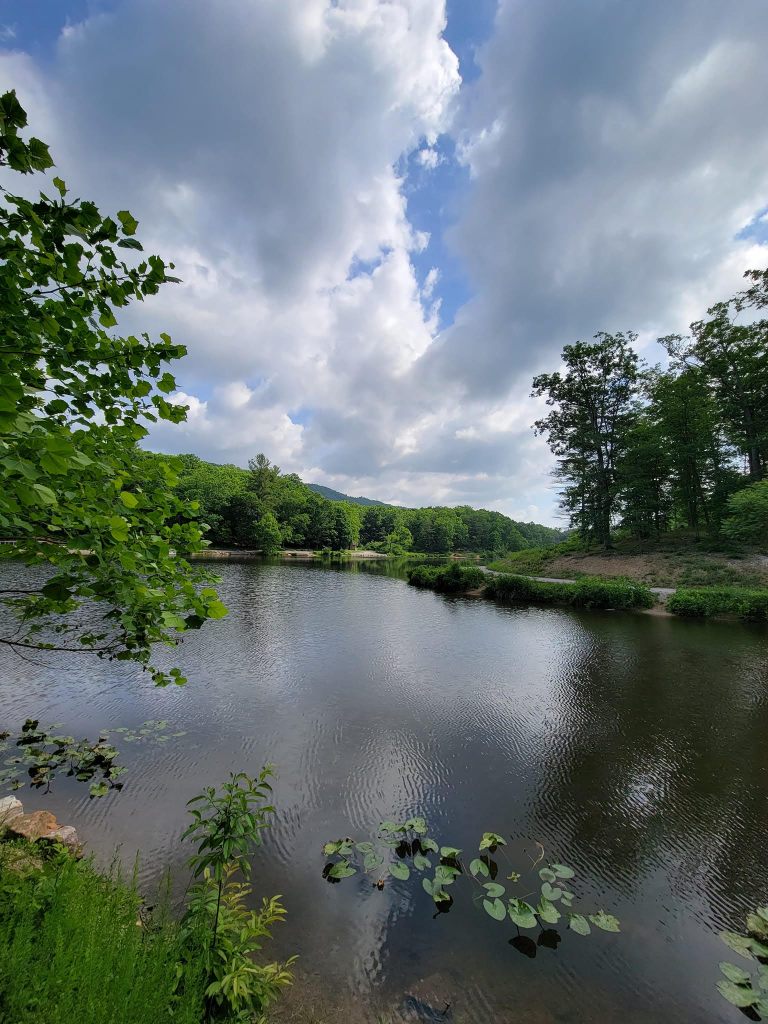
Follow me around the lake
Pushed by a brisk wind
 One of my undergraduate professors was (and still is) a haiku enthusiast. When I took his Zen Buddhism course, students were required to write haiku throughout the semester. He encouraged us to focus on the natural world as we struggled to come up with three lines of seventeen syllables, arranged in a five-seven-five pattern. I eventually discovered lots of pleasure creating a haiku poem—crisp, even stark—using words with a precision I found beautiful.
 Feminism and Religion