
Legacy of Carol P. Christ: Solstice Comes But Once A Year, Now It’s Here!

This was originally posted on December 17, 2012

Actually it comes twice, once in midsummer, the longest day of the year, and once in midwinter, the longest night.  Winter Solstice is also known as the first day of winter.
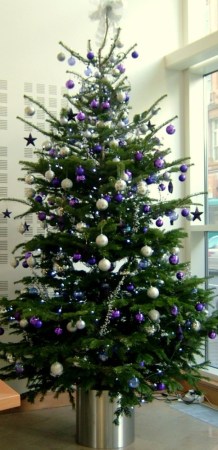
ChristmasTrees20060001

For those of us attuned to the cycles of Mother Earth, Winter Solstice is a time to celebrate the dark and the transformations that come in the dark. Many of the customs associated with Christmas and Hannukah, including candles, Yule logs, and trees decorated with lights were originally associated with Winter Solstice.  The extra pounds put on during winter feasting were insulation against the cold winter nights.

Those who fear that many of the customs of the Christmas season might be pagan are right.  As we learn again to honor our place within the cycles of birth, death, and regeneration, we can return these customs to their roots in the circle of life.

Continue reading “Legacy of Carol P. Christ: Solstice Comes But Once A Year, Now It’s Here!”
From the Archives: “I Missed a Day Again: Reflections on Hanukkah.”

Author’s note: This post was orginally published December 13th 2015. Nonetheless, I still find this post relevant and my hope is that you, dear reader, do as well. Chag semeach!

When I first started back on my journey to reclaim Judaism, I distinctly remember the first Hanukkah I lit candles. Not only was I bringing light into the literal darkness of night, I was also kindling the divine spark within myself. Each night I walked through a meditation I had created using the letters of the word Hanukkah, since there were eight letters and eight nights. I remember some of the words I had assigned to the nights: Holiness, Attentiveness, Night, Understand, Knowledge and Keep. I can’t remember the rest, but I do remember feeling the calm of the candlelight and the deepness of the meditation. I also remember that at some point, either I missed a night of lighting or I repeated one night twice because the days were officially over, and I still hadn’t lit all eight candles.

Continue reading “From the Archives: “I Missed a Day Again: Reflections on Hanukkah.””

On Mikeitz: How Joseph Brings Meaning to My Hanukah Observance during This Pandemic by Ivy Helman


It is Hanukah.  I have discussed the reasons I have found observing it difficult in a past blog.  Namely, as an ecofeminist, I will not celebrate the violence of war or the slaughter of animals at the temple.  This year presents a new challenge: how to celebrate the miracle of the oil in the midst of a global pandemic.  For inspiration, I have looked at this week’s Torah portion: Mikeitz.  Its Joseph tale has helped me find a meaningful practice for my Hanukah observance this year: the power of a human community’s action to preserve life.

The parshah begins with pharaoh having bad dreams.  He has called on every interpreter he can think of and no one could interpret them for him.  That is until he hears tale of Joseph and summons him.  After hearing his dreams, Joseph satisfactorily explains the dreams’ meaning.  Joseph says that there will be seven years of abundant crops followed by seven years of famine.  The pharaoh believes Joseph and begins to make preparations.  He appoints Joseph to oversee them.  

Continue reading “On Mikeitz: How Joseph Brings Meaning to My Hanukah Observance during This Pandemic by Ivy Helman”

Happy Birthday, Solar Gods By Barbara Ardinger

Throughout history and all around the world, people have celebrated midwinter and the rebirth of the sun. My favorite night of the solstice-Hanukah-Christmas season is December 24, Modranicht. If we have Mother’s Day in the springtime, it seems only fair that we should celebrate Mother’s Night in the winter. We get the term Mothers’ Night from the English monk, Bede, who said that the Angles began their year on the night of December 24–25.

The winter solstice this year falls on December 21, though it can also occur on December 22 and December 23. The word “solstice” means “sun stand still.” No, it’s not Joshua’s long day again. On the solstice, the sun rises from the same point on the horizon for a couple days (this is the standing still), is at its lowest point in the sky at noon, and (in the Northern Hemisphere) is at its southernmost point. It’s the longest night of the year, and when the sun is reborn, it moves across the sky for six months to the summer solstice, where it’s at its northernmost point.

Continue reading “Happy Birthday, Solar Gods By Barbara Ardinger”