From the Archives: Gift-Economy in a Time of Lack by Elisabeth S.

This was originally posted on May 17, 2019

Carol Christ wrote about gift economy on this blog in 2013, and I am taken by her story of the woman who brought raisins or cracked nuts to the group even though she had very little. In beginning to encounter the literature on gift economy myself, I am wondering how it all works, especially wondering, perhaps outside of such a conversation if it doesn’t relate or misses the point, what someone who feels they have nothing to give can give.

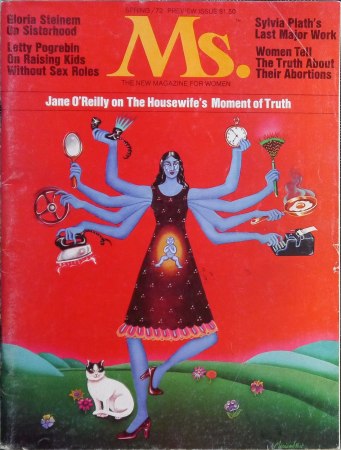
When Genevieve Vaughan wrote about gift economy in Ms. Magazine in 1991, she wrote, “where there is enough, we can abundantly nurture others. The problem is that scarcity is usually the case, artificially created in order to maintain control, so that other-orientation becomes difficult and self-depleting.”

I think we start to look for other ways of existing when we experience the brokenness of a current existence. The exchange economy under mindless capitalism does not honor equal, fair exchanges. If we could keep from manipulating and being deceptive about what a product is worth, if we could more generously assess the contribution of workers, then some of us might not be bothered. Of course, for that work which is never compensated by money, mostly women’s work, that is the other issue that might not be solved by more equal exchange, and probably more the point of Vaughn’s.

Continue reading “From the Archives: Gift-Economy in a Time of Lack by Elisabeth S.”

From the Archives: The Story of Juneteenth by Kelly Brown Douglas

This blog has been posted twice before. June 18,2013 and June 19, 2022. Today is Juneteenth in the USA.

Tomorrow is a special day for me. It is Juneteenth.  On June 19, 1865, news finally reached Galveston, Texas that slavery had been abolished. This was of course two and a half years after Lincoln issued the Emancipation Proclamation. While the actual impact of the emancipation for the enslaved remains a source of historical discussion if not debate, the fact of the matter  is that the proclamation of emancipation and the reality of freedom for black women and men did not necessarily coincide. To be sure, for a variety of reasons, the Emancipation Proclamation did not have an immediate impact on the daily lives of enslaved women, men and children.  While the “official” historical records marks   January 1, 1863 as a day of emancipation, the historical record for the descendants of enslaved men and women marks June 19, 1865 as the day of freedom. For, it was on this day that the last slaves were free.

While the celebrations of Juneteenth have waxed and waned over the years, it remains a day in which African Americans reflect upon the “mighty long way” we have come as well as the “mighty long way” we have left to go on the pathway toward freedom.  As I celebrate Juneteenth, in the words of a black gospel song, “My soul looks back and wonders how they got over.”  And so it is that my theological imagination is stirred, for it is clear that it was by faith that they (the enslaved) got over. And so I ask, what kind of faith was it that allowed them to get over, that is, to survive a life of bondage? This question is even more pressing to me each time that I am reminded that there were those who were born into slavery and died in slavery, and thus, as Toni Morrison once exclaimed, “never drew a free breath.” So, what kind of faith was it that carried these people through life?

Continue reading “From the Archives: The Story of Juneteenth by Kelly Brown Douglas”

Nature and the Body Were Never the Enemy

Reflecting on the contradictions of modern life, this essay explores how both wilderness and female embodiment became culturally suspect within Western thought. Drawing on themes of estrangement, relational ontology and kinship, it considers how practices of attention, presence and nature connection may help us return to a deeper sense of belonging.

Continue reading “Nature and the Body Were Never the Enemy”

Embodiment as Positive Resistance

I nearly cancelled my recent trip to the United States. The political climate felt tense, the global atmosphere uncertain, and travelling across the Atlantic seemed questionable for several reasons.

Friends encouraged me to go anyway, suggesting that meeting people in person would offer a different perspective from the one shaped by media narratives. And of course, it wasn’t headlines I was meeting, but people, in a human reality that persists beneath larger systems. Thankfully, my trust in relational experience outweighed my hesitation, and I returned from my travels with renewed inspiration.

I’m writing this essay because many people I met spoke with an apologetic tone about being American. They expressed disbelief, embarrassment or anger about their conspicuous yellow haired chief. I just want to acknowledge the warmth, generosity, care and humanity I encountered wherever I went.

The entire experience confirmed what I have long sensed in my work with movement, ritual and community: that embodied presence, especially in uncertain times, is such a remedy for heart and soul. What I encountered was meaningful human contact, even in a politically divided country.

Continue reading “Embodiment as Positive Resistance”

Micro Joys by Xochitl Alvizo

“Micro joys helps us deal with macro sadness,” Ana Navarro. 

Ana Navarro, a political commentator, spoke those words when trying to explain the significance of the Bad Bunny Half Time show for Latin American people in the U.S. (the show which was also affectionately called “The Benito Bowl,” Benito being Bad Bunny’s first name). It’s a statement that captures the experience I witnessed among my extended Puerto Rican family regarding the meaningfulness of the Bad Bunny performance during the Super Bowl’s Half Time Show. (Mind you, we were only tuned in to catch the Benito Bowl, not the football game).    

It would be hard to overstate the significance and meaningfulness of the performance for Boricuas. Every single detail of the show means something and represents important aspects of Puerto Rican life, culture, and history. I encourage you to read a few articles or posts on the show if you are not already familiar in order to help you understand all that was involved and included in the performance. 

Continue reading “Micro Joys by Xochitl Alvizo”

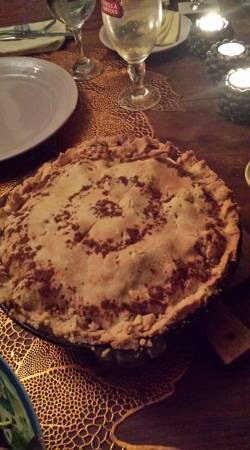
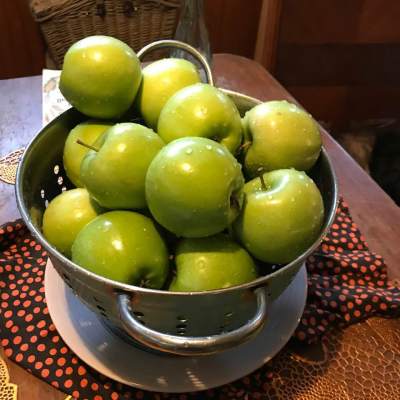
From the Archives: And the Pies! Ongoing Grateful Thanks for Tradition by Marie Cartier

This post was originally published November 24, 2018.

In November 2017 I wrote about pie baking. 

And in November 2015 I also wrote about pie baking.

Photo by Lisa Hartouni

In November 2016, I was destroyed by the “election” and wrote a post in November of that year “For Strong Women” just to help many of us keep going.

Continue reading “From the Archives: And the Pies! Ongoing Grateful Thanks for Tradition by Marie Cartier”

Lessons in Community at the Lily Pond by Carolyn Lee Boyd

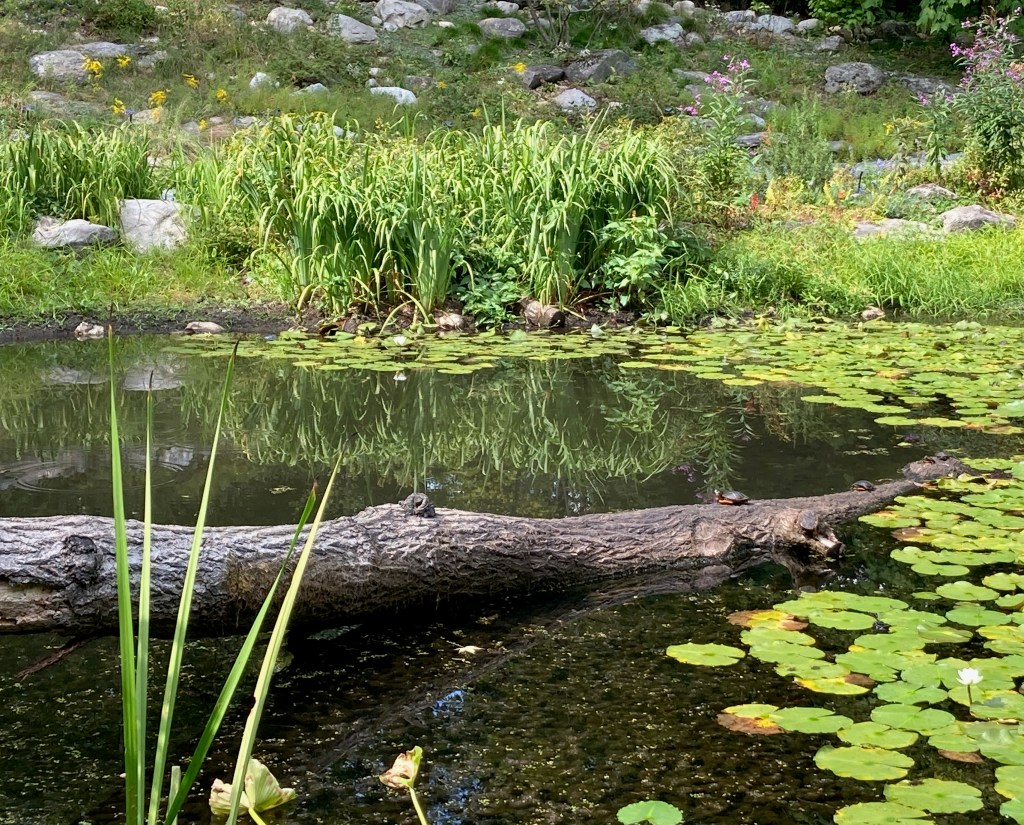
Turtle family on a log
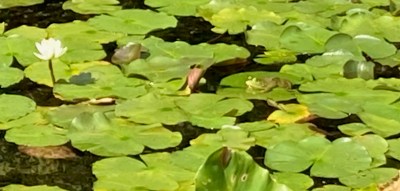
Frog on a lily pad

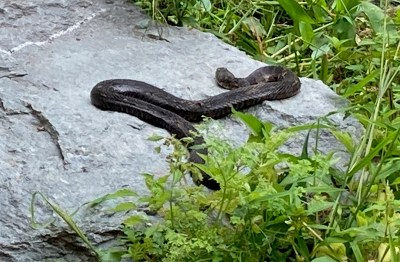
On a recent tranquil Sunday afternoon I was wandering around a lily pond in a nearby botanical garden, fully immersed in that liminal time between summer’s outbursts of nature’s abundance and the peaceful contentment of fall. The late goldenrod and delicate white wood asters danced a hued duet in the wind among the turtleheads and cardinal flowers, while hydrangeas shifted from white to the vibrancy of their last red passion. The lilies in the pond poked their heads above the water while frogs lay in repose on the pads. They were joined on nearby logs by a family of turtles, parents on one side and two babies on the other, close enough for security but far enough to enjoy some independence. A long dark brown watersnake was curled up unmoving on a boulder. All seemed to be basking in the sun, napping now and then. Around the pond were wanderers like me and human caretakers, silently tending to wildflowers and trees and occasionally stopping to watch if one of the beyond-human inhabitants plopped into the water for a little late afternoon swim. 

watersnake on a rock

Of course, I also knew that the peacefulness of this snapshot moment would not last forever because what do watersnakes eat? Frogs, fish and other beings that live around ponds. And what do frogs and fish eat? Insects, snails, and other beings, and so on up and down the food chain. But even this is part of the wholeness of the pond, as each being fulfills its place in the cycle of birth, life, death, and rebirth so that all of us can, in our own time, enjoy these short times of contentment living on the face of our magnificent planet.

Continue reading “Lessons in Community at the Lily Pond by Carolyn Lee Boyd”

NO Kings Day Protest – Lakewood, CA by Marie Cartier 

Note – usually we have a Carol Christ Legacy post on Mondays. Today we have a post in the spirit of the elections taking place this week across the United States.

October 18, 2025

Largest single day protest in US history- over 7 million people- 2700 + gatherings

P.s. That’s my wife in the inflatable bear costume– NO KINGS and YES ON 50!

Continue reading “NO Kings Day Protest – Lakewood, CA by Marie Cartier “

NO KINGS Day June 14, 2025 by Marie Cartier

#nokings #nokingsday 
Many actions took place in Southern California. I participated in one which was so unusual and historic I want to share it with you all on FAR.

My wife and I and friends stood and protested in Seal Beach, CA and then drove through 1000s and 1000sof people lining both sides of Pacific Coast Highway for 30 miles from Seal Beach to Dana Point. I was up through the moon roof screaming “NO KINGS!” for hours!

Continue reading “NO KINGS Day June 14, 2025 by Marie Cartier”

Census in Times of Fear by Xochitl Alvizo 

I received a notice from the U.S. Census Bureau recently that I was randomly selected to complete the “American Community Survey.” It came as a letter at first with instructions to complete the survey online. A few days later I received another letter saying “A few days ago, you should have received a letter from the U.S. Census Bureau asking me to complete the American Community Survey,” with big bolded letters that my “response is required by law.” I have since then received follow-up post-card reminders, a physical form survey with the same bolded message, and another post-card that they have sent repeated requests to complete the survey.

Continue reading “Census in Times of Fear by Xochitl Alvizo “