There’s a fascist in the White House — a malevolent clown and front man for a cabal of the hard right. Their takeover of the US government proceeds rapidly, a stunning succession of defeats for democracy.
The nightmares of fascism are taking shape in waking reality. Now is the time, I tell myself, to speak up, speak out, name the perpetrators, name their games.
The bully in the White House has been called a rapist, and fascism is patriarchy on steroids, waging unremitting war on nature, people of color, and women.
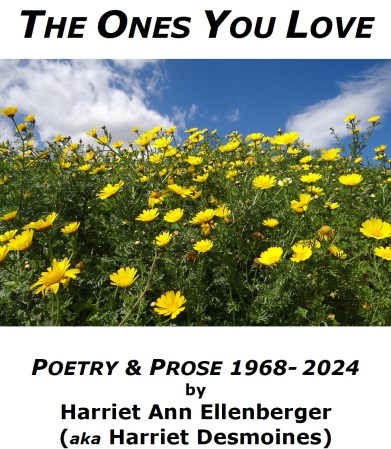
The Ones You Love, Poetry and Prose 1968-2024 is a half-century retrospective love letter from Harriet Ann Ellenberger to friends, family, and lovers; lesbian and overall feminism; lesbian feminist literature and theater; Nature; and those who have been victimized by war. Infusing the book is her overarching love of freedom, not only for herself, but for women, for humanity, and for the Earth. Harriet has been using her authorial and editorial gifts for her entire adult life to move our planet away from extinction into new ways of being, and has now collected her best writings, both prose and poetry, into a single volume. The book is both a brilliant, truthful, unglossed portrait of herself as well as a glimpse into feminism, and lesbian feminism in particular, over decades through one woman’s experience. She often notes in introductions to various pieces that she no longer completely agrees with what she wrote so long ago, but she does not edit out these views, (speaking of her “younger fiery-feminist self,” she says “I’m proud of her courage and proud of the work she undertook” (11)) which offers us a better understanding of both her own progression of thoughts and ideas as well as what issues and points of view were of concern at the time.
Of her most well-known achievement, she writes, “On July 4, 1976, the 200th anniversary of the American Revolution, Catherine Nicholson and I published the first issue of Sinister Wisdom, which has since become the longest-lived lesbian literature and arts journal in the world” (11). She explains the journal’s expansive perspective: “We exist in the interface between a death culture and the faint beginnings of a culture of — not humans — but life-lovers, a culture that embraces animals, plants, stars and those women who choose the future at the risk of their ‘sanity’ and security” (17). This is a vision she has carried with her ever since.



 Feminism and Religion