Archives from the FAR Founders: On the Events of Charlottesville, VA by Xochitl Alvizo

This post was originally published August 13, 2o17. And even though it was about the specific attack against peaceful protesters by white supremacists in Charlottesville, VA in 2017, during agent orange’s first term, it makes me think about the current, larger, and more global forms that white supremacy has taken during his second term. It reminds me just how much greater the need for our collective action continues to be.

It is in our hearts –one’s sense of superiority exists within. We are all and each capable of hate and bigotry.

It is considered the appropriate and necessary response to say that there is no room for it “here” – that we will not tolerate, in this case, white supremacy – here. Except here is exactly where it exists; here in our country, in our cities, in our communities, laws, structures, churches, homes, hearts and mind. The thread of a people’s sense of supremacy (power to dominate or defeat) has been woven into the fabric of this colonialist nation from the very beginning of what has come to be known as the United States of America.

Continue reading “Archives from the FAR Founders: On the Events of Charlottesville, VA by Xochitl Alvizo”

Embodiment as Positive Resistance

I nearly cancelled my recent trip to the United States. The political climate felt tense, the global atmosphere uncertain, and travelling across the Atlantic seemed questionable for several reasons.

Friends encouraged me to go anyway, suggesting that meeting people in person would offer a different perspective from the one shaped by media narratives. And of course, it wasn’t headlines I was meeting, but people, in a human reality that persists beneath larger systems. Thankfully, my trust in relational experience outweighed my hesitation, and I returned from my travels with renewed inspiration.

I’m writing this essay because many people I met spoke with an apologetic tone about being American. They expressed disbelief, embarrassment or anger about their conspicuous yellow haired chief. I just want to acknowledge the warmth, generosity, care and humanity I encountered wherever I went.

The entire experience confirmed what I have long sensed in my work with movement, ritual and community: that embodied presence, especially in uncertain times, is such a remedy for heart and soul. What I encountered was meaningful human contact, even in a politically divided country.

Continue reading “Embodiment as Positive Resistance”

From the Archives: Passover and the Exodus: A Feminist Reflection on Action, Hope, and Legacy by Michele Stopera Freyhauf

This was originally posted on March 26, 2015

Freyhauf, Durham, Hahn Loeser, John CarrollLast week, Supreme Court Justice Ruth Bader Ginsburg was in the news again, but not for reasons you would expect.  She, along with Rabbi Lauren Holtzblatt, penned a feminist essay about the Exodus title “The Heroic and Visionary Women of Passover.”  Finding this story was exciting, especially because I am so drawn to the Exodus story (the intrigue and curiosity of which caused me to return to school and study, as one of my main areas of focus, Hebrew Scriptures – along with Archaeology and Ancient Near Eastern History).  Now women’s roles in this story are being elevated thanks to Justice Ruth Bader Ginsburg and Rabbi Holtzblatt.

Before I discuss the message and the importance this message brings, I think it is important to know an important fact about Justice Ginsburg.  Ginsburg is not observant, but does embrace her Jewish identity.  When her mother died, she was excludedRuth_Bader_Ginsburg_official_portrait[1] from the mourner’s minyan because she was a woman; an event in Judaism that is meant to comfort the mourner, brings a sense of community, and is considered obligatory – a means of honoring our mother/father.  This important event left an impression and sent a loud message that inspired and influenced her career path – she did not count – she had no voice – she had no authority to speak.  No wonder her life and career focuses so much on women’s rights and equality.

As many of us know, the story of Exodus is focused on two things 1) Moses and 2) liberation from the bonds of servitude and enslavement; women are rarely discussed.  In the essay co-authored by Ginsberg, women are described as playing a crucial role in defying the orders of Pharaoh and helping to bring light to a world in darkness.  In the Exodus event, God had partners – five brave women are the first among them, according to Ginsburg and Holtzblatt.  These women are: Continue reading “From the Archives: Passover and the Exodus: A Feminist Reflection on Action, Hope, and Legacy by Michele Stopera Freyhauf”

I Believe Dolores by Marie Cartier

I played Dolores Huerta in an adaptation of Antigone Too: Rights of Love and Defiance, at the feminist theater in Minneapolis, At the Foot of the Mountain, in 1983. When the theater closed in 1991, it was the longest continuously operating women’s theater in the United States. For Antigone Too, they brought, I think, twenty- five actresses from around the country to play twenty-five significant women who stood up for social justice. We had parts illustrating our histories, interspersed throughout the traditional script of Antigone.

I got the part of Dolores Huerta—championing the cause of social justice for farm workers.

I loved the character and I was deeply honored to become her. (Today I question why I, a woman with white skin privilege, but native heritage, was chosen for this role—but at the time I was just intensely grateful.)

Continue reading “I Believe Dolores by Marie Cartier”

From the Archives: “On Purim and the Value of Courage.”

Author’s Note: This post was first published on 10 March 2013. This year, Purim was on the 2nd of March. This post has updated imagery.

The Jewish Festival of Purim and the book of Esther offer us an opportunity to reflect on the value of courage from a feminist perspective. The online Webster’s Dictionary defines courage as, “mental or moral strength to venture, persevere, and withstand danger, fear, or difficulty.” In religious discourse, courage is often categorized as a virtue or a moral principle. Aristotle (384BCE – 322BCE), one of the most famous of the virtue ethicists, believed a virtue like courage should be practiced according to the mean or the right amount. Too much courage leaves one rash, possibly too reactionary and hot-headed while too little makes one cowardly and weak, but just the right amount in a given situation leads to moral behavior. Virtuous living leads to happiness, or perhaps is itself happiness, for Aristotle.  Yet, as a feminist, I understand the worth of courage differently.  To me, the value of courage lies not in individualistic gains nor in personal happiness but in its use toward achieving justice and equality in society.

Continue reading “From the Archives: “On Purim and the Value of Courage.””

From the Archives: I Believe Anita! by Marie Cartier

Moderator’s Note: This has been posted on FAR twice, originally on April 7th, 2014 and then again on July 15, 2022. We are posting this a third time because of its importance. It is a piece of history that helps to illustrate how we got to where we finds ourselves today.

Marie Cartier

During the past week I attended a Los Angeles premiere of a new documentary Anita: Speaking Truth to Power (Dir: Freida Lee Mock USA, 2013). The screening was sold out and I had great seats saved for me– sitting with a friend who works at Samuel Goldwyn, the distributor of this fine film.

In 1991, Anita Hill provided testimony she hoped would serve to dissemble the nomination of Clarence Thomas as a Supreme Court justice. Although the vote would end up being close (52-48) Hill’s testimony did not serve to dissuade the decision — Clarence Thomas’ nomination was confirmed and he was appointed to a life term on the Supreme Court four days after Hill’s testimony concluded. Here is an outline of the debate.

Continue reading “From the Archives: I Believe Anita! by Marie Cartier”

Renee Nicole Good—An Acrostic Poem by Marie Cartier

Say Her Name So We Remember Her

R—Remember– that is what I think we need to do
E– Everything that she did, like poetry, like raising kids
N–  Not just the horror of what happened… Bam! Bam! Bam!
E— Everything she did …like win the Academy of American Poetry Prize
E— Everything she did …like be a lesbian, be so beloved, be.

***

N- Not just that video on an endless loop- Bam! Bam! Bam! “Fuckin’ bitch.”
I–I want to see her, more of her, before that day, all of her
C- Colors. All of the crayons in the coloring box she represented.
O- -Oh! I wish I had known her. I wish it hadn’t happened. I wish we weren’t here right now in these United States
L– Let me say I wish we were not here.
E– Everything feels dystopian. I forget all the crayons in the coloring box, except gray.

Continue reading “Renee Nicole Good—An Acrostic Poem by Marie Cartier”

In the Belly of Winter: Tending the Sacred Flame by Molly M. Remer

It is February, the belly of winter. We stand in the doorway between worlds, a thin, pale light ahead of us, just beginning to gather itself at the horizon. While life may feel still and inspiration frozen, something in us is listening for the first faint whispers of spring. In earth-centered, neopagan spiritual traditions drawing inspiration from old Celtic holidays, the holiday of Imbolc is on February 1-2. Imbolc is based on an old Irish word that means “in the belly.” One of my favorite reminders to myself at any time of year, not just February, is to cradle myself in the belly of the moment.* To be in the belly reminds us that we need not be focused on arriving or figuring it all out, instead we incubate, we gestate, we draw nourishment from deep within. We do not have to be ready. We are becoming. We are in the belly of winter, and the work of the belly is to hold, to warm, to nourish what is not yet visible.

In the middle of winter as well as in the middle of national crises, international conflict, and climate disaster, the world can feel grim and gray, and like hope and optimism are misplaced or even extinguished. We may feel burned out, used up, or simply too tired to offer anything of value.

Continue reading “In the Belly of Winter: Tending the Sacred Flame by Molly M. Remer”

In these United States: A Gratitude Poem, after all, for 2025, by Marie Cartier

Oh yes, I’m grateful for the Portland frog—that blow up adult sized character with the pink scarf blowing back in the wind facing down a squad of ICE “officers.”

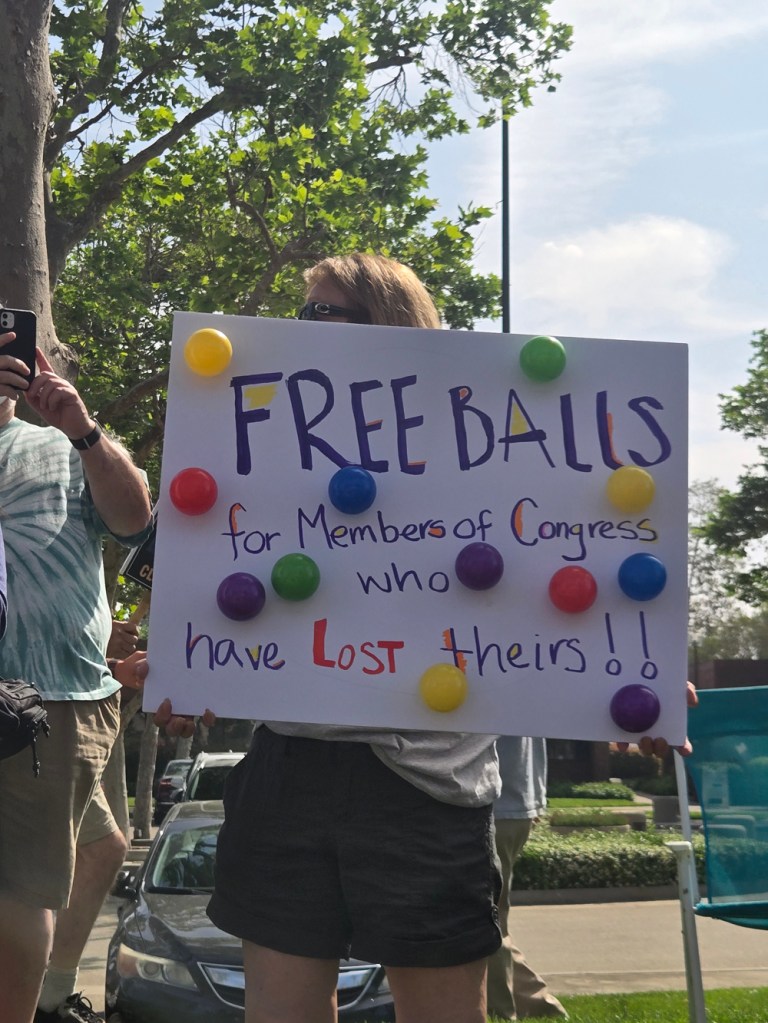
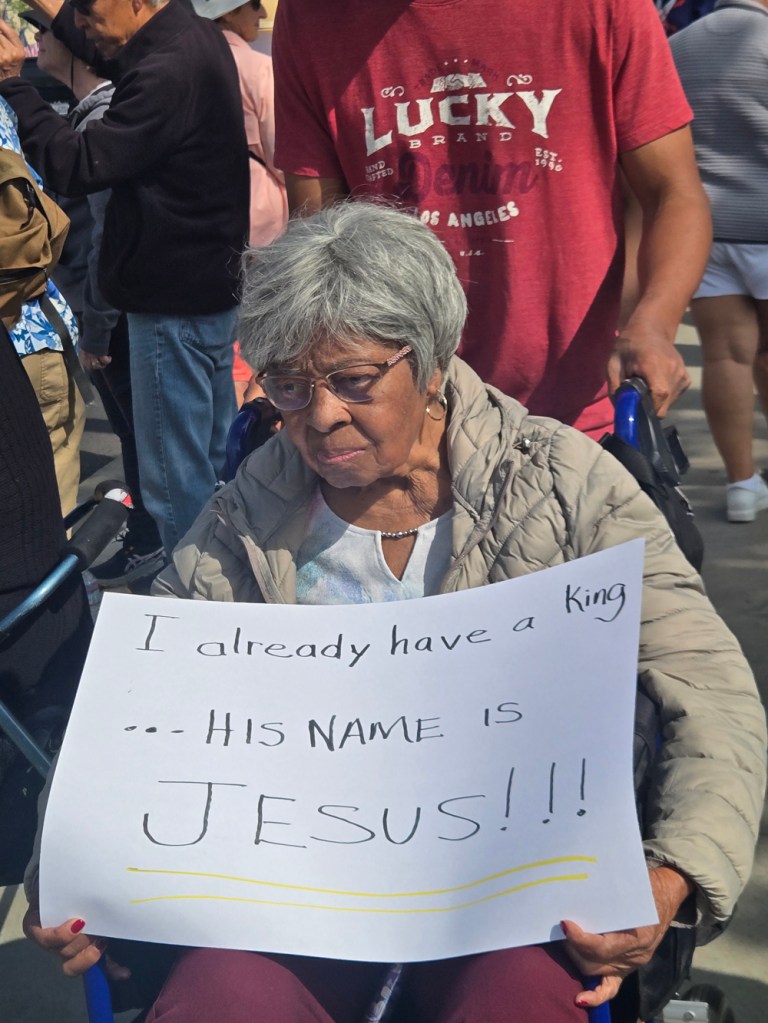
I’m so grateful for all the blow-up adult size characters who showed up at the largest protest for anything, single day protest in the U.S. to shout NO KINGS!! And more—the blow-up Tiger with the sign “Fascists get scratches!” My wife inside a blow-up bear, the California bear! With a sign that said, “Yes on 50!”

And so grateful we won: yes, on 50!

Grateful, grateful, for Indivisible! Spreading like Morning Glory. Glory! Glory! Across all 50 states and feeding people, feeding children, passing out whistles – alerting communities when ICE is nearby, stopping ICE in their tracks when they are places, especially in front of schools… I mean, why are they there? (As Gertude says, “There is no there there.”)

But this is a grateful poem. A rant.

I’m grateful for the blow-up unicorn with the sign, “Honk if you are not on the Epstein list.” Dancing on the curb with the rest of us. I’m grateful for all the cars honking as they went by us and all the food donated to give to people in need—some of those in hiding since last spring when this b.s. started – this f*** bullshit– but this is a grateful poem. A rant.

Continue reading “In these United States: A Gratitude Poem, after all, for 2025, by Marie Cartier”

The Legacy of Carol P. Christ: “Oh For a Pair of Clean Dry Warm Socks”

This was originally posted on Jan. 15, 2018

Stories about refugees in the island of Lesbos (where I live) are no longer front page news. Yet according the United Nations Refugee Agency, 12, 742 refugees arrived here in 2017. This number is equivalent to 15% of the year-around population of the island. Though this number is huge, it does not compare to the estimated 91,506 arrivals in Lesbos in 2016. In January 2018, 7572 refugees are estimated to be stranded in the island waiting for their applications for asylum to be processed. The government-controlled reception center has a capacity of 2000, but up to three times that number are being housed there at any one time, in conditions that must be described as inhumane. It is suspected that “someone” in Greece or the European Union is slowing the asylum process in order to discourage refugees from attempting to enter the EU via Lesbos.

Recently I have begun to work with the Starfish Foundation, a local non-profit helping refugees on the island, using my skills as a writer to help with outreach. Today I share with the FAR community a blog I wrote to contextualize the desperation of the situation the refugees find themselves in.

Continue reading “The Legacy of Carol P. Christ: “Oh For a Pair of Clean Dry Warm Socks””