“Instead of looking to the male world for approval, I had to learn to rely on my own instincts. In some strange way, the rejections I faced strengthened me, but only because they forced me to learn to live as I saw fit and to use my values and judgment as my guides.” The Flowering: The Autobiography of Judy Chicago
Janet: I live near New York City and am fortunate to be close to many museums. The New Museum has been showing an exhibit by Judy Chicago that takes up the entire facility of four floors. And it is remarkable. Not only is the breadth of her work astounding but so are the stories of how she has had to fight to be accepted in a man’s world of art. Joyce Zonana first recommended that I go. This blogpost came about as part of a discussion between the two of us.
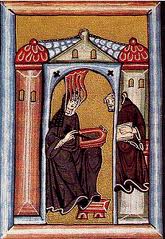
The visionary abbess Hildegard von Bingen (1098-1179) has long been regarded as a saint, with her feast day of September 17, yet she was only officially canonized in May 2012. Why did it take the Vatican over eight centuries to canonize this great polymath, composer, and theologian?
The first attempt to canonize Hildegard began in 1233, but failed as over fifty years had passed since her death and most of the witnesses and beneficiaries of her reported miracles were deceased. Her theological writings were deemed too dense and difficult for subsequent generations to understand and soon fell into obscurity, as did her music. According to Barbara Newman, Hildegard was remembered mainly as an apocalyptic prophet. But in the age of Enlightenment, prophets and mystics went out of fashion. Hildegard was dismissed as a hysteric. Even the authorship of her own work was disputed as pundits began to suggest her books had been written by a man.
Newman states that Hildegard’s contemporary rehabilitation and resurgence was due mainly to the tireless efforts of the nuns at Saint Hildegard Abbey in Eibingen, Germany. In 1956 Marianna Schrader and Adelgundis Führkötter, OSB, published a carefully documented study that proved the authenticity of Hildegard’s authorship. Their research provides the foundation of all subsequent Hildegard scholarship.
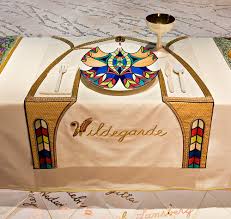
In the 1980s, in the wake of a wider women’s spirituality movement, Hildegard’s star rose as seekers from diverse faith backgrounds embraced her as a foremother and role model. The artist Judy Chicago showcased Hildegard at her iconic feminist Dinner Party installation.
Medievalists and theologians rediscovered Hildegard’s writings. New recordings of her sacred music hit the popular charts. The radical theologian Matthew Fox adopted Hildegard as the figurehead of his creation-centered spirituality. Fox’s book Illuminations of Hildegard of Bingen remains one of the most accessible and popular books on the 12th-century visionary. In 2009, German director Margarethe von Trotta made Hildegard the subject of her luminous film, Vision. And all the while, the sisters at Saint Hildegard Abbey were exerting their quiet pressure on Rome to get Hildegard the official endorsement they believed she deserved.
Pope John Paul II, who had canonized more saints than any previous pontiff, steadfastly ignored Hildegard’s burgeoning cult, possibly because he was repelled by her status as a feminist icon. Ironically it was his successor, Benedict XVI, one of the most conservative popes in recent history—who, as Cardinal Ratzinger, expelled Matthew Fox from the Dominican Order where Fox had served for thirty-four years—finally gave Hildegard her due. Reportedly Joseph Ratzinger, a German, had long admired Hildegard. He not only canonized her but elevated her to Doctor of the Church, a rare and solemn title given to only the most distinguished theologians.
But I believe the true credit for Hildegard’s triumph is due to the Benedictine Sisters at Saint Hildegard Abbey for keeping Hildegard’s flame burning.
Read Hildegard’s poem slowly as a prayer, contemplating how the Sacred Flame, however you envision it in your own spiritual tradition, relates to your life.



 Feminism and Religion