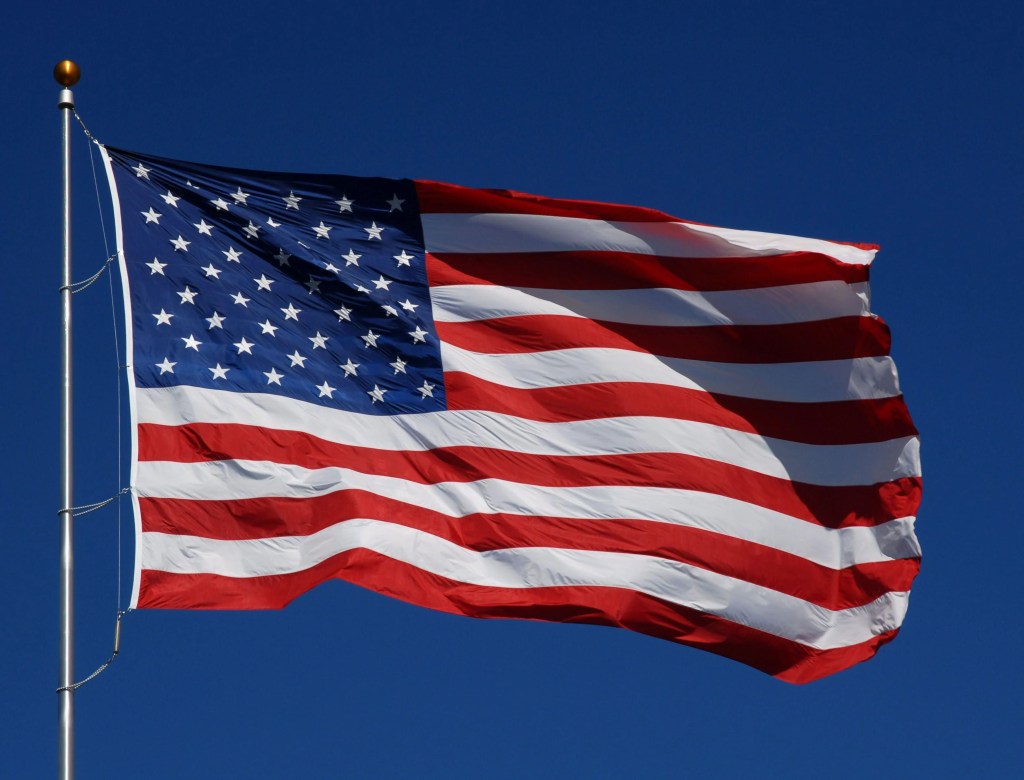
I am an American.
I am proud to be an American.
I am not proud of everything America does—
But I am proud of democracy—
of the idea of democracy.
And I do not want to waste my shot, either.

Exploring the F-word in religion at the intersection of scholarship, activism, and community.

I am an American.
I am proud to be an American.
I am not proud of everything America does—
But I am proud of democracy—
of the idea of democracy.
And I do not want to waste my shot, either.
This was originally posted on July 8, 2013.
July 4, American Independence Day, has come and gone. Perhaps now is as good a time as any to reflect on patriotism. What is it? What does it mean from a feminist perspective? What is the relationship between patriotism and militarism? Can one be a patriot and oppose war? Can one be a patriot and deny that “America is the greatest country in the world,” the foundation of the doctrine of American exceptionalism?
In a recent blog, Caroline Kline called attention to the use of patriarchal God language in the patriotic hymns her child was asked to sing in the 1st grade. She wondered if this God language could be changed to female positive or gender neutral. Her post prompted me to ask if changing pronouns would be enough and to revisit the question of patriotism and nationalism.
Continue reading “Legacy of Carol P. Christ: What Is Patriotism?” Originally published on July 8, 2013 on FAR under the title “What Is Patriotism?,” this blog asks questions that seem even more important today, when tanks have been paraded in front of the Lincoln Memorial and children are held in appalling conditions at our borders because their parents dared to seek asylum in the United States.
July 4, American Independence Day, has come and gone. Perhaps now is as good a time as any to reflect on patriotism. What is it? What does it mean from a feminist perspective? What is the relationship between patriotism and militarism? Can one be a patriot and oppose war? Can one be a patriot and deny that “America is the greatest country in the world,” the foundation of the doctrine of American exceptionalism?
In a recent blog, Caroline Kline called attention to the use of patriarchal God language in the patriotic hymns her child was asked to sing in the 1st grade. She wondered if this God language could be changed to female positive or gender neutral. Her post prompted me to ask if changing pronouns would be enough and to revisit the question of patriotism and nationalism. Continue reading “Patriotism Reconsidered by Carol P. Christ”
 While Puerto Rico has faced its worst natural disaster in over a century; Trump has once again used trumpfoolery to distract his base from his failed action in assisting Americans in crisis by starting a fight with the NFL. It seems a fitting plot for the reality show television host turned fake politician/president.
People are dying in the streets with no access to water or medication. It is expected to take four months to restore power to the island and everyday mothers take their children to stand in line for a minimum of twelve hours to get two packs of ice – hopefully, a few more if their children are allowed a share as well.
Rather than mobilizing efforts to bring aid to Puerto Ricans, Trump has diverted attention from his failure by ranting that NFL players should be fired for disrespecting the American flag by taking a knee during the national anthem. It is no surprise that our fake president is unable to make the connection between the peaceful protests and lack of rights for every American – he likely thinks that Rosa Parks was protesting the transportation system. Continue reading “White Christianity, Flags, and Football by Gina Messina”
 Former Mayor of New York Rudy Giulaini recently questioned the American President’s patriotism when he asked if Obama had been “brought up the way you were brought up and I was brought up, through love of this country.” When Chris Hayes discussed the furor surrounding Guiliani’s statement on MSNBC with James Peterson of Lehigh University, I would say that they both missed the point. Their defense of the President was to insist that he is a dyed in the wool patriot. Should anyone be a dyed in the wool patriot these days? What does and should patriotism mean? These were questions not asked.
Asked to clarify his comments, Giulani opined that Obama speaks from the perspective of “socialism” and “perhaps anti-colonialism” rather than good old American patriotism. Again Hayes and Peterson dropped the ball. They were quick to agree that the American Colonialists should be considered anti-colonialist given that they rebelled against the colonial power of England. What they failed to say was that the American Colonialists were colonialists too. Though they threw England out, they had no compunction in asserting their right to take the land, the resources, and the very lives of earlier inhabitants of what became the American land.
I heard Giuliani’s statement in a different way. When Giuliani spoke of being brought up to love his country, I heard echoes of my own childhood. Like many Americans, Giuliani included, I was taught to love my country right or wrong. Indeed I was taught that my country was never wrong. From the perspective of my current understanding of the world, I now feel that the way I was brought up to love my country was itself wrong.
The American nation has been wrong on many things. First we must consider the idea our forebears held that the American land was theirs for the taking. No matter what degree of relation immigrant Americans had to the Native Americans, they all were taught that the Indians were barbarians who had no right to the land being claimed by civilized Europeans. Next we can ask why slavery was not outlawed and women were denied the vote at the time of the founding of the American nation. If we look at the truth of the matter, there are many reasons not to feel as proud of our country as “we” were taught to do.
And then of course there are the many wars—from the Pequot War to the Iraq and Afghanistan wars. How many, if any of them were just wars? And how many of them should rightly give us reason to temper any patriotism we have with the double eye that sees both the good and the bad that our nation has done?
If Chris Hayes had been interviewing me, I would not have been so quick to defend patriotism and the American nation. Rather I would have asked what patriotism means and whether anyone should defend any nation right or wrong. This would not have extricated Obama from Giuliani’s criticism, but it might have instigated deeper and more complex questioning of Giuliani’s premise.
In recent programs on MSNBC Lawrence O’Donnell opened a complex discussion of religion in general and Islam in particular, following Obama’s (now controversial) assertion that the terrorism of the Islamic State is not “the real” Islam and his statement that Christians were also guilty of atrocities during the crusades.
It was clear to me that the context of Obama’s statements is the feeling of many Americans that “Islam” is to blame for the terrorist activities of jihadists acting in its name, along with the conclusion they draw from this that “Islam” is a violent religion while “Christianity” is not. Obama was trying to make two related points: not all Muslims are violent jihadists; and Christianity is not all good and Islam is not all bad. Obama was immediately attacked for comparing Christianity and Islam for both having violent histories.
O’Donnell (unlike Hayes) resisted any knee-jerk temptation he might have had to defend Obama in any simple way from his critics. Rather O’Donnell (revealing the power of Roman Catholic theological education), began a more complex conversation about what constitutes “the real” Islam and “the real” Christianity.
Not one to mince words, O’Donnell asserted that Catholicism “was once the most murderous force on the face of the earth.” I was more interested in the statement of Asra Q. Nomani, the author of Standing Alone: An American Woman’s Struggle for the Soul of Islam, that the President was wrong to say that Islamic State is beyond the pale of Islam. Rather, she asserted, Islamic State represents, “a very serious interpretation of Islam in the world that is wreaking havoc on all of us.” Though Normani does not agree with Islamic State’s interpretation of Islam, she argues that well-meaning scholars, journalists, and politicans, along with progressive Muslims, are simply burying their heads in the sand if they refuse to recognize that the Islamic State’s understanding of Islam is rooted in Islamic texts and in Islamic history.
This discussion of what is or is not “the real “Islam” and “the real” Christianity reminds me of debates feminists were having a few decades ago about whether or not “the real” Christianity or Judaism are sexist or not. Along with Mary Daly, Rosemary Radford Ruether, Judith Plaskow, and others, I engaged in this debate for a period of time.
In the end, I came to see that the question of what constitutes “the real” Judaism or Christianity is a moot point. Whatever good or bad exists in the past of any group is subject to interpretation by actors and groups of actors in the present: they are the ones who will determine which texts and which history they will consider normative and which parts they will transform or discard. From this perspective we can see that both jihadists and progressive Muslims are engaged in interpretation of Islam in the present, and that they are struggling with each other about which interpretation of Islam will be brought into the future.
It is not easy to initiate complex discussions of complex issues, but these are the very discussions we most need to have—about patriotism and about religion. It is clear that these discussions are related. Guiliani criticized Obama’s patriotism in part because Obama dared to criticize Christianity. Many people on both sides of the discussions about religion and politics are are convinced that their country is right because their God is on their country’s side.
I commend Lawrence O’Donnell and Asra Normani for showing us that complex discussions of religion are possible in public spaces, even when the political stakes are high. I hope this discussion will continue, and that a more complex discussion of patriotism and love of country can be initiated as well. No religion and no country is all good nor is any religion or country all bad. Blind faith in religion or country, on the other hand, is never a good thing.
Carol leads the life-transforming Goddess Pilgrimage to Crete (facebook and twitter)–space available on the spring and fall 2015 tours. Carol’s books include She Who Changes and and Rebirth of the Goddess; with Judith Plaskow, the widely-used anthologies Womanspirit Rising and Weaving the Visions; and forthcoming next year, Goddess and God in the World: Conversations in Embodied Theology. Photo of Carol by Michael Bakas.
 July 4, American Independence Day, has come and gone. Perhaps now is as good a time as any to reflect on patriotism. What is it? What does it mean from a feminist perspective? What is the relationship between patriotism and militarism? Can one be a patriot and oppose war? Can one be a patriot and deny that “America is the greatest country in the world,” the foundation of the doctrine of American exceptionalism?
In a recent blog, Caroline Kline called attention to the use of patriarchal God language in the patriotic hymns her child was asked to sing in the 1st grade. She wondered if this God language could be changed to female positive or gender neutral. Her post prompted me to ask if changing pronouns would be enough and to revisit the question of patriotism and nationalism.
While I had opposed the Vietnam War in the 1960s and 70s, I was surprised to read Jonathan Schell’s questioning of national sovereignty and the nation-state itself in his 1982 book on the nuclear question, The Fate of the Earth. Schell wrote, “the nuclear powers put a higher value on national sovereignty than they do on human survival, and … while they would naturally prefer to have both, they are ultimately prepared to bring an end to [hu]mankind in their attempt to protect their own countries.” (210) Schell concluded that the adherence to the idea of a nation state may in fact be antithetical to human survival. He stated, “Just as we have chosen to live in the system of sovereign states, we can choose to live in some other system.” (219) Continue reading “What Is Patriotism? by Carol P. Christ”
 Feminism and Religion