
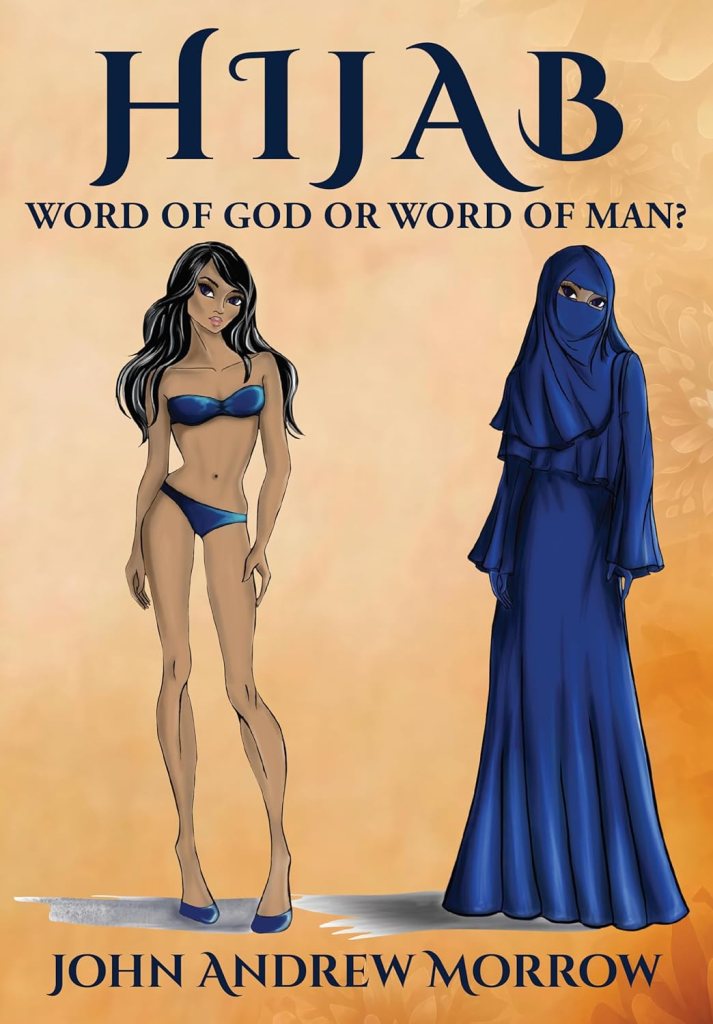
Hijab: Word of God or Word of Man? By John Andrew Morrow: BOOK REVIEW by Esther Nelson

Dr. Morrow’s book is a treasure chest of facts that also includes a wide variety of scholarly opinions regarding hijab.  His meticulous scholarship, laser-like vision, and accessible writing style clearly differentiate between what the Qur’an requires of women’s dress and what the jurists (overwhelmingly male) have enforced.  Morrow’s book would be an invaluable addition to Islamic Studies curricula in the academy, yet it’s comprehensible enough to a lay person interested in learning about hijab.

I thoroughly enjoyed reading this substantial volume.  I got a fuller picture of the meaning of hijab over time.  Dr. Morrow is clear—women ought not to be forced (legally or socially) to wear hijab.  Muslims are fond of saying: There is no priesthood in Islam.  There is no mediator between an individual and Allah.  Yet, many Muslim clergy enforce a patriarchal bent (that social system absorbed from their culture and society) to their juristic rulings that constrict women from making a free choice.

Continue reading “Hijab: Word of God or Word of Man? By John Andrew Morrow: BOOK REVIEW by Esther Nelson”
Shariah is not a Law by Esther Nelson

I will never forget the day Nasr Abu Zaid (1943-2010), an Islamic Studies scholar and teacher extraordinaire, told me, “Shariah is not a law.”  In spite of his assertion, many people—both Muslims and non-Muslims—are convinced that Shariah is synonymous with archaic legal rulings that are at odds with democracy and modernity.


What is Shariah, then, if not a law?  When we see or hear the word Shariah, the word “Law” almost always follows.  Shariah literally means a path—a well-trodden path such as animals use on their way to a watering hole.  Shariah, then, can be understood as something that when embraced has potential to give life and sustenance.


Muslims believe that the Qur’an was revealed to Prophet Muhammad by the angel Gabriel circa 600 C.E.  That revelation—Muslims believe it to be God’s actual speech—took place over a period of approximately twenty-one years. The Qur’an contains Shariah (path) in the form of information, narrative, and poetry.  Since Shariah is essentially a path that leads to life, the critical question centers on how Shariah can be appropriated, leading us to the water that sustains.

Continue reading “Shariah is not a Law by Esther Nelson”

Why I am an Islamic Feminist by Shehnaz Haqqani

FAR - SHWhile Islam has undoubtedly granted women many rights—some of which were radical for much of the world in the 7th century, such as the rights to divorce, consent in marriage, education, and financial independence—many Muslim women around the world are denied those rights in practice. That these rights were “radical” for the 7th century is significant: one would think that this is an indication that our rights should be “radical” in all times. What Islamic feminism does is to help us deal with this tension of the existence of women’s rights in theory but their denial in practice.

I understand Islamic feminism to be a response to the mistreatment of Muslim women, whose rights have been marginalized, or completely denied, because of interpretations of Islam that do not acknowledge their full humanity and view them as inferior to men; Islamic feminism therefore requires re-visiting the Qur’an to re-interpret it from a standpoint that does not favor any one gender over another and sees all as equally valuable. Needless to say, Islamic feminism, or any other form of feminism, does not claim that women and men are “the same”; men and women need not be the same in order to be viewed as and treated equally and fairly. Continue reading “Why I am an Islamic Feminist by Shehnaz Haqqani”