
Legacy of Carol P. Christ: Of Human Life*

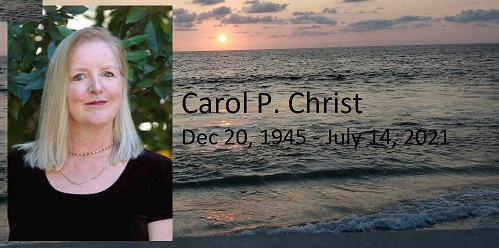
This post was originally published on July 2nd, 2012like many of Carol’s other posts, it is eerily poignant for today.

Watching the last episode of the Australian series Brides of Christ in which Catherine leaves the sisterhood of the convent because of her disagreement with Humanae Vitae brought me right back to the Yale Roman Catholic chapel and the folk mass I attended regularly.  In 1968 just after the publication of Humanae Vitae, priest and co-graduate student Bob Imbelli preached a sermon on the doctrine of conscience, arguing that though it was incumbent on Catholics to think carefully about the papal encyclical on birth control, it was also the responsibility of every Catholic to follow her or his conscience on the matter.  In the episode, Sister Catherine encourages a Roman Catholic mother of six who has already self-induced more than one abortion to take the pill, but the woman decides she cannot go against the church’s teachings.  Catherine allows an editorial against Humanae Vitae to be published in the school newspaper even though she knows it will probably lead to the expulsion of one of her favorite students.

Continue reading “Legacy of Carol P. Christ: Of Human Life*”
Legacy of Carol P. Christ: Of Human Life*

This was originally posted on December 30, 2011

Watching the last episode of the Australian series Brides of Christ in which Catherine leaves the sisterhood of the convent because of her disagreement with Humanae Vitae brought me right back to the Yale Roman Catholic chapel and the folk mass I attended regularly.  In 1968 just after the publication of Humanae Vitae, priest and co-graduate student Bob Imbelli preached a sermon on the doctrine of conscience, arguing that though it was incumbent on Catholics to think carefully about the papal encyclical on birth control, it was also the responsibility of every Catholic to follow her or his conscience on the matter.  In the episode, Sister Catherine encourages a Roman Catholic mother of six who has already self-induced more than one abortion to take the pill, but the woman decides she cannot go against the church’s teachings.  Catherine allows an editorial against Humanae Vitae to be published in the school newspaper even though she knows it will probably lead to the expulsion of one of her favorite students.

Continue reading “Legacy of Carol P. Christ: Of Human Life*”

The “Tenting” God and the Tenacity of Hope by Sheila E. McGinn, Ph.D.

Easter Sunday 2010 marked the last Mass at Historic Saint Peter Church in Cleveland, Ohio. After over 150 years of continuous use, the oaken doors of this sacred space on 17th and Superior were closed and locked. In rich irony, the building that once had been the womb of a vibrant inner-city Catholic community closed like a tomb on the very day when the Christian church around the world celebrated the feast of Christ breaking the bonds of death and rising triumphant from the grave. The official ecclesiastical act of “suppression” that closed the church building was intended likewise to roll the stone across the grave of the vibrant parish community that inhabited that domus ecclesiae. But Christians know that Resurrection happens. Easter cannot be stopped, not even by bishops.

Almost before he set foot in the door of the Chancery in Cleveland, Bishop Richard Lennon announced his intention to close one-third of the 180+ parishes in the diocese. Sixty-three parishes were to be selected for elimination based on the criteria of declining membership and financial dependency. Not surprisingly, many of the faithful were quite disturbed at this announcement. The diocesan spokesman sought to reassure them: “We don’t close parishes; we close empty buildings.” “Alright,” I thought, “maybe this won’t be so bad as it sounds.” And at first, that looked to be the case. Continue reading “The “Tenting” God and the Tenacity of Hope by Sheila E. McGinn, Ph.D.”

Of Human Life* By Carol P. Christ

Watching the last episode of the Australian series Brides of Christ in which Catherine leaves the sisterhood of the convent because of her disagreement with Humanae Vitae brought me right back to the Yale Roman Catholic chapel and the folk mass I attended regularly.  In 1968 just after the publication of Humanae Vitae, priest and co-graduate student Bob Imbelli preached a sermon on the doctrine of conscience, arguing that though it was incumbent on Catholics to think carefully about the papal encyclical on birth control, it was also the responsibility of every Catholic to follow her or his conscience on the matter.  In the episode, Sister Catherine encourages a Roman Catholic mother of six who has already self-induced more than one abortion to take the pill, but the woman decides she cannot go against the church’s teachings.  Catherine allows an editorial against Humanae Vitae to be published in the school newspaper even though she knows it will probably lead to the expulsion of one of her favorite students.

I had forgotten that Pope Paul VI issued the prohibition on birth control against the clear majorities of the Roman Catholic commissions instructed to study the matter.  In the episode, Sister Catherine, told by her bishop that she can no longer express her own opinions on birth control, tries to explain to her students that Roman Catholics cannot use birth control because it is against “natural law.”  This provokes one of the students to ask if people are not supposed to use birth control because animals don’t use it.  This question sparked an “ah-ha” moment for me.  Hmm, I thought, while “man” has invented birth control, “women” cannot use it because we are meant to remain “like the animals.” This debate really is about the question of whether women are human! Continue reading “Of Human Life* By Carol P. Christ”

The Vatican’s Spiritual Violence Against Women’s Ordination By Rosemary Radford Ruether

The Vatican has adopted what amounts to a “zero tolerance” policy against those Catholics who actively advocate for women’s ordination, particularly against anyone involved in the movement of Roman Catholic Womenpriests which, for the past three years, has ordained thirty-five women in the United States. This movement began in June, 2002, when seven women were ordained by some Catholic bishops in Austria. Later several of these women were ordained bishops by these same bishops. They, in turn, have ordained more women priests. From this has sprung an increasingly organized movement, which is developing the theological vision of church which they hope to generate and are laying down the formal rubrics for education and preparation for ministry of those aspiring to be ordained in their community.

The Vatican summarily excommunicated the initial seven women ordained in 2002. As more women were ordained it was at first silent and then decreed that anyone being ordained in this movement, as well as those supporting it, were automatically excommunicated. This saved them the trouble of addressing each of these women individually. However, they have escalated their campaign against women’s ordination in the last month in response to Maryknoll priest, Father Roy Bourgeois, who on August 9, 2008 in Lexington, Kentucky, concelebrated the mass where long-time friend, Sevre-Duszynska, was ordained. Father Bourgeois also preached the homily at this ordination mass, where he denounced the Church’s refusal to ordain women as a sin comparable to the sin of racism. “Sexism is a sin” he declared. Continue reading “The Vatican’s Spiritual Violence Against Women’s Ordination By Rosemary Radford Ruether”