
An Omer Calendar of Biblical Women by Jill Hammer

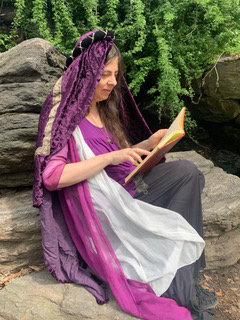
Jill as the prophetess Huldah

Right before Passover every year, my wife and I visit a botanical garden to look at the spring flowers: daffodils, tulips, cherry and apple blossoms, magnolia.   One year, in 2004 or so, we were on our way there when I had an idea. I grabbed a pen and started scribbling long lists of biblical women.

“What are you doing?” my wife asked.

“Making an Omer Calendar,” I said. 

Since biblical times, there is a Jewish practice of counting the forty-nine days between the holiday of Passover (the barley harvest and festival of freedom) and the holiday of Shavuot (the first fruits festival and the season of receiving Torah).  These forty-nine days were the time of the barley and wheat harvest and were a fraught time for biblical farmers.  According to the Talmud, each day of the Omer must be counted along with a blessing.  One must count consecutively each day (usually in the evening) and one loses the right to say the blessing if one misses a full day of the count.  The Omer is often understood as a time of semi-mourning because of plagues said to occur during this time, but it is also a joyful season when nature’s abundance is at the forefront.  This seven-week period embodies both fear that the harvest will be damaged and gratitude for the harvest.

Continue reading “An Omer Calendar of Biblical Women by Jill Hammer”
Sacred Secrets: The Legacy of Women’s Wisdom Across Generations by Rabbi Nadya Gross

From my earliest memories, I saw things that others didn’t see and knew things I had no business knowing. But at the time, I didn’t realize that others didn’t witness the dance of light around their bodies or the life forms at the base of trees. I didn’t know that the insights I had into people’s emotions were not universally shared. My curiosity led me to ask questions about these things… until my grandmother, Savta (Heb), took me into the kitchen (where everything important happened), closed the doors, and told me never to talk about these things with anyone except her. And so, my training began.

Savta was gifted in ways different from mine. She had grown up in a circle of women and their daughters, a circle where women educated each other, shared their unique gifts and insights, and passed down a legacy of wisdom.

The wisdom she shared with me was as ancient as the land on which we lived. We began with reverence for the Earth and all her elements—pre-patriarchal Goddess wisdom. We explored what it means to be intimately connected to all aspects of Creation, understanding that we are interdependent. Harm to a tree, an insect, or the water harms us. We learned that the respect we wish to receive from others must first be shown by us. I learned to never pick up a beautiful stone that caught my attention without first asking permission to remove it from its resting place. When harvesting fruit from one of the many trees in my grandparent’ yard, I expressed deep gratitude to the mother-tree whose body nurtured that fruit to ripeness.

Continue reading “Sacred Secrets: The Legacy of Women’s Wisdom Across Generations by Rabbi Nadya Gross”

The Daughters of Zelophehad and the Five Feminine Powers of the Kabbalah by Rabbi Jill Hammer

Jill anointing her daughter. photo by Shoshana Jedwab

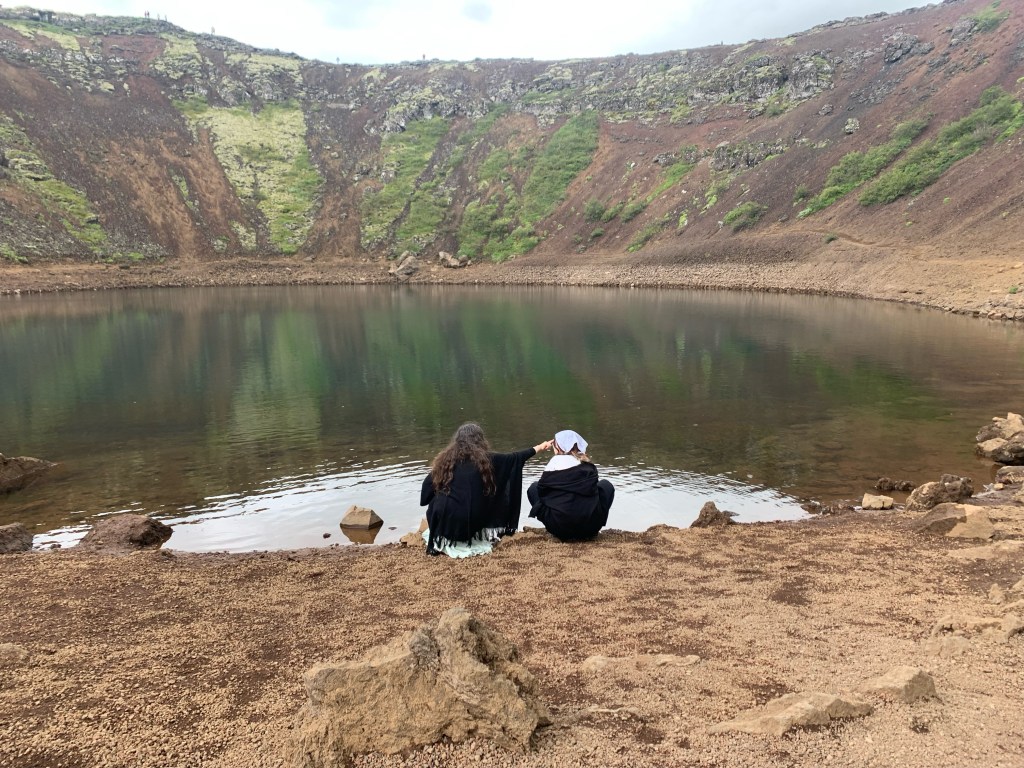
This summer, I visited Iceland, a beautiful and magical land.  While I was there, I saw the Kerid Crater, which is a caldera: a volcanic crater with a lake inside.  My family and I hiked around the edge of the crater and then down close to the lake.  The perfect roundness of the crater-lake gave the impression of a circular container—a jewel-box shaped by some immense hand— or else a massive eye looking up from the earth.  My daughter and I sat by the lake’s waters and anointed one another, having the sense we were in a sacred place.

Later that summer, I grappled with a story that reminded me of the crater. In Numbers 27, five sisters—the daughters of a man named Tzelafchad—approach Moses with a question.  Their father had daughters, not sons, and it seems this means his family will receive no land allotment in Canaan.  The daughters ask that they be given land allotments: “Let our father’s name not be lost to his clan just because he had no son!” (Numbers 27:4).  Moses takes their complaint to God and brings back an answer: the daughters have spoken rightly, and will receive a land allotment as they request.  However, they must marry men of their own tribe so that the tribal land is not lost— if the women married men of another tribe, their heirs would belong to that other tribe and so the land would change its tribal designation.  Thus, patriarchy is mitigated but not ultimately contradicted—the women become heirs to their father, but primarily for their father’s sake, not their own. 

Continue reading “The Daughters of Zelophehad and the Five Feminine Powers of the Kabbalah by Rabbi Jill Hammer”