
The Last Time, by Molly Remer

I lie in bed with him, cementing the details in my memory. The way the morning air is heavy and green. The sound of last night’s raindrops continuing to drip from the overfull gutters on the roof. The insistent stab of a single-note bird song in the air. His head nestles in the crook of my arm the way it has done every morning for three years. Blond hair against my nose, breathing in the slightly baby smell of him. “This is the last time,” I whisper softly. “We are all done after this. This is the last time we will have nonnies.”
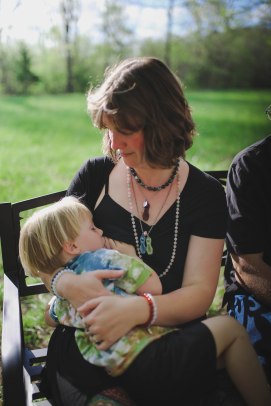
This is not the first last time for me, but it is the last, last time.  The first baby was born 14 years ago and gathered to my breast with all the tenderness and uncertainty and instinctiveness of a first, first. “Do you want nursies?” I whisper to that new little boy, and we begin the next steps in our bond, nursing for nearly three years, until one day, six weeks away from the birth of the next baby boy, I decide that we truly have to be done. I am a breastfeeding counselor for other nursing mothers and I feel like I should want to tandem nurse my two boys. I fondly envision their hands joining across my body, the easy love and camaraderie between them blossoming through this shared time with their mother. But, I feel an intense irritation with nursing while pregnant, nearly a sense of revulsion and the almost irresistible urge to shove away my sweet little boy as I prepare to greet the life of another. I talk to my midwife about my feelings and she explains that with her own two daughters, the agitated feeling at nursing the older one did not go away with the birth of the second, but instead became dramatically worse. After hearing this, I feel panicky and I decide we do, in fact, have to wean. He is a very verbal and precocious toddler and I am easily able to explain to him that it is time to be finished nursing. One night though, he lies in bed with me crying and begging to nurse. He says he really needs to. I tell him, “remember, we’re all done, but if you really, really need me, if you really, really still need to have nursies, you can.” He doesn’t nurse, but instead falls asleep, reassured that while our nursing relationship might be over, I’m still here.

Continue reading “The Last Time, by Molly Remer”

Seeing Through My Nipples by Karen Moon

Karen 2006

This article is inspired from my Facebook group’s book study of Women Who Run with the Wolves by Clarissa Pinkola Estes, specifically Chapter 11: Retrieving a Sacred Sexuality.

I confess that I had never before heard of the term ‘seeing through your nipples.’ I continue to think on that. But I tell you what though; I do know the power of a nipple. And I can definitely say that it made me take one definitive path in life that has led me right here.

I’m going to take a moment and also ‘speak through my vulva’. I get that, too. It’s raw, and it’s honest. And I hope I don’t offend as it’s always so ‘touchy’ this talk of breastfeeding. But I am not meaning any of this in a judgmental way. I just wanted to speak of my experience personally. I wish I had had these stories before I became a mother so I could try them out, test them on my tongue and make a decision that worked for me without some of the trials I went through.

When I had my first child, way back in 2000, we were living in an apartment east of San Francisco in the rolling green hills. My mother-in-law came for the birth as my mom was on vacation somewhere in South America with my stepfather.

I had planned on breastfeeding, and my mother-in-law decided to ‘humor’ me. She is one of those tough New Jersey, Brooklyn born and raised women who have no idea how something like breastfeeding could actually work. She doubted the value of it. She wanted to see the can, the formula inside it, a nicely sanitized bottle and a chart with three hour intervals. And she was quite the persuasive lady. Continue reading “Seeing Through My Nipples by Karen Moon”

Breastfeeding and the Abject? by Sara Frykenberg

The trappings of motherhood are all too powerful reminders that, as Catherine Keller reminds us in her book From a Broken Web, mother goddesses have to be continually slain for patriarchal heroes to be born. Indeed, she suggests that conceptions of Western selfhood are based upon this symbolic matricide—so it is no wonder that breast milk might be considered abject…

IMG_3269Once upon time formula companies and complicit medical experts launched a serious campaign to sell more formula, telling a generation of mothers that this product was both superior to breast milk and far better for baby and mother. Some were convinced, others found formula a good alternative to breast milk given their employment status, hormonal changes, their particular baby’s needs,personal choice, difficulty producing their own milk, or the like; and still others chose to breastfeed despite criticism, like my mother-in-law, who received scorn and derision from medical personnel as the only breastfeeding mother in the hospital in which she gave birth in 1970.
Despite this effort, science has finally “proven” that breast milk, when it is possible to give it, is better for your child than synthesized alternatives. Wow. Well, the politics of believability aside, women in the U.S. are now encouraged to trust their own bodies to feed their babies and give the breast a try. In fact, every new book, article, website and internet forum, birthing class teacher and hospital nurse will tell you that “breast is best,” repeatedly, for months, asking you about your breastfeeding plan, and urging you to keep trying until you and baby get it right. A counter-campaign, this vigorous encouragement is working to undo the attitudinal changes within popular culture that placed a stigma on the breastfeeding woman. Continue reading “Breastfeeding and the Abject? by Sara Frykenberg”

Truly Our Sister by Laura Grimes

Laura GrimesMiriam of Nazareth, the fiery and courageous Jewish prophet who single-handedly enabled the incarnation of God/dess, is a profoundly ambivalent figure for Catholic feminists.  Her racist and patriarchal deformation as a sexless European Barbie has often been used to club and control other women.  Yet she refuses to be silenced or appropriated by oppressors, carrying the lost image of God/dess through the centuries and empowering women to know the sacredness of their own physical and spiritual life–giving labors in Her image.  I composed this hymn to celebrate the feast of the brown and pregnant Guadalupe/Tonantzin, and to mark the Marian feastdays of the Assumption (Aug. 15) and Queenship of Mary (August 22).  It reflects a long journey of exorcising the false misogynist Mary from my own mind and heart and claiming her as role model and mentor in my own call as thealogian, mother of four, and spiritual director.  It may be used in ritual or republished with the inclusion of author and copyright information (Laura M. Grimes, copyright 2010).

Image from: http://www.fisheaters.com/images/marialactans160020.jpg

My original inspiration, after the birth of my younger daughter, was the traditional Litany of Loreto.  I came to love its eloquent images when I was studying in Rome and prayed it daily with the old Italian women who had the last liturgical word by leading it, in Latin and from memory, after each day’s mass.   It also includes key scriptural passages about Mary and many of the traditional mysteries of the rosary.  But the work’s gestation was incomplete until I became involved in an interfaith women’s spirituality church, the Goddess Temple of Orange County, and encountered the fourfold Goddess for the first time.  Rev. Ava Park, Presiding Priestess, has been a leader in the recent movement to add the missing image of the wise and loving Queen to the traditional Maiden, Mother, and Crone as a celebration of midlife and a model for women’s leadership.  The second through fifth verses of the hymn highlight Mary’s experience in each stage of women’s life and affirm every woman’s power and beauty as an icon of these four aspects of the Divine.  The title will be recognized by many as a reference to Elizabeth Johnson’s groundbreaking book on Mary—criticized by traditionalists for a cover depicting her scripturally as the mother of a large family!
Continue reading “Truly Our Sister by Laura Grimes”