
A Maternal Economy: Making the Intangible Tangible by Caryn MacGrandle

Mother Goddess sculpture from Madhya Pradesh or RajasthanIndia, 6th-7th century, in the National Museum of KoreaSeoul

In meditation this morning, it occurred to me how a vital ingredient to the paradigm shift is making the intangible tangible.

I am speaking of the work that you and I do.

I have put nine years of tireless work into my computer app, working daily and spending my personal funds to the tune of about $100,000. With new features that I added this year, the business plan is sound. I just need about ten times the registrants. In other words, I’m 100 feet shy of an 8000 foot mountain. And about to run out of money.

Continue reading “A Maternal Economy: Making the Intangible Tangible by Caryn MacGrandle”
Sappho’s Poems as an Ethos for Women’s Ritual by Jill Hammer

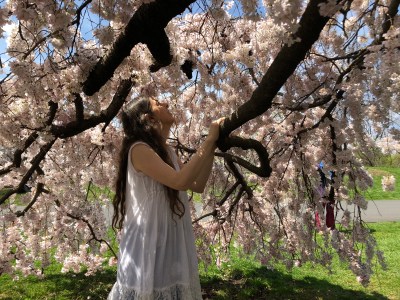
Photo by: Zac Jaffe

For by my side you put on

many wreaths of roses

and garlands of flowers

around your soft neck


and with precious and royal perfume

you anointed yourself.


On soft beds you satisfied your passion.


And there was no dance

no holy place

from which we were absent.


–Sappho (trans. Julia Dubnoff)


Sappho, the poet from Lesbos (630-570 BCE), was considered one of the greatest poets of her time—one of her epithets was “the tenth Muse.” I discovered the poems of Sappho in my thirties and was utterly captivated.  I had newly embarked on a relationship with a woman and Sappho’s love poetry (though by no means exclusively lesbian) supported the expression of eros between women.  Yet even more than that, Sappho’s poems supported an erotic relationship between self and world—a relationship that included ritual as a form of intimacy.  I’m not a Greek scholar—I experience Sappho’s poems in translation. Yet the translations I read back then were a revelation: a world in which women lived in circle with one another.

Continue reading “Sappho’s Poems as an Ethos for Women’s Ritual by Jill Hammer”