Sea Glass by Elanur Williams

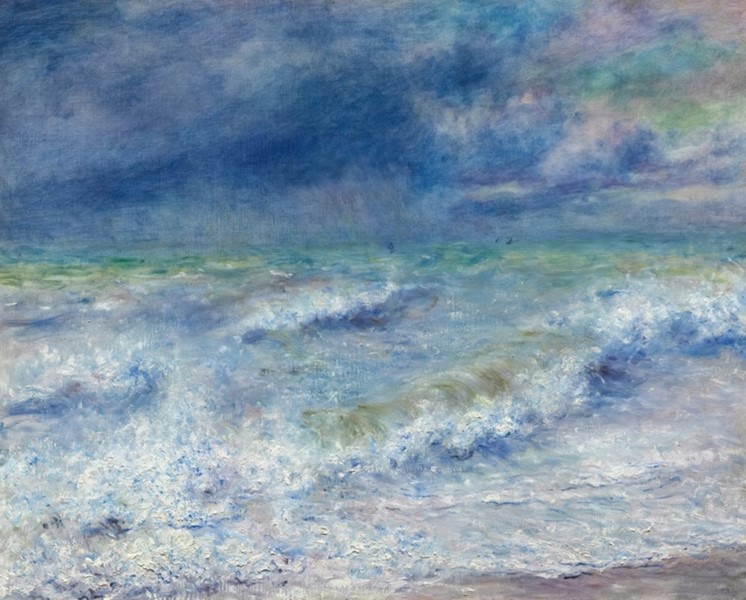
Image Credit: Seascape, 1879, Pierre-Auguste Renoir (available on public domain).

I am drawn to the sea not for its grandeur, but for what it returns: small, broken things that once had sharpness. As a child, I remember walking along the shore searching for glimmers, glass fragments dulled into misty greens, smoky ambers, pale blues. I wanted to gather the pieces of what had once been whole and what had once been contained. I collected the way a child collects secrets, each piece a contradiction. Maybe I thought I could make something from these fragments; after all, I was the kind of child who looked for meanings and signs in everything. It is in part what drew me to literature and writing.

There is a piece of sea glass I remember more than the others: an opalescent shard, a piece of moon. That piece became a metaphor for the self I hadn’t yet become. Like those fragments, I too had sharp edges once. Pain teaches that: the need to defend, to protect oneself from further breakage, carves us into angular shapes. I learned early how to brace for fracture, and there was a comfort I found in control, a fierce desire for wholeness that was often mistaken for strength. But there is a brittleness to that kind of armor, and eventually, it begins to break. It took years of undoing for my edges to soften.

Continue reading “Sea Glass by Elanur Williams”
As a Hen Gathers by Elanur Williams

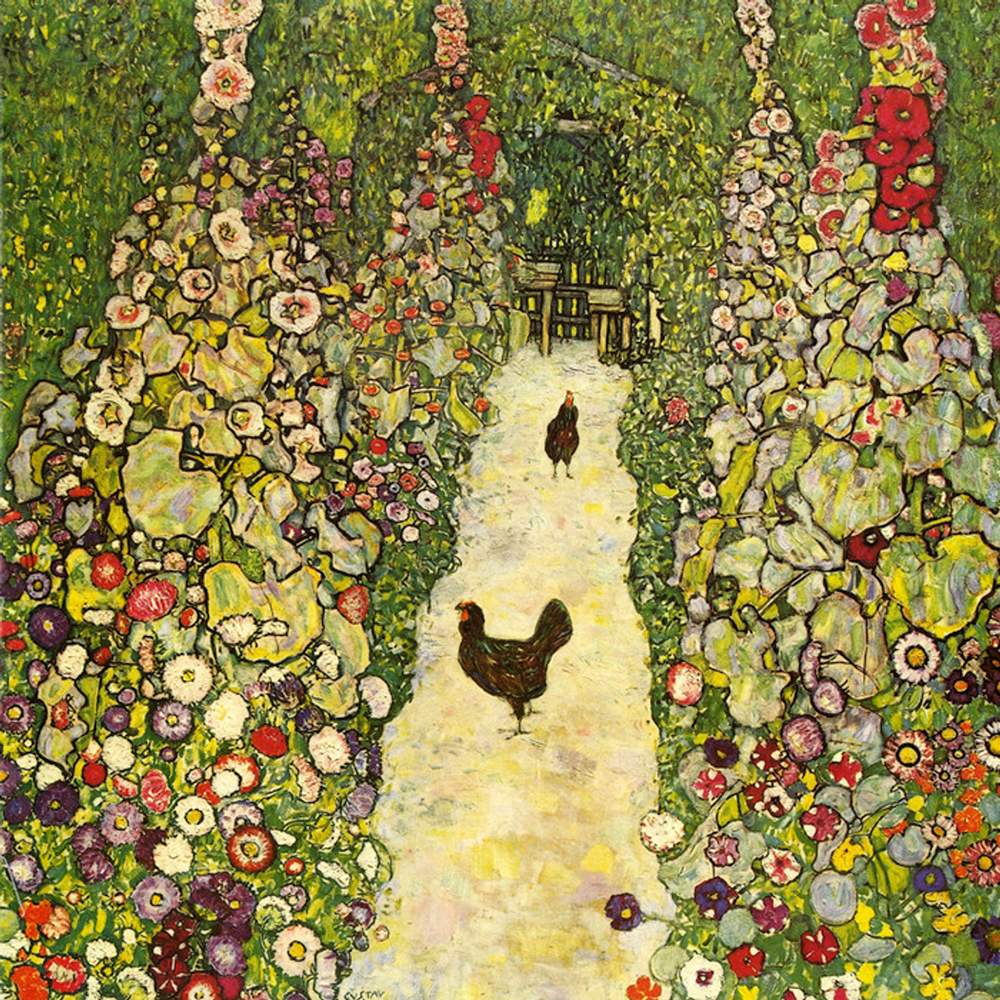
Gustav Klimt, Garden Path with Chickens, 1916

In the early years of my childhood, my family lived for a short time on a poultry farm in Bandırma. Hens wandered freely, unconfined. The contours of that land have long since changed, replaced by refrigerated depots and industrial freezers that hum along the highways, the relentless march of capital. In the Gospels of Luke and Matthew, Jesus laments: “How often have I desired to gather your children together as a hen gathers her brood under her wings, and you were not willing.” These days, I find myself returning to the image of the mother hen—a figure who embodies a special wisdom that is seldom named, yet deeply and instinctively known.

Although I did not have a religious upbringing, I grew up embracing aspects of many faiths. My spiritual background is Alevi, and after inviting the Presbyterian faith into my life following my marriage, I find these layered identities influence each other in ways that are both intricate and transformative. In her sermon Who Is Jesus? Mother Hen, Reverend Agnes Norfleet lingers on the vulnerability of the mother hen metaphor, questioning what strength a hen can possibly offer in the face of the fox—Herod—and, more broadly, in the face of violence at large. Reverend Norfleet asks why Jesus does not invoke a more forceful or fiercer maternal figure—a lion, perhaps, or a bear? What does this choice imply for our activism and understandings of leadership? What unique wisdom does the mother hen offer?

Continue reading “As a Hen Gathers by Elanur Williams”

Witches and Queens in C. S. Lewis’s Chronicles of Narnia by Elanur Williams

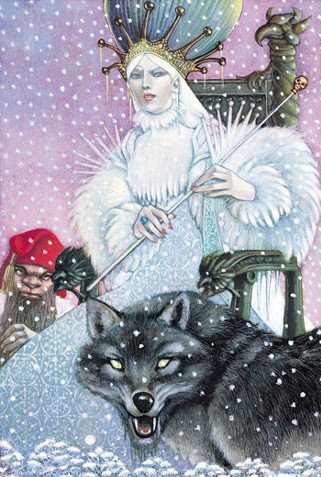
Jadis, The White Witch, by Leo and Diane Dillon. Front Cover for The Lion, The Witch, and the Wardrobe.

When I first encountered the Narnia novels as a child, the Christian symbolism was lost on me. I grew up in Istanbul, and what captivated me most was the magical world of Narnia, where one of my favorite characters, Aslan, had a Turkish name—a rarity in the British children’s books I read at the time. I also loved the mention of Turkish delight, which I did not consider to be “exotic;” rather, it was an ordinary reference to the rose, lemon, and pistachio flavored confections I often enjoyed at home. However, the character who truly fascinated me was Queen Jadis, also known as the White Witch. Her cold, regal majesty—draped in furs and gliding across a snowy landscape in her sleigh—was enchanting. I preferred witches to princesses and was drawn to stories where characters defied the roles they were expected to play, so it’s no surprise that I found the Witch’s character far more compelling than Lucy’s or Susan’s. I even had a picture of Jadis pinned to my bedroom wall. Yet within myself, I suppressed the Witch’s more admirable qualities—her anger, conviction, and sense of personal power. It took me years to reclaim, heal, and integrate these aspects.

Much has been written about C. S. Lewis’s restrictive and problematic portrayal of female characters. He perpetuates misogyny in Christian thought by depicting women who are idealized, distracted by ‘nylons and lipstick,’ in need of protection, or portrayed as liars—like Lucy, whose discovery of Narnia is initially dismissed as a childish fabrication, even though she is a truth-teller. Traces of paternalism run throughout his works, particularly through his reinforcement of a rigid gender binary. He perpetuates the view that women must suppress their own desires and dreams, in favor of being useful and serving others. Although the Narnia novels may appear to position women like Lucy and Susan as capable and responsible leaders (especially when they are crowned co-rulers of Narnia), this vision of female leadership is complicated by the presence of villainous witches and Queens.

Continue reading “Witches and Queens in C. S. Lewis’s Chronicles of Narnia by Elanur Williams”

St. Brigid: Reproductive Justice and the Realms of the Miraculous by Elanur Williams

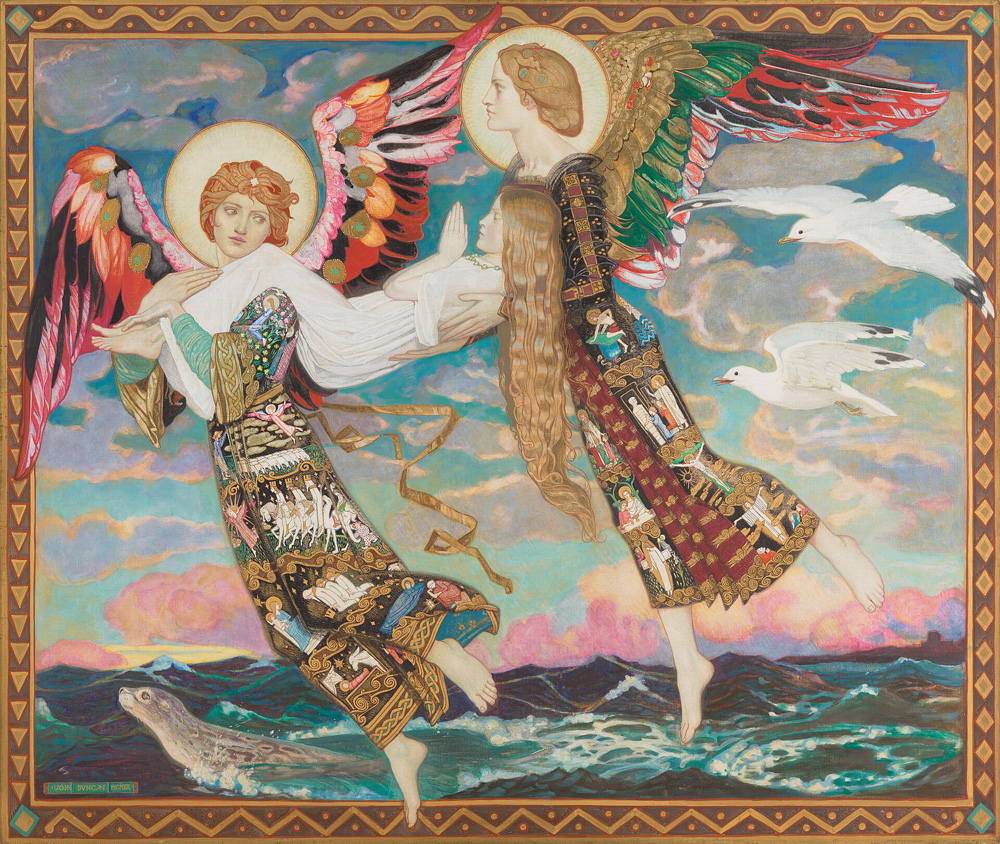
St Brigid being carried away by angels, in a painting by John
Duncan (1913)

One of my favorite saints is St. Brigid of Kildare, the patroness of poetry, learning, healing and protection. She is frequently called upon during childbirth. Brigid’s hagiographies are noteworthy for her remarkable abilities to heal and perform miracles—including her ability to make pregnancies vanish, for those who ask. In Vita Prima and Vita Brigitae (Life of Saint Brigit) published around 650 C.E. by Cogitosus, an Irish monk from Kildare, it is claimed that “Saint Brigid, by the very powerful strength of her faith, blessed a woman who had fallen [pregnant]…and the conception in the woman’s womb decreased and she restored her to health…without childbirth and its pangs.” The pregnant people in Brigid’s tales turned to Brigid to help them reclaim and restore their dignity. Consequently, their abortions served as catalysts for change. “Abortion miracles” have narrative and theological functions: they expose constructs of sexuality, chastity, purity, and sin. In addition, they test our understandings of healing—physical and spiritual—by revealing the intersectionality between medicine, pregnant people, power, and personal agency. Scholars have theorized the presence of “abortion miracles” in hagiographies, and whether they are to be read as a kind of defiance towards early Christian morality, or as a demonstration of chastity’s role and value in early medieval Irish Christianity. Some Irish penitentials view medieval abortions as malefic acts or as a kind of malevolent magic; however, according to Arica Roberts (2020), it can be argued the abortion miracles found in Irish hagiography can instead be read as “medicines of penance” and as contributing to healing.

Continue reading “St. Brigid: Reproductive Justice and the Realms of the Miraculous by Elanur Williams”