Holy Acts of Becoming: Sacred Reclamations and Gender in Children’s Literature, part 2 by Elanur Williams

part 1 was posted yesterday

Liminality of the Soul

‘Hansel and Gretel’ illustration by Karrie Fransman in ‘Gender Swapped Fairy Tales’ by Karrie Fransman and Jonathan Plackett (Faber & Faber, 2020). Used for commentary and review purposes under Fair Use guidelines. Website: https://karriefransman.com/project/gender-swapped-fairy-tales/

I have always adored fairy tales and folk tales, as they were the original, shimmering mirrors of my own interior world. In my own spiritual formation, I found my earliest refuge in the ‘monsters’ of the canon. I was drawn to the Selkie, whose power lived in her shed skin, and the shapeshifters who refused to be fixed in a single narrative. These were my mysterious teachers who offered profound knowledge, that I might have an interior life that does not match the exterior expectations of the world. By re-reading these archetypes, I see that the ‘liminal’ is not a place of exclusion, but the most sacred place of all: the threshold where the divine creates.

The traditional “curse” of the beast in fairy tales can be approached as a narrative of liminality, an invitation to exist in the “in-between” where nature and spirit intersect. This “curse” is, fundamentally, a colonial misunderstanding of power and a fear of the fluid. Figures like the trickster, the shapeshifter, and the mermaid reveal that the “soul” has never been bound by a static form.

Continue reading “Holy Acts of Becoming: Sacred Reclamations and Gender in Children’s Literature, part 2 by Elanur Williams”

Holy Acts of Becoming: Sacred Reclamations and Gender in Children’s Literature, part 1 by Elanur Williams

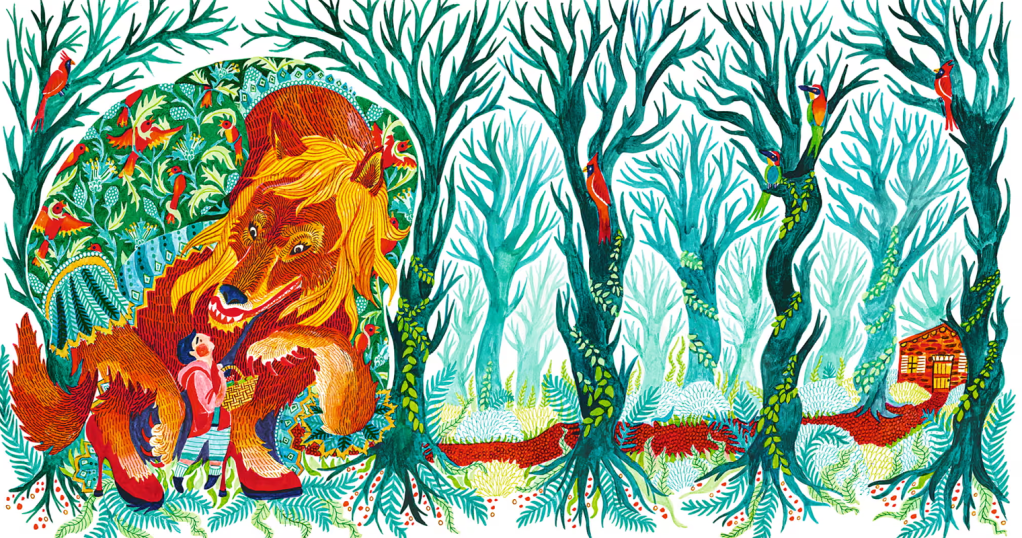
‘Little Red Riding Hood’ illustration by Karrie Fransman in ‘Gender Swapped Fairy Tales’ by Karrie Fransman and Jonathan Plackett (Faber & Faber, 2020). Used for commentary and review purposes under Fair Use guidelines. Website: https://karriefransman.com/project/gender-swapped-fairy-tales/

For generations, books have served as children’s first primers on the soul, and long before children encounter formal theology, they are offered spiritual blueprints through folklore, myths, and fairy tales. Although folklore is a metamorphic and often subversive space, too often these stories have been constrained by essentialist moralism, a framework where goodness must be beautiful, evil must be deformed, and gender is an immutable divine decree. Imagine the princess waiting in passive, delicate virtue; the prince acting with muscular, conquering strength. Any disruption of these orders (think of the cursed beast or the transformative sea witch) is framed as a tragedy, a cautionary tale against altering one’s inherent form.

But these interpretations do a profound disservice to the expansiveness of the divine. Spiritual language does not need to be rigid; spiritual experience is often the opposite. In fact, the lexicon of faith, mysticism, and mythology is uniquely, beautifully equipped to honor gender fluidity and the trans experience. To diversify children’s literature is not merely a political act; it is an act of holy reclamation.

Continue reading “Holy Acts of Becoming: Sacred Reclamations and Gender in Children’s Literature, part 1 by Elanur Williams”

Grief, Grace, and the Eco-Feminist Legacy of Katherine Paterson’s Bridge to Terabithia, part 2 by Elanur Williams

Part 1 was posted yesterday.

The Fridging Paradox

Jesse and Leslie’s autonomy is structurally threatened by the narrative’s conclusion, and Leslie’s sudden death invites a critique of the “fridging” trope, a term derived from the comic book industry describing the practice of injuring or killing a female character primarily to serve as a plot device for a male character’s emotional development. Named after a 1994 comic book scene in The Green Lantern where a hero discovers his murdered girlfriend in a refrigerator, the term critiques the tendency in fiction to treat female characters as disposable tools for male growth rather than as autonomous individuals with their own arcs.

In Bridge to Terabithia, this sacrifice unfolds in three critical movements:

  1. The Intersection of the Boundary: When the narrative notes, “The rain had been falling all night… the creek would be angry,” it signals the reassertion of the physical world. The creek acts as the boundary between the wild sanctuary and the dangerous, restrictive reality. By having the creek kill her, the text suggests that the “wild” or “feminine” space is inherently dangerous and incompatible with long-term survival.
  1. The Reduction to Catalyst: In the aftermath, the text frames Leslie’s existence through her utility to Jesse. He realizes “it was up to him to pay back to the world in beauty and caring what Leslie had loaned him in vision and strength.” This is the core of the “fridging” critique; Leslie is explicitly framed as a “loaned” object, and as a resource for Jesse, rather than a person with her own trajectory.
  2. The Post-Death Domesticization: Finally, Jesse assumes control: “He had to teach May Belle, for he was the king of Terabithia, and it was his duty to pass on the crown.” This shift in language marks the institutionalization of their anarchic space. By bringing May Belle in, Jesse settles the “frontier,” turning a radical, feminist space into a legacy for the next generation, effectively cementing Leslie as a relic of the past.

This tension is most visible in how the forest is described. When Leslie is alive, the forest is an active, creative force. Paterson describes how “Leslie had turned into a beautiful wild creature.” Yet, after she is dead, the forest becomes a site of mourning and memory, described as “still, and the creek was clear and cool.”

Would the novel have been more or less feminist if Leslie had lived? Does her death (within the context of a 1970s children’s book) actually provide the only way for a “non-conforming” girl to be fully accepted by the patriarchal structures of Lark Creek?

To view Leslie solely as a plot device is to overlook the novel’s sophisticated, often brutal, exploration of grief as a catalyst for moral maturity. While the “fridging” critique highlights a structural reliance on her death, one might argue Paterson is engaging in a deeper inquiry regarding the necessity of loss in the formation of the self. In this light, Leslie’s death serves not to diminish her agency, but to transition the novel from a fantasy of escapism into a somber, realistic lesson on the burden of growth. She is not merely a tool for Jesse’s development; rather, her death forces the permanent integration of her radical, imaginative spirit into the “real” world. By “loaning” him her vision, Leslie ensures her feminist influence survives her physical body, compelling Jesse to carry that disruptive, egalitarian force into a resistant, patriarchal landscape. She becomes an internalized mentor, suggesting that a true feminist impact is measured by how deeply one’s vision survives in those who remain. Terabithia ceases to be a secret getaway and becomes a foundation for the transformation of others.

It’s also important to keep in mind Paterson writes from a place of deep, personal vulnerability. She began the novel to help her son process the sudden death of his best friend. When we realize this, the “fridging” trope takes on a different hue. While the structural critique holds, it is also an attempt by an author to offer healing for her son.

The Secular Saint: Aesthetic Grace and Mentorship

Some may argue Miss Edmunds serves as the narrative’s secular saint of aesthetic grace. By treating Jesse’s art with profound respect, she acts as a bridge to a wider world, a living testament that one can exist within a rural community without being confined by its rigid gendered expectations. She provides institutional permission for Jesse to value his own sensitivity, effectively acting as the precursor to the creative sanctuary he will later build. While Leslie represents the collaborative, anarchic spirit of childhood, Miss Edmunds offers a glimpse of that same autonomy realized in adulthood. She is the professional, self-actualized woman of the story, and her presence proves to Jesse there is an alternative way to be, an existence defined by the pursuit of beauty and individual purpose.

Looking back, I can see how Leslie’s golden room and her expansive approach to faith taught me one of my first lessons in feminism, religion, and spirituality. It showed me that the borders we build, whether between countries, genders, or theological doctrines, are often artificial. Although the narrative’s reliance on “fridging” reveals a patriarchal constraint, the legacy of Leslie’s vision remains, and continues to inspire.

This piece is part of a series of explorations on children’s literature, spirituality and feminism by Elanur Williams. FAR has posted several of them.
Two pieces on The Chronicles of Narnia which you can read here and here.
Anne of Green Gables which you can read here.

Bibliography and Recommended Reading:

Escaping to Nature: Ecofeminism in the Children’s Book Bridge to Terabithia, by Anandayu Suri Ardini (2023):

https://www.researchgate.net/publication/372862789_Escaping_to_Nature_Ecofeminism_in_the_Children’s_Book_Bridge_to_Terabithia

BIO: Elanur Williams writes from Dublin, Ireland. She holds an MPhil in Children’s Literature and a MS Ed in Literacy Studies. She is a teacher who specializes in reading and writing instruction, as well as a poet whose work has appeared in Eunoia Review, the Ekphrastic Review, Halfway Down the Stairs, and Cosmic Daffodil, among others. Above all, she is inspired daily by her daughter, whose presence imbues her life with joy, magic, and a sense of limitless possibility.

Grief, Grace, and the Eco-Feminist Legacy of Katherine Paterson’s Bridge to Terabithia, part 1 by Elanur Williams

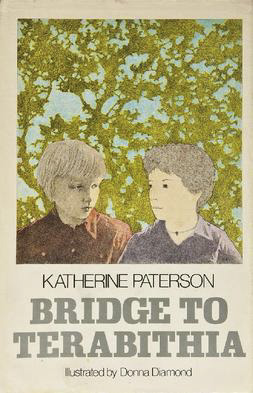
Bridge to Terabithia, First Edition (1977), by Katherine Paterson. Illustrated by Donna Diamond.

There are stories that define our childhoods, and then there are the rare narratives that teach us how to survive the contradictions of adulthood. When my family relocated from Istanbul to a Philadelphia suburb during my elementary school years, I remember feeling suspended between two universes. My efforts to map suburbia onto the vibrant textures of the home I had left behind corresponded with my encounter with Katherine Paterson’s classic novel, Bridge to Terabithia, and its sibling text, Jacob Have I Loved. I remember being completely mesmerized by Leslie Burke’s house, specifically the room she and her parents painted gold. To a child who felt uprooted and out of place, that golden room was a sanctuary of pure possibility. The book was also one of the first I’d encountered that dared to tackle the complexities of grief.

Published in 1977, Bridge to Terabithia reflects the burgeoning spirit of Second-Wave Feminism, a movement that championed the personal as political and sought to dismantle the rigid gender roles of the post-war era. Leslie’s rebellion, however, carries a bittersweet resonance for the modern reader; while her struggle fits the Second-Wave pursuit of liberation, her eventual “fridging” reflects the persistent literary habit of the era to treat female autonomy as a temporary, tragic catalyst for the male hero’s journey.

Continue reading “Grief, Grace, and the Eco-Feminist Legacy of Katherine Paterson’s Bridge to Terabithia, part 1 by Elanur Williams”

The Creative Divine: L.M. Montgomery’s Anne of Green Gables and Emily of New Moon by Elanur Williams

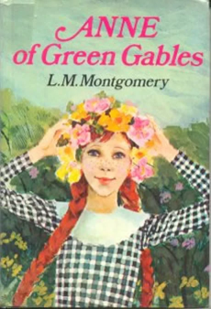
Montgomery, L. M. Anne of Green Gables. Bantam Books, 1982 edition.

Long before I lived in Montréal, the lands known to the Kanienʼkehá:ka Nation as Tiohtià:ke, Canada lived in my heart. When I moved there as a young adult, the reality beautifully exceeded my imagination; yet in the years before experiencing those landscapes firsthand, they existed for me purely through books. I was an avid reader and an aspiring writer, searching for characters who felt the same strong and sometimes overwhelming pull toward self-expression that I did. I found that mirror in the windswept shores of Prince Edward Island, through L.M. Montgomery’s fiercely imaginative protagonists, Anne Shirley and Emily Byrd Starr. In her Anne of Green Gables and Emily of New Moon books, Montgomery dismantles the rigid, punitive theology of her upbringing and offers a sharp, proto-feminist interrogation of late 19th-century Canadian Presbyterianism. In doing so, she constructs a deeply personal, feminist spirituality that equates creativity and autonomy with the divine.

Continue reading “The Creative Divine: L.M. Montgomery’s Anne of Green Gables and Emily of New Moon by Elanur Williams”

Brave Girls, Bad Witches: Age, Agency, and Anxiety in C.S. Lewis’s Chronicles of Narnia by Elanur Williams

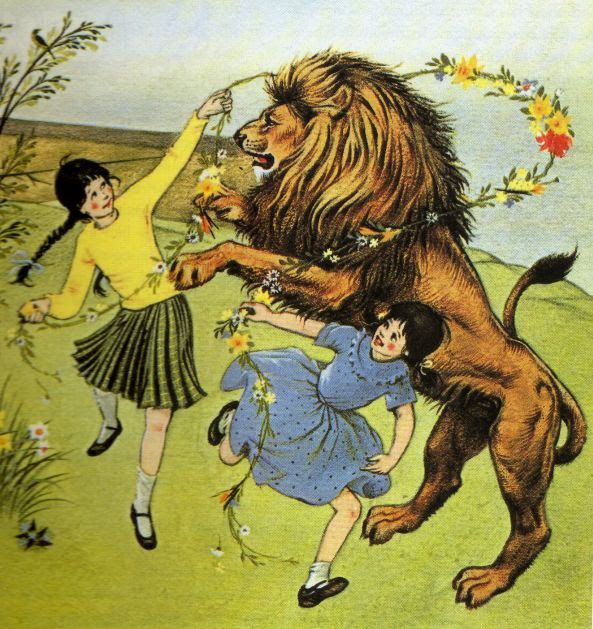
Lewis, C. S. The Lion, the Witch and the Wardrobe. Illustrated by Pauline Baynes, 1950

In the landscape of mid-twentieth-century children’s literature, C.S. Lewis’s The Chronicles of Narnia initially appears remarkably progressive. Long before modern fantasy embraced the trope of the fiercely independent heroine, Lewis gives us the Pevensie sisters, Jill Pole, Aravis, and Polly Plummer. These are active, clear-eyed adventurers. Lucy is the spiritual compass of the entire saga, possessing a theological clarity that routinely eludes her brothers. Jill braves subterranean terrors to rescue a captive prince, while Aravis flees an arranged marriage with the sharp wit of a seasoned survivalist. In Narnia, childhood is a meritocracy of spirit, and Lewis grants his young girls immense pluck, agency, and divine grace.

However, from a feminist and theological perspective, this grace comes with a strict expiration date, and a jarring ideological fracture occurs the moment a female character crosses the threshold into adult womanhood. I find that although Lewis champions the plucky girl, he displays narrative anxiety toward the grown woman. Could it be that in the Narnian universe, female maturity is treated as a spiritual fall from grace, an intersection where Christian purity is compromised by adult desire and bodily autonomy?

Continue reading “Brave Girls, Bad Witches: Age, Agency, and Anxiety in C.S. Lewis’s Chronicles of Narnia by Elanur Williams”

Sea Glass by Elanur Williams

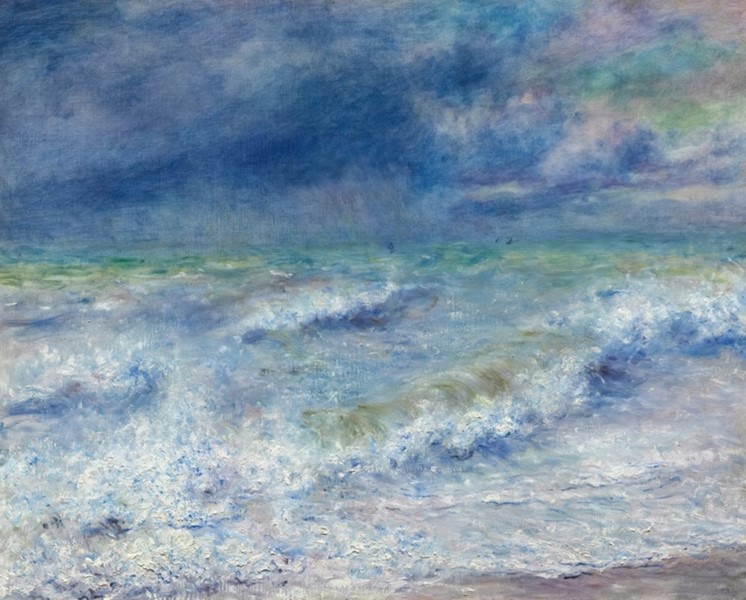
Image Credit: Seascape, 1879, Pierre-Auguste Renoir (available on public domain).

I am drawn to the sea not for its grandeur, but for what it returns: small, broken things that once had sharpness. As a child, I remember walking along the shore searching for glimmers, glass fragments dulled into misty greens, smoky ambers, pale blues. I wanted to gather the pieces of what had once been whole and what had once been contained. I collected the way a child collects secrets, each piece a contradiction. Maybe I thought I could make something from these fragments; after all, I was the kind of child who looked for meanings and signs in everything. It is in part what drew me to literature and writing.

There is a piece of sea glass I remember more than the others: an opalescent shard, a piece of moon. That piece became a metaphor for the self I hadn’t yet become. Like those fragments, I too had sharp edges once. Pain teaches that: the need to defend, to protect oneself from further breakage, carves us into angular shapes. I learned early how to brace for fracture, and there was a comfort I found in control, a fierce desire for wholeness that was often mistaken for strength. But there is a brittleness to that kind of armor, and eventually, it begins to break. It took years of undoing for my edges to soften.

Continue reading “Sea Glass by Elanur Williams”

As a Hen Gathers by Elanur Williams

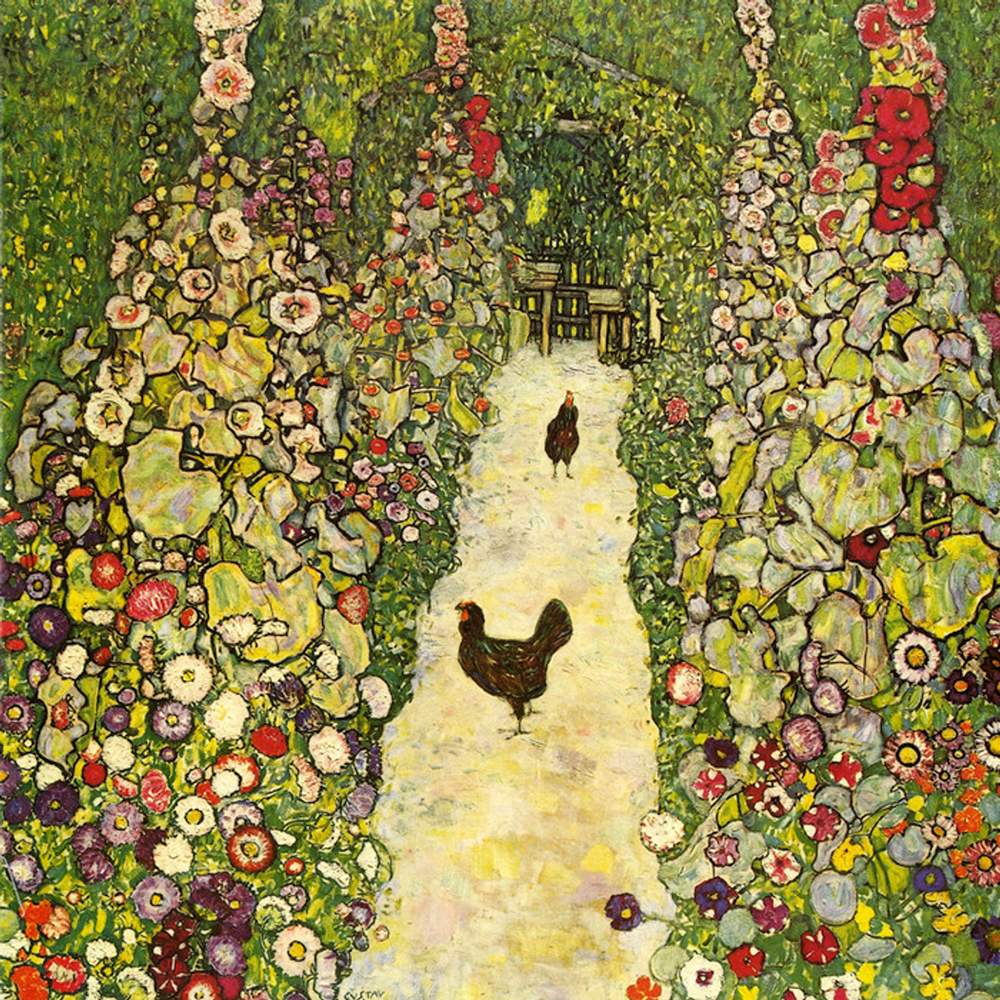
Gustav Klimt, Garden Path with Chickens, 1916

In the early years of my childhood, my family lived for a short time on a poultry farm in Bandırma. Hens wandered freely, unconfined. The contours of that land have long since changed, replaced by refrigerated depots and industrial freezers that hum along the highways, the relentless march of capital. In the Gospels of Luke and Matthew, Jesus laments: “How often have I desired to gather your children together as a hen gathers her brood under her wings, and you were not willing.” These days, I find myself returning to the image of the mother hen—a figure who embodies a special wisdom that is seldom named, yet deeply and instinctively known.

Although I did not have a religious upbringing, I grew up embracing aspects of many faiths. My spiritual background is Alevi, and after inviting the Presbyterian faith into my life following my marriage, I find these layered identities influence each other in ways that are both intricate and transformative. In her sermon Who Is Jesus? Mother Hen, Reverend Agnes Norfleet lingers on the vulnerability of the mother hen metaphor, questioning what strength a hen can possibly offer in the face of the fox—Herod—and, more broadly, in the face of violence at large. Reverend Norfleet asks why Jesus does not invoke a more forceful or fiercer maternal figure—a lion, perhaps, or a bear? What does this choice imply for our activism and understandings of leadership? What unique wisdom does the mother hen offer?

Continue reading “As a Hen Gathers by Elanur Williams”

Witches and Queens in C. S. Lewis’s Chronicles of Narnia by Elanur Williams

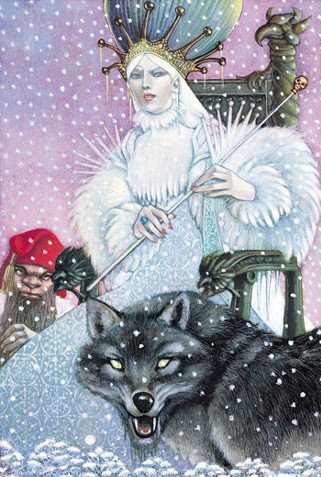
Jadis, The White Witch, by Leo and Diane Dillon. Front Cover for The Lion, The Witch, and the Wardrobe.

When I first encountered the Narnia novels as a child, the Christian symbolism was lost on me. I grew up in Istanbul, and what captivated me most was the magical world of Narnia, where one of my favorite characters, Aslan, had a Turkish name—a rarity in the British children’s books I read at the time. I also loved the mention of Turkish delight, which I did not consider to be “exotic;” rather, it was an ordinary reference to the rose, lemon, and pistachio flavored confections I often enjoyed at home. However, the character who truly fascinated me was Queen Jadis, also known as the White Witch. Her cold, regal majesty—draped in furs and gliding across a snowy landscape in her sleigh—was enchanting. I preferred witches to princesses and was drawn to stories where characters defied the roles they were expected to play, so it’s no surprise that I found the Witch’s character far more compelling than Lucy’s or Susan’s. I even had a picture of Jadis pinned to my bedroom wall. Yet within myself, I suppressed the Witch’s more admirable qualities—her anger, conviction, and sense of personal power. It took me years to reclaim, heal, and integrate these aspects.

Much has been written about C. S. Lewis’s restrictive and problematic portrayal of female characters. He perpetuates misogyny in Christian thought by depicting women who are idealized, distracted by ‘nylons and lipstick,’ in need of protection, or portrayed as liars—like Lucy, whose discovery of Narnia is initially dismissed as a childish fabrication, even though she is a truth-teller. Traces of paternalism run throughout his works, particularly through his reinforcement of a rigid gender binary. He perpetuates the view that women must suppress their own desires and dreams, in favor of being useful and serving others. Although the Narnia novels may appear to position women like Lucy and Susan as capable and responsible leaders (especially when they are crowned co-rulers of Narnia), this vision of female leadership is complicated by the presence of villainous witches and Queens.

Continue reading “Witches and Queens in C. S. Lewis’s Chronicles of Narnia by Elanur Williams”

St. Brigid: Reproductive Justice and the Realms of the Miraculous by Elanur Williams

St Brigid being carried away by angels, in a painting by John
Duncan (1913)

One of my favorite saints is St. Brigid of Kildare, the patroness of poetry, learning, healing and protection. She is frequently called upon during childbirth. Brigid’s hagiographies are noteworthy for her remarkable abilities to heal and perform miracles—including her ability to make pregnancies vanish, for those who ask. In Vita Prima and Vita Brigitae (Life of Saint Brigit) published around 650 C.E. by Cogitosus, an Irish monk from Kildare, it is claimed that “Saint Brigid, by the very powerful strength of her faith, blessed a woman who had fallen [pregnant]…and the conception in the woman’s womb decreased and she restored her to health…without childbirth and its pangs.” The pregnant people in Brigid’s tales turned to Brigid to help them reclaim and restore their dignity. Consequently, their abortions served as catalysts for change. “Abortion miracles” have narrative and theological functions: they expose constructs of sexuality, chastity, purity, and sin. In addition, they test our understandings of healing—physical and spiritual—by revealing the intersectionality between medicine, pregnant people, power, and personal agency. Scholars have theorized the presence of “abortion miracles” in hagiographies, and whether they are to be read as a kind of defiance towards early Christian morality, or as a demonstration of chastity’s role and value in early medieval Irish Christianity. Some Irish penitentials view medieval abortions as malefic acts or as a kind of malevolent magic; however, according to Arica Roberts (2020), it can be argued the abortion miracles found in Irish hagiography can instead be read as “medicines of penance” and as contributing to healing.

Continue reading “St. Brigid: Reproductive Justice and the Realms of the Miraculous by Elanur Williams”