

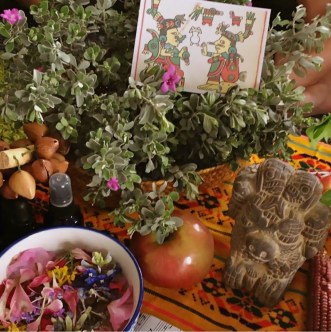
 On a corner adjacent to a cantina, across the street from a home full of barefoot children running through open doorways, and a few houses down from a paleteria y fruteria in San Antonio, Texas, sits a bright white house dressed up in orange trimmings – Casa Coatlicue[1]. Before you walk through the gate you notice a raised bed of herbs, a garden, a large collection of potted succulents, and a metate[2] on the ground. Walking inside you can’t help but smell the sage, copal, and other herbs and incense that have left their smoky traces on the walls of the living room, the kitchen, and then the bedroom. As the house begins to introduce itself, you notice altars in corners and crevices of each room. Your curiosity begins to churn as you notice pictures and canvasses on the walls of ancient and present day cultural symbols, including one poster that reads “This land was Mexican once, and indigenous always,” and a large picture of Selena Quintanilla that captures her warm smile and beautiful black hair. As soon as you begin to take in the colors and ancient smells, the house is introduced to you by name, Casa Coatlicue, the home of four queer young healers, dreamers, lovers, artists, scholars, and spiritual activists who are reclaiming the life-giving traditions of their ancestors.
Earlier this year, I was invited to a curanderismo workshop hosted at Casa Coatlicue. The word curanderismo had an air of secrecy, power, and nostalgia of home for me. I understood curanderismo as the medicine and magic of our grandmothers, and increasingly the forgotten inheritance of our communities. As I spoke with the residents of Casa Coatlicue, we began to identify the chronic erasure and appropriation of brown folks’ spiritual traditions, food, art, and customs by predominantly white, new age culture. Saddened by the loss and the historical disconnect of our people, we collectively affirmed the urgency and importance of relearning and reclaiming our own spiritual traditions not only to tap back into our cultural identity as native and mestizo people but also to tap into a powerful tool for the transformation of our current realities. In the midst of historic and present day manifestations of systemic violence against us – young brown bodies being gunned down in our streets, whole communities being persecuted, incarcerated, and displaced, as well as forced sterilization and assimilation- there is a critical need to tap into radical and sustainable ways to not only resist but to heal. Continue reading “Casa Coatlicue by Erica Granados De La Rosa”
 Feminism and Religion