
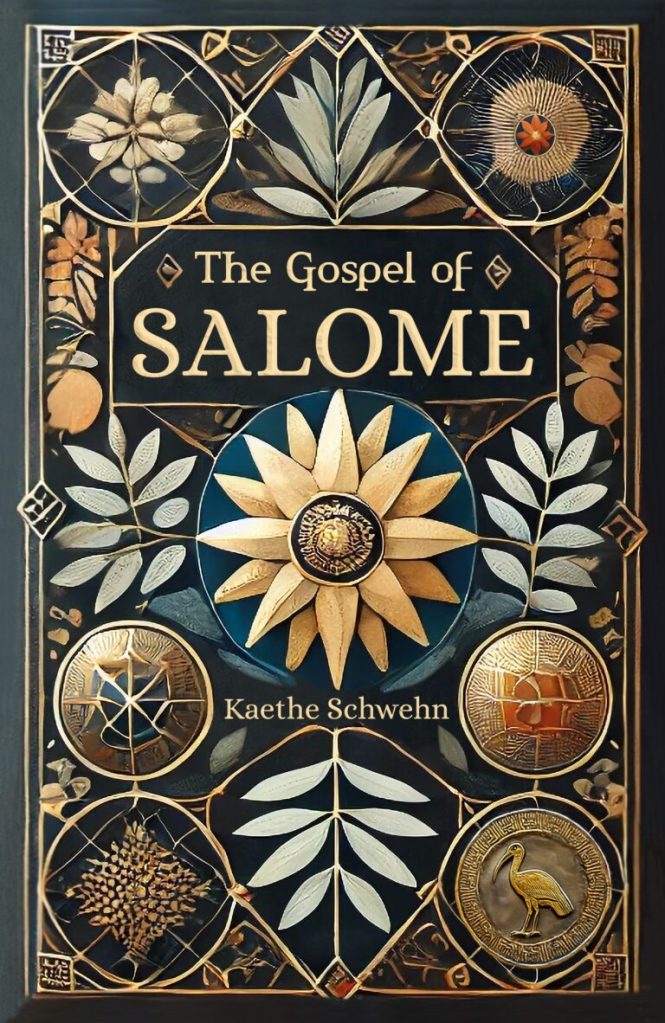
The Gospel of Salome by Kaethe Schwehn, Book Review by Michelle Bodle

What would happen if you were a disciple of Jesus and you had an encounter with someone who told you a different narrative than what you had heard in the past? How would you react? What would you preserve? How would you reconcile the stories you have been told and have told others as an apostle with what someone is now proclaiming?

            The Gospel of Salome is a work of Biblical fiction focused on Salome, a character who we hear of being present at the crucifixion and the empty tomb in the Gospel of Mark. Some scholars have connected her with “the mother of Zebedee’s children” in the Gospel of Matthew or “his mother’s sister” (i.e. Mary’s sister) in the Gospel of John. Schwehn takes a different approach, portraying Salome as a woman who was sought out for her skills in medicine, finds herself in the presence of John Mark, one of Jesus’s disciples who has come to Alexandria.

            Going back and forth between speaking to John Mark in the present and living in her memories of the past, Salome tells the apostle that she is the true mother of Jesus. However, there is another factor to consider in her proclamation – Salome’s dementia, which is threatening to steal her memories. Memories about Salome’s agreements with Mary about Jesus’s desire to learn how to heal or Mary asking Salome to not be present in Jesus’s life. Memories of being at the cross and the empty tomb.

Continue reading “The Gospel of Salome by Kaethe Schwehn, Book Review by Michelle Bodle”

A Christian Theologian’s Perspective on Feminism By David Buhrow

The following is a guest post written by David Buhrow,MA, Theology Instructor at Notre Dame College.

I am a Christian. Not a “Catholic” Christian or a “Protestant” Christian, just a Christian. I spent most of my early life thinking we (Christians) were making a fairly good effort doing what Jesus would do. I never thought much about this whole feminism thing until I happily, discovered that my firstborn was a girl. Then, everything changed. This little one, this new life, arrived into our world and our world was not ready for her. At the prospect and the potential of her venturing into the world and being able to discover everything for the first time, I found myself frightened and grieved by the ill-fated history of women and the little that the Church has done to resolve the problem. My once ideal and naive understanding of Christianity as being liberating and freeing was dashed to pieces in the hopes of my daughter finding a place in this world and within my Christian faith.

I cannot understand how we have come so far in “Christendom” just to learn that we have not yet begun to “fight the good fight.” When you read the Gospels, you quickly learn that Jesus was a Liberator. He sought to liberate anyone and everyone to free us from each other and ourselves. Paul quoted in Galatians a primal Christian baptismal creed that cries out for freedom and liberation: “There is no Jew or non-Jew, slave or free, male and female.” In this he saved the best for last. He doesn’t say “male or female” as if we should be identifying the differences within Christianity, but “male and female” identifying the unity within our diversity. Paul later writes a series of epistles and letters that seem to have forgotten the basic principles that he allegedly set forth in the Letter to the Galatians. 1 Corinthians 15 mentions a myriad of “witnesses” to the resurrection of Jesus Christ without ne’er a mention of a female. But, when we look back to the 4 canonical (i.e. chosen by men at the leading of god) Gospels, that are supposed to be foundational to our faith, the women were the first and some of the only witnesses to Jesus’ posthumous physical appearances. The men were gone, scared away from Jerusalem, in abstentia, AWOL, missing. Hence, Jesus in his resurrected condition, after enduring hours of debilitating torture and death, and then a shocking-to-the-system resurrection, had to travel on foot all the way to Galilee to “find” his disciples who were “hiding” some 65 miles away. Continue reading “A Christian Theologian’s Perspective on Feminism By David Buhrow”