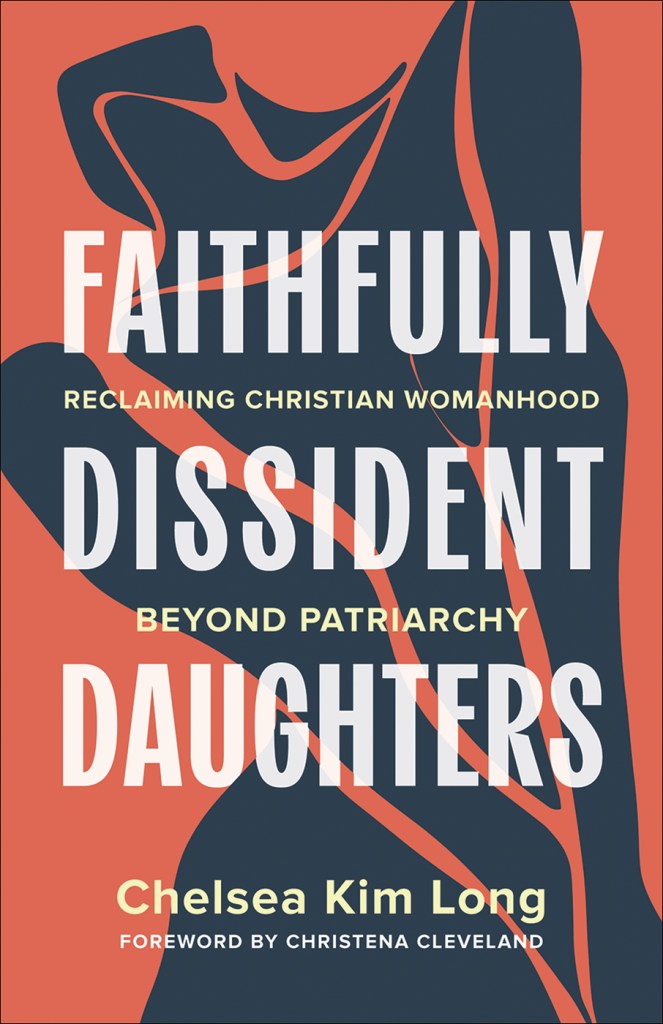
Faithfully Dissident Daughters by Chelsea Kim Long

At 28 weeks pregnant with twins, on a gorgeous summer day, I looked in the mirror and marveled at the way my body had expanded to accommodate the two lives within. I was proud of my body, proud of myself. I put on a black, lacy bralette with matching underwear and threw a lightweight open front kaftan on top. I set my phone on a self timer and took some beautiful shots of myself. Sitting on the bed. Standing in front of a mirror. Next to the crib, looking down at my belly.

The lighting was perfect; I felt ethereal—like the definition of a glowing pregnant woman. Pregnancy is magical for about 2 seconds out of 9 months and I was basking in them. I thought about God as Mother and smiled at the way my body reflected the image of God. I uploaded a photo to Instagram. Positive comments started to come in right away.

A few minutes later, my husband Colby walked into the room asking, “Did you just post a picture of yourself wearing a bra? That’s really weird.”

My heart dropped into my stomach. He had policed my outfit choices before, and it wasn’t worth the conflict to bring it up. This time felt different. This time I was carrying a baby girl who would be a sister in a family with two brothers.

Continue reading “Faithfully Dissident Daughters by Chelsea Kim Long”

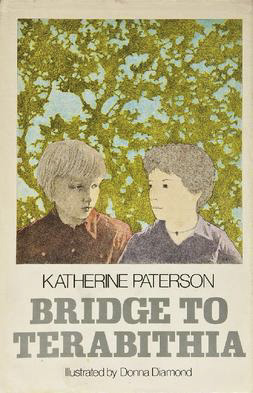
Grief, Grace, and the Eco-Feminist Legacy of Katherine Paterson’s Bridge to Terabithia, part 1 by Elanur Williams

Bridge to Terabithia, First Edition (1977), by Katherine Paterson. Illustrated by Donna Diamond.

There are stories that define our childhoods, and then there are the rare narratives that teach us how to survive the contradictions of adulthood. When my family relocated from Istanbul to a Philadelphia suburb during my elementary school years, I remember feeling suspended between two universes. My efforts to map suburbia onto the vibrant textures of the home I had left behind corresponded with my encounter with Katherine Paterson’s classic novel, Bridge to Terabithia, and its sibling text, Jacob Have I Loved. I remember being completely mesmerized by Leslie Burke’s house, specifically the room she and her parents painted gold. To a child who felt uprooted and out of place, that golden room was a sanctuary of pure possibility. The book was also one of the first I’d encountered that dared to tackle the complexities of grief.

Published in 1977, Bridge to Terabithia reflects the burgeoning spirit of Second-Wave Feminism, a movement that championed the personal as political and sought to dismantle the rigid gender roles of the post-war era. Leslie’s rebellion, however, carries a bittersweet resonance for the modern reader; while her struggle fits the Second-Wave pursuit of liberation, her eventual “fridging” reflects the persistent literary habit of the era to treat female autonomy as a temporary, tragic catalyst for the male hero’s journey.

Continue reading “Grief, Grace, and the Eco-Feminist Legacy of Katherine Paterson’s Bridge to Terabithia, part 1 by Elanur Williams”

The Legacy of Carol P. Christ: Patriarchy As An Integral System of Male Dominance Created at the Intersection of the Control of Women, Private Property, and War, Part 3

Part 2 was posted yesterday. You can read it here, or the original in the link below.

carol p. christ 2002 color

Patriarchy is a system of male dominance, rooted in the ethos of war which legitimates violence, sanctified by religious symbols, in which men dominate women through the control of female sexuality, with the intent of passing property to male heirs, and in which men who are heroes of war are told to kill men, and are permitted to rape women, to seize land and treasures, to exploit resources, and to own or otherwise dominate conquered people.

As the discussion of patriarchy* I began last week and the week before shows, patriarchy is not simply the domination of women by men. Patriarchy is an integral system in which men’s control of women’s sexuality, private property, and war (including violence, conquest, rape, and slavery) each play a part. These different elements are so intertwined that it is impossible to separate one as the cause of the others.  Patriarchy is an integral system of interlocking oppressions, enforced through violence, and legitimated by religions.

The model of patriarchy I have proposed argues that the control of female sexuality is fundamental to the patriarchal system.  This explains why there is so much controversy about the “simple matter” of access to birth control and abortion in the US today. It also explains why so much vicious anger is directed at single mothers by politicians and commentators.  Any woman who dares to control her own sexuality is questioning the foundations of the patriarchal system.

Continue reading “The Legacy of Carol P. Christ: Patriarchy As An Integral System of Male Dominance Created at the Intersection of the Control of Women, Private Property, and War, Part 3”

Legacy of Carol P. Christ: Patriarchy as a System of Male Dominance Created at the Intersection of the Control of Women, Private Property, and War, Part 1

Moderator’s Note: This three part series was originally posted in 2013 near the start-up of FAR. Because of its seminal nature, wee have re-posted it several times since then. This piece not only set FAR off on its ground-breaking direction but Carol also educated many of us about the roots, the patterns and experiences of patriarchy. This knowledge and understanding is so important to understanding where our culture is and what is happening now that we have decided to post it each year starting on the anniversary of Carol’s death, July 14th, 2021 and continuing for the 3 days.

carol p. christ 2002 color

Recently feminist scholar Vicki Noble commented that this is the best definition of patriarchy she has read–but she hadn’t read it earlier. I am reposting it now in the hopes that all of you will share it with your social media so that it will be more widely known.

Patriarchy is often defined as a system of male dominance. This definition does not illuminate, but rather obscures, the complex set of factors that function together in the patriarchal system.  We need more complex definition if we are to understand and challenge the the patriarchal system in all of its aspects.

Patriarchy is a system of male dominance, rooted in the ethos of war which legitimates violence, sanctified by religious symbols, in which men dominate women through the control of female sexuality, with the intent of passing property to male heirs, and in which men who are heroes of war are told to kill men, and are permitted to rape women, to seize land and treasures, to exploit resources, and to own or otherwise dominate conquered people.*

Marx and Engels said that the patriarchal family, private property, and the state arose together. Though their understanding of the societies that preceded “patriarchy” was flawed, their intuition that patriarchy is connected to private property and to domination in the name of the state was correct.  It has long seemed to me that patriarchy cannot be separated from war and the kings who take power in the wake of war.  Many years ago I was stunned by Merlin Stone’s allegation that in matrilineal societies there are no illegitimate children, because all children have mothers. Lately, I have been trying to figure out why the Roman Catholic and other churches and the American Republican party are so strongly opposed to women’s right to control our own bodies and are trying to prevent access to birth control and abortion. In the above definition of patriarchy, I bring all of these lines of thought together in a definition which describes the origins of patriarchy and the interconnections between patriarchy, the control of female sexuality, private property, violence, war, conquest, rape in war, and slavery. 

Continue reading “Legacy of Carol P. Christ: Patriarchy as a System of Male Dominance Created at the Intersection of the Control of Women, Private Property, and War, Part 1”

A Transgender Man’s Perspective on Purity Culture Got This Cisgender Woman Thinking by Liz Cooledge Jenkins

“Ewww, there’s been a boy in our cabin!” One of my cabinmates squealed. We were at sixth grade camp. Others chimed in quickly: “Gross!”

The evidence? A pair of boys’ cargo shorts, held gingerly between a thumb and forefinger as if they had cooties.

“Ew!” “Weird!” “How’d he get in here?”

The shorts were mine. But I did not admit this.

As a kid, I sometimes wore hand-me-down clothing from my older brother. It made sense. I didn’t have strong opinions about fashion, and the clothes felt just as comfortable and fit just as well as the girl clothes my parents bought for me.

My elementary school classmates didn’t seem to notice or care. But this was sixth grade. This was the first year of middle school. Things were changing, and I hadn’t quite realized the full extent of these changes. Showing up at sixth grade camp with hand-me-down boys’ shorts was taboo.

Continue reading “A Transgender Man’s Perspective on Purity Culture Got This Cisgender Woman Thinking by Liz Cooledge Jenkins”

Legacy of Carol P. Christ: Patriarchy As An Integral System of Male Dominance Created at the Intersection of the Control of Women, Private Property, and War, Part 3

carol p. christ 2002 colorPatriarchy is a system of male dominance, rooted in the ethos of war which legitimates violence, sanctified by religious symbols, in which men dominate women through the control of female sexuality, with the intent of passing property to male heirs, and in which men who are heroes of war are told to kill men, and are permitted to rape women, to seize land and treasures, to exploit resources, and to own or otherwise dominate conquered people.

As the discussion of patriarchy* I began last week and the week before shows, patriarchy is not simply the domination of women by men. Patriarchy is an integral system in which men’s control of women’s sexuality, private property, and war (including violence, conquest, rape, and slavery) each play a part. These different elements are so intertwined that it is impossible to separate one as the cause of the others.  Patriarchy is an integral system of interlocking oppressions, enforced through violence, and legitimated by religions.

The model of patriarchy I have proposed argues that the control of female sexuality is fundamental to the patriarchal system.  This explains why there is so much controversy about the “simple matter” of access to birth control and abortion in the US today. It also explains why so much vicious anger is directed at single mothers by politicians and commentators.  Any woman who dares to control her own sexuality is questioning the foundations of the patriarchal system. Continue reading “Legacy of Carol P. Christ: Patriarchy As An Integral System of Male Dominance Created at the Intersection of the Control of Women, Private Property, and War, Part 3”

Legacy of Carol P. Christ: Patriarchy as a System of Male Dominance Created at the Intersection of the Control of Women, Private Property, and War, Part 1

Moderator’s Note:  We here at FAR have been so lucky to work along side of Carol P. Christ.  She died July 14, 2021.  We have been reprinting her blogposts every Monday as that was her “day” for many years. This year we have decided that in honor of Carol we would reprint her important three part series on Patriarchy on three consecutive days. We plan to do this each year. In a world that seems to have gone mad, we feel that this series is crucial to understanding so much of our patriarchal world and it should not be forgotten. 

Recently feminist scholar Vicki Noble commented that this is the best definition of patriarchy she has read–but she hadn’t read it earlier. I am reposting it now in the hopes that all of you will share it with your social media so that it will be more widely known.

Patriarchy is often defined as a system of male dominance. This definition does not illuminate, but rather obscures, the complex set of factors that function together in the patriarchal system.  We need more complex definition if we are to understand and challenge the the patriarchal system in all of its aspects.

Patriarchy is a system of male dominance, rooted in the ethos of war which legitimates violence, sanctified by religious symbols, in which men dominate women through the control of female sexuality, with the intent of passing property to male heirs, and in which men who are heroes of war are told to kill men, and are permitted to rape women, to seize land and treasures, to exploit resources, and to own or otherwise dominate conquered people.*

Marx and Engels said that the patriarchal family, private property, and the state arose together. Though their understanding of the societies that preceded “patriarchy” was flawed, their intuition that patriarchy is connected to private property and to domination in the name of the state was correct.  It has long seemed to me that patriarchy cannot be separated from war and the kings who take power in the wake of war.  Many years ago I was stunned by Merlin Stone’s allegation that in matrilineal societies there are no illegitimate children, because all children have mothers. Lately, I have been trying to figure out why the Roman Catholic and other churches and the American Republican party are so strongly opposed to women’s right to control our own bodies and are trying to prevent access to birth control and abortion. In the above definition of patriarchy, I bring all of these lines of thought together in a definition which describes the origins of patriarchy and the interconnections between patriarchy, the control of female sexuality, private property, violence, war, conquest, rape in war, and slavery.  Continue reading “Legacy of Carol P. Christ: Patriarchy as a System of Male Dominance Created at the Intersection of the Control of Women, Private Property, and War, Part 1”

What’s In A (Last) Name: My Mom’s Solution for Feminist Families

Dan and I celebrated our 25th anniversary recently. I asked my adult daughters whether it might be fun to make a big event of it – a worship service, a reception, an opportunity to see beloved family and friends. My older daughter thought it sounded wonderful. My younger daughter was so moved, she wept.

It’s no accident that our two daughters felt so joyful. Of course, they love us, and want to celebrate, to sing and dance with loved ones. But it’s also part of something bigger. Something they don’t take for granted, ever. Something feminist. And something religious. 

It’s part of a larger story that several people have asked me to write up over the years; so in celebration, I thought now would be a good time. I met Dan as an undergrad in the 90s – he was a grad student in my first biology lab. He had such a nice smile; I thought to myself, wow, he sure is friendly for a guy with a mohawk and a Gwar T shirt. Later, I found out he was a PK, like me. We preacher’s kids are a unique breed. We understand each other. Just rebellious enough to stay sane; otherwise, fairly wholesome. He asked if I’d found a church I liked, and then invited himself along; and the rest is sort of nerdy PK history. Through lots of fascinating post-sermon conversations over late night snacks, we became great friends. After a few years of that, we realized what others had already seen – we were also perfect for each other.

Continue reading “What’s In A (Last) Name: My Mom’s Solution for Feminist Families”

The Pain and Struggle of Gender by Michele Bodle

In the April 2024 issue of Christianity Today, Fellipe Do Vale wrote, “Gender on Earth as in Heaven: Will Our Gender be Removed or Renewed in the Resurrection?”

            The entire issue was dedicated to a conversation between egalitarian and complementarian beliefs regarding gender, which I am not here to argue. However, I will wholeheartedly and fully engage with a quote in the article where Do Vale states the following.

                        There is a long and impressive lineage in Christian history and
contemporary theology that says the best way to envision the
redemption of our gender is to picture its removal….
They say that gender was an attribute given to us only
because God knew humanity would sin. It was meant
to sustain us only until the restoration of creation. Therefore, 
attributes like gender, race, and disability, which they believe
cause the most pain and struggle in this life, will not remain
in the resurrection. 
(Do Vale, “Gender on Earth as in Heaven,” Christianity Today (Aril 2024), p. 24-25.)

Continue reading “The Pain and Struggle of Gender by Michele Bodle”

Life-Giving Blood by Michelle Bodle

“What did you think?” This question was posed to me by a young woman I am mentoring in ministry. After receiving The Book of Womanhood by Amy Davis Abdallah as a gift, she asked me to walk through the book and discuss it with her, as suggested in the introduction. 

            I inhaled deeply before replying that I thought Davis Abdallah was writing from a posture of privilege that she was completely unaware of – and that deeply troubled me.

            Davis Abdallah’s premise is that Christian women need a rite of passage accompanying the journey of getting to know themselves. Piloted at the former Nyack College where Davis Abdallah taught, Woman was a program that sought to develop a Christian right of passage for women focused on relationships with God, self, others, and creation. 

Continue reading “Life-Giving Blood by Michelle Bodle”