
Solstice Comes But Once A Year, Now It’s Here! by Carol P. Christ

carol p. christ 2002 colorActually it comes twice, once in midsummer, the longest day of the year, and once in midwinter, the longest night.  Winter Solstice is also known as the first day of winter.

For those of us attuned to the cycles of Mother Earth, Winter Solstice is a time to celebrate the dark and the transformations that come in the dark. Many of the customs associated with Christmas and Hannukah, including candles, Yule logs, and trees decorated with lights were originally associated with Winter Solstice.  The extra pounds put on during winter feasting were insulation against the cold winter nights.

Those who fear that many of the customs of the Christmas season might be pagan are right.  As we learn again to honor our place within the cycles of birth, death, and regeneration, we can return these customs to their roots in the circle of life.
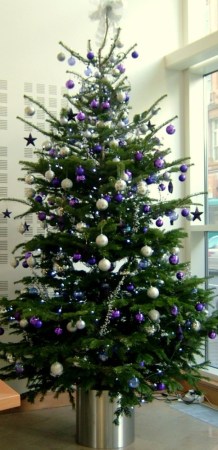
ChristmasTrees20060001

Continue reading “Solstice Comes But Once A Year, Now It’s Here! by Carol P. Christ”

Yom Kippur as Seen (With Respect) by a Pagan By Barbara Ardinger

No matter which or how many gods we believe in, thinking about what we’ve done wrong and how we can set it straight is useful. The Day of Atonement, the Talmud says, “absolves from sins against God, but not from sins against a fellow man unless the pardon of the offended person is secured.”

 Back in the Stone Age, otherwise known as the early 1980s, I had jobs as a technical writer and editor in five different industries, including aerospace and computer development. Hey, I was trained as a Shakespearean scholar, but in those days—pretty much like today—there were almost no jobs in the academy for newly-hatched Ph.D’s. So I tried technical writing. At one of the aerospace jobs, I sat in the “bullpen”—me and nineteen middle-aged white guys—whereas all the other women slaved—on typewriters in that pre-computer age—in the typing pool. There was a major class distinction in that aerospace firm, and I was glad to be with the guys. (Yes, shame on me.) Those were the days of 9 to 5. As far as I’m concerned, that movie is nonfiction. Continue reading “Yom Kippur as Seen (With Respect) by a Pagan By Barbara Ardinger”

How a Woman Became a Goddess: Athena by Laura Loomis

A large part of my fascination with Goddesses has to do with images of female power in cultures that were (and are) overtly patriarchal.  Power has a tricky balance:  when it’s being abused, the struggle is to find a way to overcome the oppressor without becoming one yourself.  But to paraphrase Erica Jong, the best oppressors don’t beat you – they get you to beat yourself.  I have been thinking about this as I watch Democrats hand power over to Republicans ever since coming back into control of the government.

Which brings me to Athena.

Athena may have had her origins as a Cretan or North African mother Goddess.  But by classical times in Greece, she was firmly established as the virgin Goddess of wisdom, household crafts, and war and peace.  It’s said that Zeus, like his father and grandfather before him, feared that his child would be more powerful than himself.  So when Metis was pregnant with Athena, he challenged her to a shape-shifting contest.  She took the form of a fly, and Zeus swallowed her.  (I don’t know why he swallowed that fly…)   Continue reading “How a Woman Became a Goddess: Athena by Laura Loomis”

How to Talk to a Deity* By Barbara Ardinger, Ph.D.

Originally, when ritual was still part of everyday life and everybody talked to gods and goddesses all the time, we spoke to them in everyday words. As time went on and priests assumed more power, however, exalted language and fulsome invocations arose, and pretty soon only the High Priest could speak to God Most High. We common folks were allowed to pray, of course, but the important prayers were uttered by the priests.

During the European Renaissance and all the way up to the 19th-century occult revival, it was thought that the gods spoke Hebrew and Latin. Ceremonial magicians wrote rituals in these languages or made up other highly esoteric languages like crypto-Egyptian, quasi-Sanskrit, and Enochian (the “angelic language” of the Elizabethan Dr. Dee). If you read books on high occultism, you’ll see scripts in these languages. Trying to pronounce the words can be like trying to unscrew the inscrutable.

Fortunately, we discovered that it can be dangerous to invoke an invisible power in a language we can neither understand nor enunciate properly nor improvise in. As anyone who has ever studied a foreign language knows, boners come easily and can be very embarrassing. Worse, some powers may become angry if we mispronounce their names … or we may not get who we intended to call. Like the modern Roman Catholic Church, occultists, ceremonial magicians, and witches have generally adopted the vernacular. Continue reading “How to Talk to a Deity* By Barbara Ardinger, Ph.D.”