From the Archives: “The Czech Tradition of Čarodějnice (Witches).”

Author’s Note: This blog first published on May 14, 2023. Čarodějnice will take place this year on Thursday, April 30, 2026.

This post is a follow-up, in a way, to the post I published here on September 11, 2016, entitled “Continuing Pre-Christian Traditions in the Czech Republic,” and will be a combination photo essay* and elaboration on one of the rituals mentioned in that first post.  On April 30th, I was in the small village where my partner’s family has their summer house.  Yes, that same village that has inspired posts like this.  There, we celebrated Čarodějnice, or Witches. This holiday seems to be related to what is called May Day or Beltane in other countries. What is unique about this tradition isn’t necessarily the májka (May Pole) although it is different than other places May Pole, but the burning of the witch.

Throughout the day, everything is gendered.  The women and girls have certain tasks; the men and boys have too.  The women and girls create and decorate.  First, they create a witch to be burned on a large bonfire; the construction and shape of both can vary.  After creating the witch, the women and girls (although it should be virgins – but no one really follows that tradition) decorate the top of a cut-down, very tall pine tree with strips of brightly colored fabric and crepe paper, tying them on to create what will become vertical streamers blowing in the wind, thus creating what is called a májka.  

Continue reading “From the Archives: “The Czech Tradition of Čarodějnice (Witches).””

The Legacy of Carol P. Christ: Spring in the Era of Pesticides, Global Climate Change, and War

This was originally posted April 6, 2015. Different wars perhaps (or a continuum) but the issues and horrors remain.

This was not a normal winter. It rained and rained and rained. It was grey, grey, grey. Gale force winds blew in from the ocean, not once but many times. Several of my shutters were shattered. An olive tree fell in my garden. I pruned the dead leaves from its branches and had it hauled away. I am still in the process of pulling out a large number of plants that did not survive an unusual number of very cold days.

The soil is so saturated that streams are running where they have never been seen before, the land gives way, and boulders come crashing down the mountainsides. I have decided to remove all of my traditional shutters rather than repair them–as it is becoming clear that no shutters will survive the winds that will blow over our island in the coming years.

They say that we used to have strong gale winds of about 50 miles per hour once a year. Now we have hurricane force winds of 70 miles per hour several times each winter. I once read that Lesbos has the largest number of sunny days of all the Greek islands. We often sit out of doors wearing light jackets in the middle of winter. This year we did not.

My response to the long winter that has only just begun to give way was to stay inside. Though I said I was mildly depressed, I think deep down I was sad and angry.

Changes in the weather are normal and natural phenomena. But it is becoming increasingly evident that the changes we now experiencing are not. Climate experts tell us that because of the carbon we have released into the atmosphere of our planet, we will experience more and more extreme weather conditions.

I have noticed a decline in bees and butterflies in my garden in recent years. So far this spring there are almost none. This is not the result of global climate change, but of our failure to heed the warnings of Rachel Carson to stop poisoning the environment with pesticides.

house martin in flight

The house martins have returned. I hear their liquid chatter as they fly above me. Freesias and irises are about to come into bloom. Pale pink, almost white petaled flowers are opening on the quince tree. Red leaves are budding on the pomegranate trees. The Judas tree burst into deep pink blossom overnight. Spring is a time of rebirth and renewal. This year is no exception.

Spring has also brought an increase in the arrival of refugees fleeing war in Syria and Afghanistan to our island. People discuss what will happen to them, but no one is talking about ending war.

Although spring is coming, it is hard for me to rejoice today. Human beings seem to be hell bent on destroying life. Right now I am holding back tears and screams because I fear that if I let them out, they will not stop.

Postscript: I will find the strength to rejoice in the regeneration of life and to redouble my commitment to save what can be saved–because we must.

In the Belly of Winter: Tending the Sacred Flame by Molly M. Remer

It is February, the belly of winter. We stand in the doorway between worlds, a thin, pale light ahead of us, just beginning to gather itself at the horizon. While life may feel still and inspiration frozen, something in us is listening for the first faint whispers of spring. In earth-centered, neopagan spiritual traditions drawing inspiration from old Celtic holidays, the holiday of Imbolc is on February 1-2. Imbolc is based on an old Irish word that means “in the belly.” One of my favorite reminders to myself at any time of year, not just February, is to cradle myself in the belly of the moment.* To be in the belly reminds us that we need not be focused on arriving or figuring it all out, instead we incubate, we gestate, we draw nourishment from deep within. We do not have to be ready. We are becoming. We are in the belly of winter, and the work of the belly is to hold, to warm, to nourish what is not yet visible.

In the middle of winter as well as in the middle of national crises, international conflict, and climate disaster, the world can feel grim and gray, and like hope and optimism are misplaced or even extinguished. We may feel burned out, used up, or simply too tired to offer anything of value.

Continue reading “In the Belly of Winter: Tending the Sacred Flame by Molly M. Remer”

A Prayer for Winter Solstice, by Molly M. Remer

A Prayer for Solstice
Winter’s Crone,
cave tender,
cauldron keeper,
mother of time,
guide us into stillness,
into a time of deep rest and reflection.
Unwind our knots
and soothe our scurrying,
remind us how to listen,
how to be still,
how to turn inward and know.
Remind us not to fear darkness
for it is a time of necessary patience and growth.
Help us to celebrate
the cycles of change
through which we move,
honoring the fallow times
and the flourishing times
as equally essential
for life.
Bone woman,
great mother of us all,
quiet our wondering
and our worries,
gentle our grief,
and soften our sorrow.
Restore our weary hearts
and renew our spirits
that we might turn
towards the light we carry within
and warm ourselves
by this,
life’s eternal and powerful flame,
knowing that we belong
to this great grand web of incarnation
and all it holds.

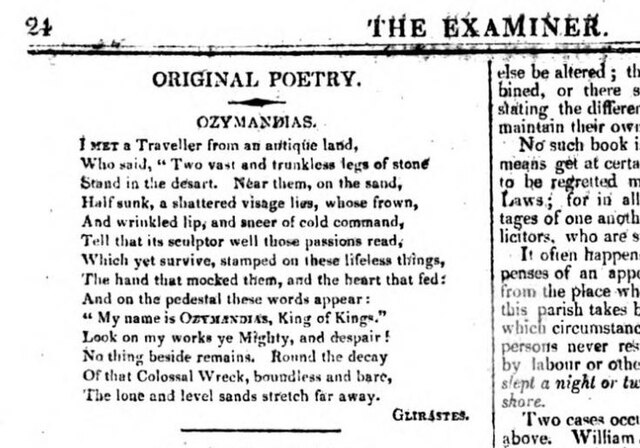
Ozymandias and Other Patriarchal Ego-isms by Janet Maika’i Rudolph

I met a traveller from an antique land
Who said: “Two vast and trunkless legs of stone
Stand in the desert . . . Near them, on the sand,
Half sunk, a shattered visage lies, whose frown,
And wrinkled lip, and sneer of cold command,
Tell that its sculptor well those passions read
Which yet survive, stamped on these lifeless things,
The hand that mocked them, and the heart that fed:
And on the pedestal these words appear:
‘My name is Ozymandias, King of Kings:
Look on my works, ye Mighty, and despair!’
Nothing beside remains. Round the decay
Of that colossal wreck, boundless and bare
The lone and level sands stretch far away.”

Percy Bysshe Shelley 1792 – 1822

There has been discussion of what to name Trump’s ever-expanding ballroom. Some have suggested naming it after Epstein. I would suggest naming it after Ozymandias from Shelley’s poem. 

There is something about building projects that feed to the patriarchal ego.  The Patriarchal ego stands on permanence, largess and if that involves crushing those “below” them, that is just how it is.  Pre-patriarchal pagan systems focus on the cycles of life and are based on an understanding that impermanence is what life is all about. Life works on cyclic movement. The seasons, the moon, the sun, the stars, all is in motion and all presages different aspects of the wheel of life.

Continue reading “Ozymandias and Other Patriarchal Ego-isms by Janet Maika’i Rudolph”

Legacy of Carol P. Christ: Was Ariadne the Most Graceful Bull-leaper of All? Deconstructing and Re-visioning Greek Mythology

carol-christ

This post was originally published on March 3rd, 2014.

Sometimes we think of Greek myth as a pre-patriarchal or less patriarchal alternative to the stories of the Bible. After all, Goddesses appear in Greek myths while they are nearly absent from the Bible. Right?

So far so good, but when we look more closely we can see that Greek myth enshrines patriarchal ideology just as surely as the Bible does.  We are so dazzled by the stories told by the Greeks that we designate them “the origin” of culture. We also have been taught that Greek myths contain “eternal archetypes” of the psyche. I hope the brief “deconstruction” of the myth of Ariadne which follows will begin to “deconstruct” these views as well.

bull leaping ring before 2000 bc phourniAriadne is a pre-Greek word. The “ne” ending is not found in Greek. As the name is attributed to a princess in Greek myth, we might speculate that Ariadne could have been one of the names of the Goddess in ancient Crete. But in Greek myth Ariadne is cast in a drama in which she is a decidedly unattractive heroine.

In the story told by the Greeks, Ariadne falls in love with Theseus, a handsome young man who was sent with 11 other Greek young people to be fed to a monster (who is half man, half bull) known as the Minotuar. The Minotuar is Ariadne’s half brother (see below). Because of her “love” for Theseus, Ariadne helps him to murder her brother.  She then flees with Theseus on his boat.

However, this “love story” does not have a “happy ending” as Theseus abandons Ariadne on a nearby island–long before he arrives home in Athens. Theseus is ever after celebrated as a hero who killed a monster, while Ariadne is just another cast-off female.  Whose story is this? Continue reading “Legacy of Carol P. Christ: Was Ariadne the Most Graceful Bull-leaper of All? Deconstructing and Re-visioning Greek Mythology”

Samhain and the Goddess by Judith Shaw

The wheel of the year is turning us once again toward the dark half of the year. Here in the United States, the bright, shining days of youth and achievement receive the most attention. Death and darkness are rarely honored and often feared.

But the ancient Celts had a completely different view of their place in the world. With a strong belief in reincarnation, the Celts saw death as simply a point of transition in a very long series of lives. People honored the darkness of both night and winter as starting points. In the Celtic worldview a day began at sunset, not sunrise, and the New Year began on Samhain, October 31—the midpoint between Fall Equinox and Winter Solstice.

Samhain, one of the four great fire festivals of Celtic tradition, might have begun long before the Celts arrived in Ireland under the influence of an ancient goddess, Tlachtga (tclak ta). She was most likely from the time of the Fir Bolgs, (fair bolak) the Bronze Age inhabitants of Ireland from the East, and later incorporated into the Celtic pantheon.

Tlachtga--celtic-goddess-painting-by-judith-shaw
Tlachtga, Celtic Goddess of Sun & Lightning, gouache on paper
Continue reading “Samhain and the Goddess by Judith Shaw”

Threshold Time, by Molly M. Remer

Step by step,
we make our way.
Breath by breath,
we choose.
Day by day,
we see where we are.
Let us remember
that we do not really finish anything,
we tumble with the turning
which is right where we belong.

It is now
in this liminal space
between the cauldron
and the cave,
as obligation struggles
to come roaring back
into center,
that we sense what we truly need
whispering beneath the surface
of all that clamors to co-opt our time
and all that howls
to claim our attention.
Stand steady.
Inhabit your own wholeness.
Cast a one word
spell of power: return.
Step into the sacred
right where you are.
Re-collect yourself.
Reclaim your right
to your own life.
Defend your edges.
Give clarity space
to crystallize
and your own knowing
space to emerge.
It is vital,
this work of reclamation.
Hold it holy.
Let the knots unravel.
Set yourself free.

Continue reading “Threshold Time, by Molly M. Remer”

Legacy Of Carol P. Christ: The Great Commandment for Women: Love and Care for Yourself as You Love and Care for Others

carol-christ

This post was originally published on Feb. 3rd, 2014.

A rabbi known as Jesus of Nazareth taught that you should  “love God with all your heart and your neighbor as yourself.”  Charles Hartshorne, philosopher of relationship and a twentieth century advocate of the “two great commandments,” added that it should be understood that this means that God wants you to love yourself too.

I quote Hartshorne’s midrash on the great teaching often because, sadly, too many women—and some men too–have been taught to love their neighbors at the expense of themselves, to care for others, but not to care as much for themselves.  Continue reading “Legacy Of Carol P. Christ: The Great Commandment for Women: Love and Care for Yourself as You Love and Care for Others”

Merrows: The Enchanting Mermaids of Celtic Mythology by Judith Shaw

Mermaids have captivated our imaginations worldwide for thousands of years. Across cultures, mermaids are depicted in differing ways—as a dangerous seductresses like the Greek sirens, or as one who could grant immortality like the Japanese ningyo.  

Celtic Ireland, with its abundance of fairies and magical beings has its own kind of mermaid, the Merrow. This term derives from the Gaelic word, “murúch,” which translates as “sea maiden.”

A Merrow‘s Longing by Judith Shaw, gouache on paper, 12″x18″
Continue reading “Merrows: The Enchanting Mermaids of Celtic Mythology by Judith Shaw”