

Lucy Pick’s Pilgrimage by Mary Sharratt

mary sharrattIn medieval Europe, religious devotion provided an alternate narrative for women’s lives in a male-dominated culture. Defiant women who stood up for themselves in the face of rape, incest, and murder were hailed as virgin martyrs. Religious vocations, such as becoming a nun or a beguine, provided a viable and esteemed alternative to forced marriage.

Even women who were married with children could escape their domestic entanglements and conjugal duties by taking an oath of celibacy as 15th century English mystic Margery Kempe did, leaving behind her husband and 14 children to go on pilgrimage to Santiago de Compostela, Rome, and Jerusalem. Her Book of Margery Kempe, the tale of her travels, reads like a kind of late medieval Eat, Pray, Love and is the first autobiography written in the English language.

Though it might seem surprising to us today, women of the European Middle Ages possessed more rights and freedoms than their descendants in the Renaissance, Early Modern, and Victorian ages. Women worked as craftspeople and artisans and were members of the guilds, alongside men. Monarchs such as Eleanor of Aquitaine were global power brokers while religious leaders such as Hildegard von Bingen devoted their lives to intellectual and artistic pursuits, composing music and writing weighty philosophical and theological books that are still being discussed today.
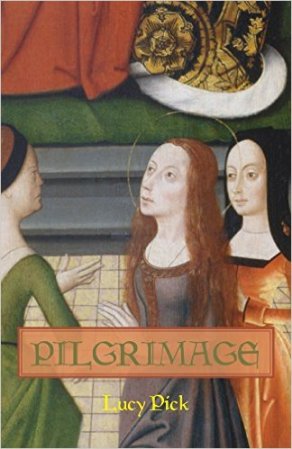
lucy pick pilgrimageThe cover of academic historian Lucy Pick’s novel Pilgrimage shows details from a painted altarpiece dedicated to Saint Godeleva. A victim of forced marriage who was strangled by order of her husband, this legendary saint was a patron of abused wives. Lucy Pick’s novel concerns the saint’s daughter, the blind Gebirga of Gistel in Flanders. What would it be like to be the daughter of a martyred saint whose miracles cured everyone except you?

Considered unmarriageable due to her blindness, Gebirga rejects life as a nun in an abbey dedicated to her sainted mother. Instead, in a bid for freedom, she embarks on a pilgrimage to Santiago de Compostela in faraway Iberia, an epic journey for that time. She serves as the companion to a highly strung teenage noblewoman and is charged with delivering the girl to the Spanish king she is contracted to marry. During their travels, Gebirga must use all her intelligence and resourcefulness to protect herself and her young charge from the considerable dangers and political intrigues they face on their way. Though they encounter hardship and heartbreak, this is a pilgrimage of miracles, healing, and redemption.

Lucy Pick, the Director of Undergraduate Studies and Senior Lecturer at the University of Chicago’s Divinity School, has infused her novel with impeccable research into the lives of medieval women. This novel is a medievalist’s delight and fans of the late Margaret Frazer will devour this book.

Mary Sharratt’s book Illuminations: A Novel of Hildegard von Bingen, won the 2013 Nautilus Gold Award, Better Books for a Better World. Her forthcoming novel, The Dark Lady’s Mask: A Novel of Shakespeare’s Muse, tells the tale of the groundbreaking Renaissance women poet Aemilia Bassano Lanier and will be published by Houghton Mifflin Harcourt in April 2016. Visit Mary’s website.


Life Begins at 42: Saint Hildegard’s Guide to Becoming a Midlife Powerfrau

hildegard statue appletrees

We live in a youth-obsessed culture. The cosmetic industry pushes wrinkle creams and hair dye on us while celebrities resort to Botox and surgery to preserve an illusion of eternal girlhood. We live longer than ever before, yet advancing age, once a mark of honour, has become a source of shame.

But what happens when women embrace midlife as an inner awakening and call to power?

One such woman was Saint Hildegard von Bingen (1098-1179), powerfrau and late bloomer par excellence.

Her youth was dire. Offered to the Church at the age of eight, she was entombed in an anchorage. Though she had been haunted by luminous visions since earliest childhood, she didn’t dare speak of them. Her entire existence was bent on silent submission to her superior, Jutta von Sponheim, an ascetic whose regime of fasting and mortification of the flesh eventually killed her.

Only after Jutta’s demise could Hildegard step out of the shadows and carve out a spiritual life based not on suffering but on celebrating life in all its burgeoning green beauty. Even so she might have remained obscure, lost to history.

But when she was forty-two, everything changed.

“When I was forty-two years and seven months old,” she wrote, “Heaven was opened and a fiery light of exceeding brilliance came and permeated my whole brain, and inflamed my whole heart and my whole breast, not like a burning but like a warming flame, as the sun warms anything its rays touch.”

Dazzling visionary experiences descended upon Hildegard, along with the divine summons to write and speak of her revelations. Reluctantly at first she embarked on her first book of theology, Scivias, or Know the Ways. After putting quill to parchment, she could never go back.

Hildegard went on to found two monasteries, go on four preaching tours, compose an entire corpus of sacred music, and write nine books on subjects as diverse as cosmology, botany, medicine, and human sexuality, thus leaving her indelible mark on history.

Most of us believe we live in a more enlightened age than Hildegard’s—after all, children are no longer offered as tithes to monasteries. Yet many young women find themselves in modern and secular forms of servitude—dead end relationships, soul-crippling jobs, credit card debt, a life of junk food and junk television—all the sadness and waste of an unexamined life.

We don’t need to be visionaries to break free. We just need to remember who we are, that we all serve some higher purpose. Each of us has our own unique gift to give the world.

In youth, it’s easy to be beguiled by the glamour of the surface of things—if we get the right job, the right partner, the right clothes we’ll be happy forever.

But in midlife we are gifted with the maturity to see through the false scripts consumer society hands to us. After a certain age we can see just how absurd it is to kill ourselves to emulate airbrushed supermodels. We realize that the greatest lover in the world can’t fulfill us until we are at peace with ourselves. And so we can let ourselves go. Paint the pictures we’ve always longed to paint. Learn French and travel the world. Dance under the stars. Play the saxophone. Offer our own song to the vast symphony of life.

Remember, it’s never too early or too late to embrace your inner powerfrau.

Mary Sharratt’s book Illuminations: A Novel of Hildegard von Bingen won the 2013 Nautilus Gold Award: Better Books for a Better World and was a 2012 Kirkus Book of the Year. Her forthcoming novel, The Dark Lady’s Mask, will be published by Houghton MIfflin Harcourt in Spring 2016. Visit her website.

Hildegard of Bingen to be Canonized and Named Doctor of the Church By Gina Messina-Dysert

Known as the “Sybil of the Rhine,” Hildegard of Bingen was a remarkable woman who produced multiple visionary writings and major theological works throughout her life (1098-1179).  During a time period when women received little respect, Hildegard was consulted by religious and political leaders and advised popes and kings.  Her contributions are many and include founding a convent, composing music, and writing about the medicinal uses of natural objects such as plants, trees, animals, and stones.

It was recently announced that Hildegard of Bingen will be canonized and declared a doctor of the church.  Hearing this I was among the many who were surprised by the news since I had assumed that Hildegard was already canonized, particularly since she has been called St. Hildegard and has had a feast day on September 17th since 1940 (although only within the Benedictine order in Germany).  Nonetheless, I have recognized Hildegard as a crucial woman in Christian history – as crucial as St. Catherine of Siena, St. Teresa of Avila, and St. Therese of Lisieux who have already been canonized.  So why the delay in granting this honor to Hildegard of Bingen? Continue reading “Hildegard of Bingen to be Canonized and Named Doctor of the Church By Gina Messina-Dysert”