

 In a land not too far away there once lived a widow who was so poor and who worked so hard day and night to make a bare living that she had almost no time to teach her daughter the things a girl needs to know to be a proper wife. The girl, whose name was Perdita, had learned how to do a few useful things around the house, but when she laid the fire she always mixed green wood with the dry, when she made the soup she always forgot the salt and pepper, and when she swept she inevitably forgot to sweep under the bed. When she sewed she always pricked her fingers and left little red spots on the fabric, and when she spun she always made huge knots and horrible tangles in the new thread. Although she wasn’t very good at these important homely tasks, she had somehow learned to read and study numbers and she had even learned about Panglossian optimism. Her parents had no idea how this learning had come to her, unless it had something to do with the scholars who regularly passed through the town and with whom Perdita spent a lot of time. In her own opinion, the girl more than made up for her lack of useful skills with her brilliant mind and quick tongue…not to mention her beauty.
One day, although her mother had ordered her to finish the washing and hang the clothes in the sun to dry, Perdita left them soaking in the tub and went out and about with her mother’s second husband. On the road they happened to meet the Queen’s eldest Nephew. Now since the Queen had borne no daughters and was now too old to do so, everyone knew that one of her Nephews would inherit the throne when she died. As soon as he spotted the young man, Perdita’s stepfather saw an opportunity.
“Here’s your opportunity,” he murmured to the girl. “Do what you can to attract this fellow. If you do, things will go well for you and your mother.”
Perdita saw an opportunity, too. An opportunity to raise herself socially and find a life that was not so filled with laundry and other mind-numbing hard work. So she tossed her curls and swung her hips, she gazed up at the Royal Nephew, and soon she had his attention, for this young nobleman was interested in the things that have always interested the upper-class men. During their ensuing conversation, Perdita said coyly, “I may have a poor mother, but I’m quite clever, you know. I can read and write. I can cook and clean. I can sew and spin.”
“I’m interested in girls who can do useful things,” said the Queen’s Nephew. “Are you good at all things you do?”
“Oh, yes, I am very, very good,” the girl replied demurely. “I have a great many talents.”
“And,” said her mother’s second husband, “some of this girl’s talents no one has uncovered yet.”
“I see,” said the young man with a wink. “And may I learn what your hidden talents are, my dear?”
“Why,” said Perdita with a pretty blush, “why I can…I can—”
“She can spin straw into gold,” said the stepfather. “Who do you know who can do that?”
“No one at all.” The Royal Nephew took Perdita’s hand. “It’s well known that no man can spin straw into gold.”
“And she works very fast,” said the stepfather. “See how soft her hands are! Her fingers are as nimble as my own. Even though we’re not even related by blood, I have taught her all she knows!”
“Indeed,” the Royal Nephew said, “nimble…” And after he thought for a moment, he added, “My dear, would you like to come to my Aunt’s palace with me and show me—show us your talents?”
So with an unnecessary push from her stepfather, Perdita, who was sure she would be moving into the best of all possible worlds, went to the palace with the Queen’s Nephew. But the Queen was not there, for she was visiting one of her Sister Queens in a nearby land. When the Royal Nephew asked Perdita to show him how she spun straw into gold, she batted her eyelashes at him and, remembering what she’d seen other girls do, shrugged her linen bodice just a little bit off one shoulder. A little while later, when the Royal Nephew asked again about spinning straw into gold, she shrugged her bodice a little bit off her other shoulder. When he asked a third time about spinning straw into gold, however, she finally understood that he expected a reply.
She had to think fast. “Oh,” she said disingenuously, “oh, I only do it at night, when the moon is full, and I can never do it if anyone is watching. I can spin straw into gold only when I am left absolutely alone with my work.” She was feeling quite sure that the Royal Nephew would never leave her alone, especially with her soft linen bodice falling off both shoulders.
But Perdita hadn’t noticed that the moon was full that very night, and when the Royal Nephew offered to let her stay in the palace, she was loath to refuse the invitation. I’ll think of a way out of this predicament, she said to herself. I always do, for I’m very clever.
The young nobleman was keenly interested in gold, as nobles always are, and so he ordered a room at the far, far end of the farthest corridor to be filled one third full with straw. Then he got his aunt’s best spinning wheel and put that in the room, too.
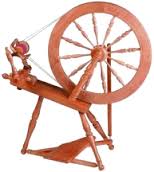 “Here is a fine and private room,” he said to Perdita, “and I guarantee that no one will disturb you. Just spend the night here and show me how you can spin straw into gold, and I’ll give you a lovely reward in the morning.” And he winked at her.
What could the girl do? She watched the Royal Nephew close the door. She heard the key turn in the lock. She began to walk about the room. At last she sat down beside the wheel. But she didn’t have the least idea about how to spin straw into gold, for she couldn’t even spin flax into decent linen thread without getting huge knots and horrible tangles in it. She began to cry. “I’m lost!” she wailed. “No one is here to advise me. No scholar I’ve ever met has considered this situation. No man can spin straw into gold, but I can’t, either. Oh, woe is me.”
“Well now.”
Suddenly she heard a voice, and when she peeked between her fingers, she saw a little man wearing a peaked green hat and a long brown jacket and wide brown trousers. He had a long white beard and big strong hands.
“Good evening,” he said. “Why are you crying?”
“I’m supposed to spin straw into gold, but I don’t know how.”
Continue reading “No Man Can Spin Gold (Part 1) by Barbara Ardinger”


 You know what?
 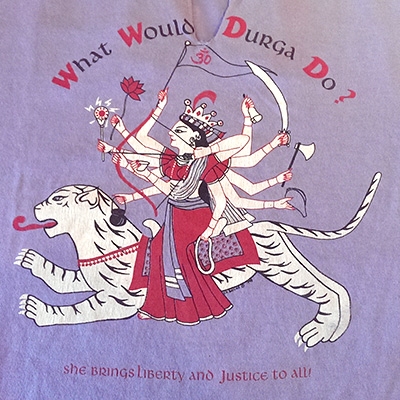 It’s one of my favorite T-shirts. Every time I wear it, people who know who Durga is comment. So do some people who don’t know who the Hindu goddess is.
 Once upon a time very close to right now and in a realm way too much like our world there lived the Sisterhood of Faeries. We remember their names. There’s the Faerie Queen, Belphoebe, who spent much of her time composing epic poetry, which her sister Gloriana wrote down for her. Other fairies were Titania (who ran the orphan asylum for abandoned children), Carabosse (whose job it was occasionally to Speak Firmly to children, both fey and human, who were behaving badly), Fata (an astrologist), Morgan le Fay (no one was ever quite sure what she did), and Tinkerbell (who especially loved to play with well-behaved children). Most of the fairies worked as fairy goodmothers and guided their special human charges through their complicated human lives. A few of the younger fairies collected teeth. It was a rule in the Realm of Faerie that fairies were forbidden to marry human men, though they could (and did) of course flirt and dally with them.

 Feminism and Religion