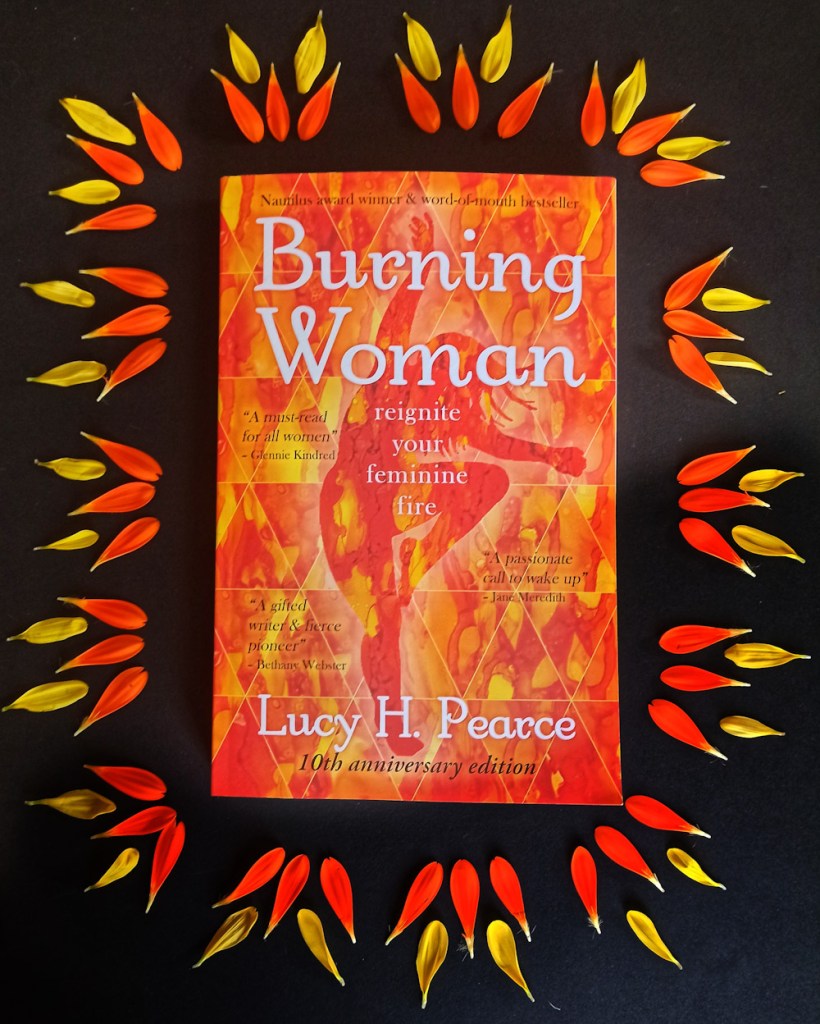
Burning Woman, by Lucy H. Pearce, 10th Anniversary Edition, Book Review by Beth Bartlett

As someone who came into feminism in the late 1970s early 1980s, reading Lucy Pearce’s Burning Woman was re-entering the power and promise of women-centered feminism – the heyday of Adrienne Rich, Audre Lorde, Mary Daly, Clarissa Pinkola Estes, Andrea Dworkin, Charlotte Bunch, China Galland, Riane Eisler, Carol Christ, Gloria Anzaldúa, Susan Griffin, Starhawk, Sara Ruddick.[i]  It was the era of reclaiming the Feminine from its patriarchal definitions and women defining themselves outside of patriarchy – celebrating women’s spirituality, art, music, language, bodies, sexuality, birthing, voices, and power – when feminism was about transforming patriarchy rather than fitting into it — when Meg Christian proudly sang Betsy Rose’s “Glad to Be a Woman.” 

And then everything changed.  Just as women were coming into our own beyond patriarchy, women-centered feminism came to a halt due to pressures both from within feminism and without – with a whole school of deconstructionist feminists[ii] now critiquing women-defined women as “essentialists,” and moving back to minimizing rather than maximizing the differences between the sexes,[iii] with an emphasis on abolishing the gender binary, welcoming trans and non-binary folk, and questioning the whole concept of “women.”  Indeed, one of my Women’s Studies, now Gender Studies, students asked me privately if it was okay to call herself a “woman” because the term had become so forbidden among many of the students.  At this time, feminist theorist Nancy Hartsock raised the important question, “Why is that just at the moment when so many of us who have been silenced begin to demand the right to name ourselves, to act as subjects rather than objects of history, that just then the concept of subjecthood becomes problematic?”[iv]

Continue reading “Burning Woman, by Lucy H. Pearce, 10th Anniversary Edition, Book Review by Beth Bartlett”

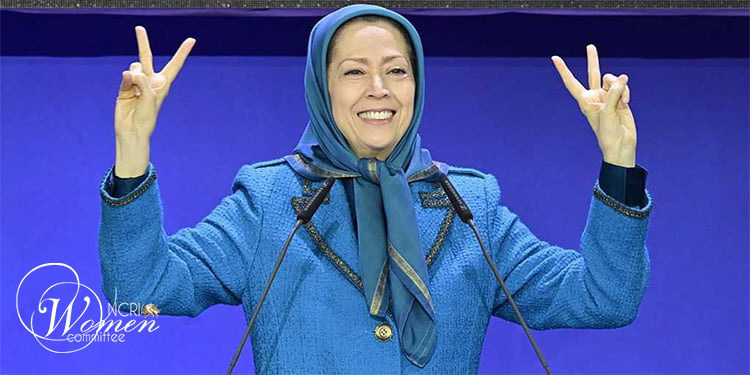
Maryam Rajavi by Yalda Roshan

My name is Yalda. I am a woman from the Iranian resistance who, for many years, has fought for women’s equality and worked to amplify the voices of Iranian women around the world. Today, I want to share with you the source of inspiration and motivation that has guided my path.

Covering every aspect of Maryam Rajavi’s life and thought in one article is a challenge, so today I will focus only on what has personally influenced me: her perspective on women.

She herself is a woman who has spent decades fighting against two dictatorships—the Shah’s and the misogynistic clerical regime—and believes that women can change the world. A brief overview of her biography: she was born on December 4, 1953, in Tehran and is a metallurgical engineer from Sharif University of Technology in Tehran. From her teenage years, she embarked on the path of struggle, learning from action rather than words.

Continue reading “Maryam Rajavi by Yalda Roshan”

From the Archives: Passover and the Exodus: A Feminist Reflection on Action, Hope, and Legacy by Michele Stopera Freyhauf

This was originally posted on March 26, 2015

Freyhauf, Durham, Hahn Loeser, John CarrollLast week, Supreme Court Justice Ruth Bader Ginsburg was in the news again, but not for reasons you would expect.  She, along with Rabbi Lauren Holtzblatt, penned a feminist essay about the Exodus title “The Heroic and Visionary Women of Passover.”  Finding this story was exciting, especially because I am so drawn to the Exodus story (the intrigue and curiosity of which caused me to return to school and study, as one of my main areas of focus, Hebrew Scriptures – along with Archaeology and Ancient Near Eastern History).  Now women’s roles in this story are being elevated thanks to Justice Ruth Bader Ginsburg and Rabbi Holtzblatt.

Before I discuss the message and the importance this message brings, I think it is important to know an important fact about Justice Ginsburg.  Ginsburg is not observant, but does embrace her Jewish identity.  When her mother died, she was excludedRuth_Bader_Ginsburg_official_portrait[1] from the mourner’s minyan because she was a woman; an event in Judaism that is meant to comfort the mourner, brings a sense of community, and is considered obligatory – a means of honoring our mother/father.  This important event left an impression and sent a loud message that inspired and influenced her career path – she did not count – she had no voice – she had no authority to speak.  No wonder her life and career focuses so much on women’s rights and equality.

As many of us know, the story of Exodus is focused on two things 1) Moses and 2) liberation from the bonds of servitude and enslavement; women are rarely discussed.  In the essay co-authored by Ginsberg, women are described as playing a crucial role in defying the orders of Pharaoh and helping to bring light to a world in darkness.  In the Exodus event, God had partners – five brave women are the first among them, according to Ginsburg and Holtzblatt.  These women are: Continue reading “From the Archives: Passover and the Exodus: A Feminist Reflection on Action, Hope, and Legacy by Michele Stopera Freyhauf”

Structural Inequality and State-Sanctioned Oppression of Women by NCRI

Moderator’s Note: This post has been posted in cooperation with the NCRI women’s committee. NCRI stands for the National Council of Resistance of Iran. You can learn more information as well as see this original article by clicking by link below. A description of their Council can be found at the end of this post. As an introduction, a NCRI representative sent us the following statement about the war. It was originally posted on March 11th and we are reposting it because of its importance.

 STATEMENT: I would like to mention that the Iranian Resistance — which established a government-in-exile years ago — has long advocated a clear position: no to war, no to appeasement of the mullahs, but a third option — regime change by the Iranian people and their organized resistance.

Mrs. Maryam Rajavi, the President-elect of the Resistance and an internationally recognized figure, has outlined this vision in her Ten-Point Plan. I am sharing the link below, as it reflects the roadmap of the Iranian Resistance. Maryam Rajavi’s Ten-Point Plan for the future of Iran

Unfortunately, behind-the-scenes dealings and political interests have often ignored this democratic alternative. In recent days, a provisional government framework has also been announced as part of this process. Announcement of the Provisional Government by the National Council of Resistance of Iran (NCRI)

Continue reading “Structural Inequality and State-Sanctioned Oppression of Women by NCRI”

Annual Report 2026: From Protests, to Uprising, and the Role of Iranian Women

On the eve of International Women’s Day 2026, the NCRI Women’s Committee presents its Annual Report 2026, offering a recap of events in 2025 as related to women’s rights in Iran.

Moderator’s Note: This post has been brought to you in cooperation with the NCRI women’s committee. NCRI stands for the National Council of Resistance of Iran. You can learn more information as well as see this original article by clicking by link below. A description of their Council can be found at the end of this post. As an introduction, a NCRI representative sent us the following statement about the war.

 STATEMENT: I would like to mention that the Iranian Resistance — which established a government-in-exile years ago — has long advocated a clear position: no to war, no to appeasement of the mullahs, but a third option — regime change by the Iranian people and their organized resistance.

Mrs. Maryam Rajavi, the President-elect of the Resistance and an internationally recognized figure, has outlined this vision in her Ten-Point Plan. I am sharing the link below, as it reflects the roadmap of the Iranian Resistance. Maryam Rajavi’s Ten-Point Plan for the future of Iran

Unfortunately, behind-the-scenes dealings and political interests have often ignored this democratic alternative. In recent days, a provisional government framework has also been announced as part of this process. Announcement of the Provisional Government by the National Council of Resistance of Iran (NCRI)

In any case, we are prepared to determine the future of our own country. We kindly ask you to help reflect the voice of the Iranian Resistance, a movement notably led by women ,so that this alternative can be more widely heard.

AND NOW FOR THE ANNUAL REPORT

Continue reading “Annual Report 2026: From Protests, to Uprising, and the Role of Iranian Women”

Visibility Matters: Where are the Women? by Maria Dintino

Moderator’s Note: This piece is in co-operation with The Nasty Women Writers Project, a site dedicated to highlighting and amplifying the voices and visions of powerful women. The site was founded by sisters Theresa and Maria Dintino. To quote Theresa, “by doing this work we are expanding our own writer’s web for nourishment and support.” This was originally posted on their site on March 4, 2025. You can see more of their posts here. 

Visibility Matters: Where are the Women?

Out of forty monuments along the National Mall in Washington, DC, none celebrate women and their contribution to American history.

One of our NWW [Nasty Women Writers] categories is Breaking the Bronze Ceiling where we track the effort to increase the number of monuments dedicated to real women in public spaces.

I’ve made many trips to Washington, DC, trekking the National Mall specifically to visit monuments. Why didn’t I notice women were missing?  Am I so conditioned to not seeing women recognized and honored at the highest levels that I don’t even expect it or question their absence?

I felt ignorant and complicit.

It’s 2025 and there is not a single monument to honor women on our National Mall, a place that “draws roughly 36 million visitors a year, more than Yosemite, Yellowstone and the Grand Canyon combined”(Schuessler).

It’s absurd and sadly, speaks volumes.

Continue reading “Visibility Matters: Where are the Women? by Maria Dintino”

Sex Radical. A new film by Andy Kirshner; film discussion by Janet Rudolph

At the bottom of this post you will find information for a free streaming of the film. 

Sex Radical, Title Image

We are witnessing now in real time what happens when the full weight of the Federal Government turns its attentions and goes after individuals and even companies with the intent to squash dissent, intimidate and punish dissenters. This is perhaps most prominent among the immigrant population and those who the administration have been targeted with the legal system. But before there was Mahmoud Khalil, CBS, The Washington Post, UC Berkeley and all the others who have been hounded by government, there was Ida Craddock who faced the full weight of a government that turned its sights on her.

Continue reading “Sex Radical. A new film by Andy Kirshner; film discussion by Janet Rudolph”

From the Archives: Censored Angel: Anthony Comstock’s Nemesis. A Novel by Joan Koster

This was originally posted on October 10, 2024.

Moderator’s Note: With the Trump administration getting closer and closer to re-establishing the Comstock Laws in their efforts to stop all abortions in the United States, we felt it important to repost this story. It is about Ida Craddock, her life and her efforts to stand against Anthony Comstock. Joan Koster wrote a powerful book about her. This post today is also a prelude to tomorrow’s post which will discuss a new movie Sex Radical that will be premiering this month about Ida Craddock’s life.

“I would lay down my life for the cause of sex reform, but I don’t want to be swept away. A useless sacrifice.” Ida C. Craddock, Letter to Edward Bond Foote, June 6, 1898

In 1882, Ida C. Craddock applied to the all-male undergraduate school of University of Pennsylvania. With the highest results on the entrance tests, the faculty voted to admit her. But her admission was rejected by the Board of Trustees, who said the university was not suitably prepared for a female. (U of P only became co-ed in 1974)

With her aspirations blocked, Ida left home determined to leave her mark on women’s lives by studying and writing about Female Sex Worship in early cultures. At the time, little information was available to women about sexual relations. To do her research, Ida resorted to having male friends take books forbidden to females, such as the Karma Sutra, out of the library for her.

An unmarried woman, she turned to spirituality and the practice of yoga, a newly introduced practice to the American public at the time, as a way to learn about sex. In her journals, she describes her interaction with angels from the borderlands, and in particular, her sexual experiences with Soph, her angel husband through what was likely tantric sex.

Continue reading “From the Archives: Censored Angel: Anthony Comstock’s Nemesis. A Novel by Joan Koster”

This is the time for good trouble by Marie Cartier

Marie Cartier performing this rant poem at the John Lewis Good Trouble Lives On Rally in Lakewood, CA July 17th. Photo by Mel Saywell

This I can guarantee you: there will come a day when it seems you cannot stop crying.

When will that day come? Today it came for me reading The Atlantic while I drank my morning coffee:

This is what they are reporting: the Trump administration has given the order to incinerate food instead of sending it to people abroad who need it. Nearly 500 metric tons of emergency food—enough to feed about 1.5 million children for a week—are set to expire tomorrow…the food, meant for children in Afghanistan and Pakistan, will be ash.

There will come a day.

And here we are in these United States with people in hiding, speaking of food. Why are they hiding? They are hiding from immigration officials and some of us are sending those people in hiding – food. Toiletries. Macaroni and cheese boxes line my grocery cart,

In these United States, we are building more prisons. And I read the detention center known as Alligator Alcatraz puts thirty-two people in a cage. Each person/prisoner costs the United States taxpayer approximately $275 a day. I guess I mean not prisoner, immigration detainee.

Continue reading “This is the time for good trouble by Marie Cartier”

Dyke March, Long Beach, CA 2025 by Marie Cartier

This year it is more important than ever to celebrate LGBTQ+ PRIDE. Here’s a taste of Long Beach, CA’s Dyke March. I was the emcee for the rally. My wife, Kimberly Esslinger was on the organizing committee and also created the first “Dykes After Dark” event– a poetry reading open mic– last year the poetry event was a pop-up with 15 people. This year the coffeehouse was filled to the max- 80 people or so, and the Dyke March itself had over 400. This is the thing: we need places to gather. And if you build it, we will come.

Continue reading “Dyke March, Long Beach, CA 2025 by Marie Cartier”