


A lifetime of research has convinced me that the women’s ritual dances and costumes of Greece are living remnants of ancient Old European Goddess traditions. In previous posts on FAR I have written about these dances and embroideries, as well as the Midwives’ day rituals which honour the wise women, and the healing effects the women’s circle dances can have. All of these threads came together again in my most recent trip to Thrace.
Today trisected into Greek, Bulgarian and Turkish parts, Thrace is a wild landscape of mountains, forests, rivers and fertile fields. Less than one hundred years ago Greeks, Slavs, Turks, Pomaks, Gagaouzides and other ethnic groups lived and mingled freely throughout the whole area, and although the traumatic wars of the 20th century precipitated a huge upheaval of refugee movement and new settlement, Thrace is still home to a great variety of different peoples here who have kept their customs alive.
In Greece, Thrace is the most northeasterly region, and Evros is the very topmost bit of it, rising up like a thumb between Turkey and Bulgaria. I started visiting the villages of Evros some years ago and have been back many times. When friends invited me to celebrate my birthday there recently I jumped at the chance. All the villages we went to are Greek Orthodox, with visible elements in costume and culture – such as the Goddess embroideries – which survive from pre-Christian times.
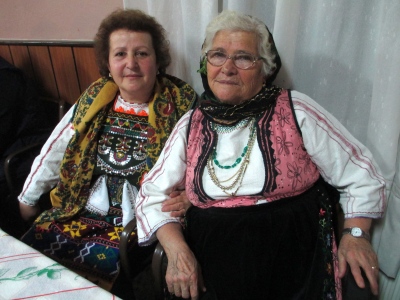
We started off in Pentalofos, my favourite village, with music, dance, song, feasting, and wonderful grandmothers in splendid traditional costumes. In this village they still spin, weave, sew and embroider their festive dress by hand. I have my own costume from Pentalofos like the one Kyria Koula is wearing (on the left), made for me by her, Kyria Loulouda and other women of the village.
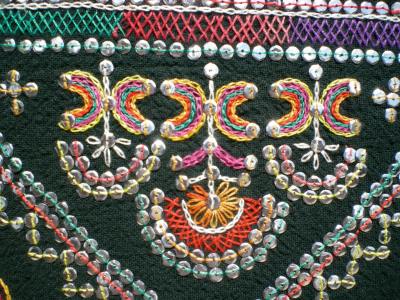
The bodice features a triple butterfly design, connected to the ancient labyris / double axe. It is also a symbol of transformation, not least the transformation of individual women – through dance, song and ritual dress – into manifestations of radiant feminine strength and beauty, moving beyond their personal identity and concerns in order to embody a larger power. This phenomenon is represented by the image of a woman with wings, easily discerned in the butterfly design here and in other villages.
Other villages have their own version of the Thracian women’s costume, as in Doxapara where we went next:
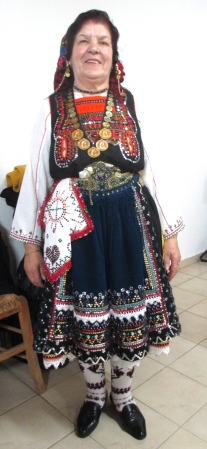
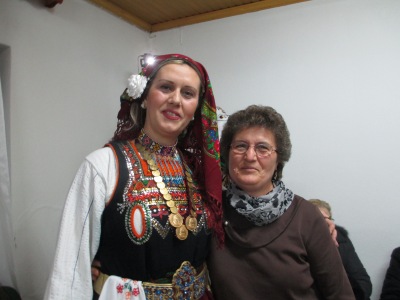
Chryssa, on the left, wears the costume made by her mother, on the right.
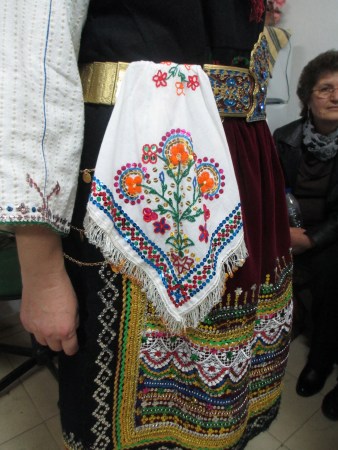
Chryssa’s handkerchief is embroidered with a flamboyant sun-headed Goddess/flower motif. An ancient V-shaped motif of spiral horns, or perhaps a pair of wings, appears on her sleeve in red. This motif is more discreet, but its central location affirms its importance. Women’s hands – which created all this and much more – were considered holy and worthy of protection. As on the handkerchief, Goddess figures are often depicted with radiant, extra-large or winglike hands.
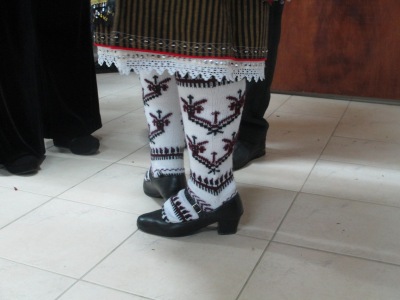
Knitted socks in Doxapara depict winged Goddess figures in red, black and white.
We celebrated my birthday eve in a little taverna in Oinoi, a village of Gagaouzides, Turkish-speaking Greek Christians from Bulgaria. Friends (and friends of friends) needed no persuading to dance up a storm.
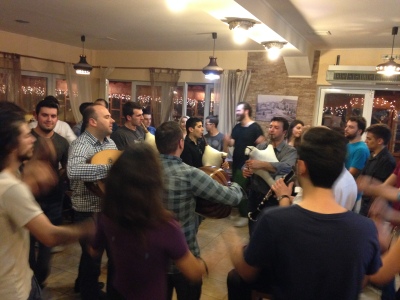
Music was provided by gaidas (bagpipes), laoutos (lutes), clarinets, violin and doumberleki, not to mention everyone singing along. The ‘Happy Birthday’ songs, both English and Greek versions, sounded fantastic with this orchestra.
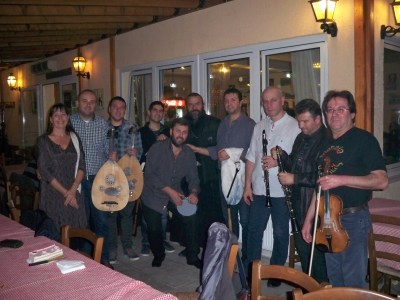
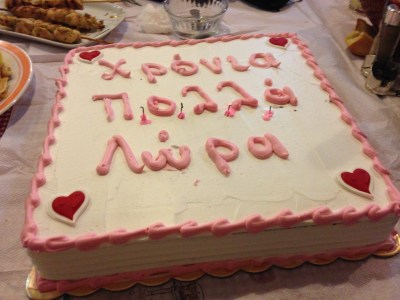
Hospitality is a sacred obligation in Greece, as in many parts of the Balkans, and dancing must be accompanied by feasting. My birthday cake weighed 3 kilos and fed 75 people. ‘Many years, Laura’!
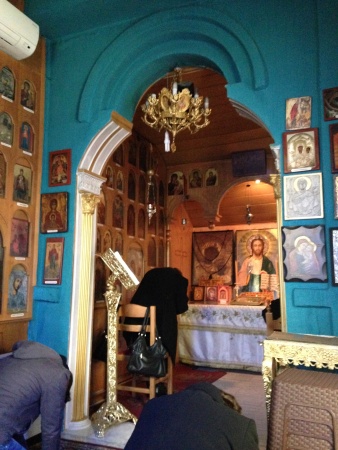
On the morning of my birthday, while everyone else was still asleep, I went to a favourite church in Kleissos, which has a little side chapel filled with 144 icons of the Virgin Mary, whom Greeks call the All-Holy One, the Panayia. As you see, people pray to her very fervently here. The images are copies of famous miraculous icons from other places like Tinos and Kythira. The Panayia of Kleissos is also believed to be a miracle-working icon; I can attest to its power from past experience.
Later we proceeded to Ambelakia, a village I had not visited before.
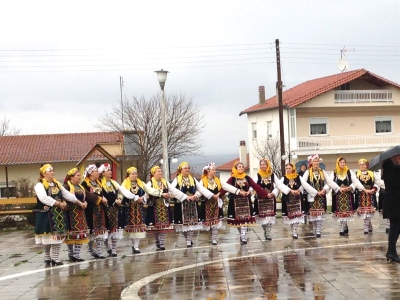
These women are Marides, an ancient Thracian tribe. Their costumes feature many Goddess embroideries and, on their socks, the recurring motif of the wild bee. Priestesses in Thrace and other areas were once known as bees (mélisses).
The women here told me about the ancient festival they keep, called ‘Gynaikokrateía’, Gynocracy or Women’s Rule. It is related to Thracian Midwives’ Day celebrations (described in a previous post) and falls on the same day, January 8th. On this day, they told me, gender and power roles are reversed and women take over the town hall, village square, cafes and other male-dominated public spaces. They exact toll payments from passing vehicles, which they use to buy wine. The women’s unrestrained merriment and public drunkenness, unthinkable on the other days of the year, is combined with ribald and satirical skits lambasting men’s misbehaviour. This sharp commentary is remembered, laughed over and talked about for months afterwards, thus providing an apparently innocent, yet effective, social deterrent to abuses of power.
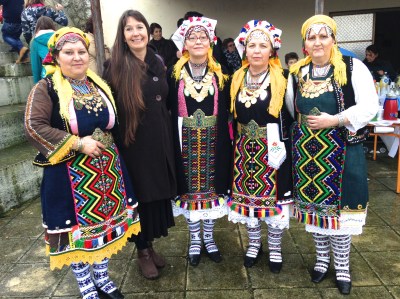
Marides women’s costumes can be ‘read’ as a treasury of ancient women’s wisdom hidden in plain view, an open secret for those with eyes to see. Yellow headscarves with long fringes resemble both sun and rain, life-giving elements of agriculture both originally identified with the Goddess. Woven aprons illustrate flowing life force, womb energy and women’s awesome creative power, with Goddess/Tree of Life figures inside the central rhombs.
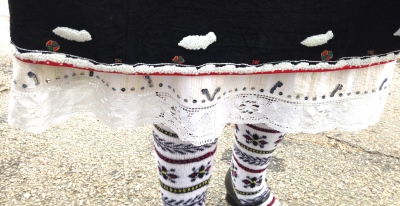
Spiral horns reappear on the hem of the underdress. Sacred symbols on this spot simultaneously pronounce and protect the power of what lies directly above. ‘Doves’ encircle the hem of the black overdress; ‘bees’ adorn the socks.
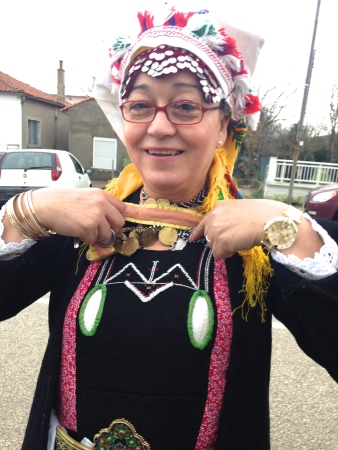
In the central place on the heart of the bodice: the winged Goddess motif, a sign of the dancing priestess and a key Thracian symbol for thousands of years. This powerful image is usually invisible, hidden under scarf fringes, beaded necklaces and garlands of gold coins, but the women revealed it to me because I knew it was there and asked to see it.
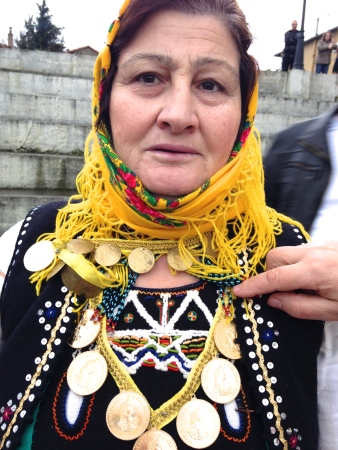
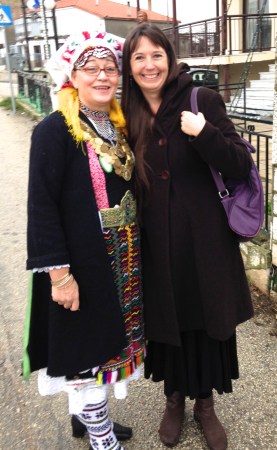
As much as I loved meeting them, they loved meeting me – as they would love to meet any woman who can recognise them for what they are and what they wear.
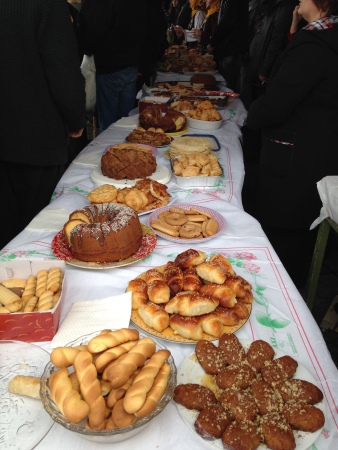
And of course there was another feast.
It was a fabulous birthday. I even danced, managing to overcome lingering injuries from a bicycle accident I had had some months before. Giving myself to the healing energy of women sharing steps together, I felt radiantly joyful and truly alive, as if at a momentary crossroads of space and time, simultaneously fleeting and eternal.
In Thrace, I feel extremely privileged to witness the survival of motifs and ritual customs with roots in Neolithic Old Europe, as well as key values from the Old European worldview articulated by Gimbutas, Carol P Christ, and others: respect for nature, a sense of interdependence, the need for social justice and the importance of community celebration.
We are blessed to live in an age where these and other ancient treasures of women’s wisdom, are now returning, visibly and consciously, to our own culture. Patriarchal domination has not and will not manage to destroy these riches from the past. At this time of the winter Solstice, I wish us all the healing joy, connectedness, and love in abundance which these dances embody, to warm us and guide us all into the rebirth of the year.
Love & blessings,
Laura
Laura Shannon has been researching and teaching traditional women’s ritual dances since 1987. She is considered one of the ‘grandmothers’ of the worldwide Sacred / Circle Dance movement and gives workshops regularly in over twenty countries worldwide. Laura holds an honours degree in Intercultural Studies (1986) and a diploma in Dance Movement Therapy (1990). She has also dedicated much time to primary research in Balkan and Greek villages, learning songs, dances, rituals and textile patterns which have been passed down for many generations, and which embody an age-old worldview of sustainability, community, and reverence for the earth. Laura’s essay ‘Women’s Ritual Dances: An Ancient Source of Healing in Our Times’, was published in Dancing on the Earth.


 Feminism and Religion