Anita Caspery, IHM: Prophetic Icon of Renewal By Cynthia Garrity-Bond

this we were, this is how we tried to love,

and these are the forces they had ranged against us,

and these are the forces we had ranged within us,

within us and against us, against us and within us.

Adrienne Rich

Last week a colleague of mine forwarded the sad news that Anita Caspary, IHM, had died at the rich age of 95. This was the same day (October 5) that Steve Jobs passed away from his battle with pancreatic cancer.  The tension between the two figures was not lost on me.  The death of Jobs, an icon of ingenuity and leadership, wonderful husband and father, is mourned throughout the world.  The life and legacy of Anita Caspary will be remembered and mourned as well, but by comparison, on a much smaller scale. That’s unfortunate, because the life and legacy of Caspary as an instrument for change in the lives of Catholic women in general, and Women Religious in particular is what legends are made of.

As an IHM sister, Caspary was teacher, poet, author, and president of Immaculate Heart College (1958-1963), but is best known in her role as Mother General Sister Humiliata (1963-1973) of the IHM’s.  In Witness to Integrity, Caspary dramatically chronicles the painful struggles and controversies between the IHM sisters and Cardinal Archbishop of Los Angeles, James Francis McIntyre, in which 600 IHM Los Angeles nuns were released from their canonical vows in 1970.  Released because of their self-determination in remaining at the center of their religious fidelity and thought by putting into practice The Second Vatican Council’s  Decree on Up-to-Date Renewal of Religious life, or Perfectae Caritatis Addressed to priest and religious, this decree sanctioned the exodus from the middle ages for the sisters by insisting they join the modern world in both dress and discernment of vocation that best utilized each sister’s talents.  In an exert put forth from the 1967 Decrees of the Ninth Chapter, the IHM community clarify their position for renewal: Continue reading “Anita Caspery, IHM: Prophetic Icon of Renewal By Cynthia Garrity-Bond”

Diminished Quality of Catechesis as a Basis for Limiting the Role of a Catholic Theologian: An Examination of the Controversy Surrounding Elizabeth Johnson’s Book The Quest for the Living God By Michele Stopera Freyhauf

The biggest mistake people make is to use theology and catechesis interchangeably.  This is an important distinction that impacts the scholarly community of Catholic Theologians.  So what is the difference?  Catechesis in the Catholic tradition is an “echoing” of the faith.  Theology on the other hand, using St. Anselm’s definition, is “faith seeking understanding.”  Michael G. Lawler and Todd A. Salzman, in “Beyond Catechesis: What is the Proper Role of Theology”, states that catechesis can be included in theology, but theology is distinguished from catechesis because it “uses scholarly principles not only to communicate the truths of faith but also to explore the meanings of those truths and contemporary ways of articulating them.”  Also the theologians’ role is seen as mediator between the magisterium and the faithful. Richard P. McBrien states that the required role of a theologian is to investigate and examine the whole of the Christian tradition; what it means, how it fits, how it is developed, and how it relates to the outside the world in theory and in practice.   Ex Corde Ecclesiae also emphasizes community and dialogue, which is not always realized in practice.  Continue reading “Diminished Quality of Catechesis as a Basis for Limiting the Role of a Catholic Theologian: An Examination of the Controversy Surrounding Elizabeth Johnson’s Book The Quest for the Living God By Michele Stopera Freyhauf”

Interlocking Pieces and the Maleness of Jesus: Exegeting the “America’s Pope’s” Statement on Gay Marriage and Ordination of Women By Michele Stopera Freyhauf

On a 20/20 interview, posted August 21, 2011, Morley Safer interviewed the Archbishop of New York, Timothy Dolan.  Dolan is also referred to as “America’s Pope.”  In this article, Safer calls him a scholar and a “passionate defender” of issues that he considered to be “settled questions.”  These settled questions? Gay marriage and women’s ordination.

Gay Marriage: Incest, “Necessary Attributes,” and Interlocking Pieces

Dolan makes an unbelievable comparison of gay marriage to the desire to marry his mother:  “I love my mom, I don’t have the right to marry her.”  He further compared gay marriage to his desire to be a shortstop for the Yankees, which is not possible because he does not have “what it takes.”  Both analogies Dolan uses give a clear indication that he does not understand what a committed relationship looks like for a gay couple.  Many in society share this ignorance.  In fact during my daughter’s health class, at a public school no less, she was told that sex was only between a man and a woman because they fit together like a jigsaw puzzle.  Not only does this fail on words, it lays the foundation for bullying, repression of identity, sexual confusion, and problems for children who are members of a modern family.  Besides, last time I checked not all puzzles have interlocking pieces.   Continue reading “Interlocking Pieces and the Maleness of Jesus: Exegeting the “America’s Pope’s” Statement on Gay Marriage and Ordination of Women By Michele Stopera Freyhauf”

In Search of My Religious Identity By Gina Messina-Dysert

I try to avoid watching too much television – it feels like there are so many other things I should be focused on; but I was quite engrossed in the show Big Love during its run on HBO.  Its concluding season was by far my favorite because of its focus on women and faith.  In one of the final episodes the character Barbara Hendrickson struggled with whether or not to be baptized into a new church and it was a struggle I identified with greatly.  Although her faith had changed and she no longer felt connected to the doctrine of her previous church, moving on to a new community that fit her beliefs meant abandoning her family.

I was raised in a very traditional Italian/Sicilian Roman Catholic household, attended Catholic schools, and was married in the Catholic Church.  As a child, being Catholic offered me a sense of pride; however growing up I began to question the Church as I recognized the many ways it is abusive to women.  Becoming a graduate student of religion led me on a roller coaster journey that allowed me to further explore my religious identity. Continue reading “In Search of My Religious Identity By Gina Messina-Dysert”

The Dark Night of a Theological Education By Cynthia Garrity-Bond

Yesterday I decided I would attend Sunday Mass.  I have been involved in some fairly weighty theological conversations with my friend, bringing to the surface awareness that I am restless and in a state of holy longing for the Absolute One. I do not usually attend conventional Mass. The exclusive language of the liturgy is like a cacophony of painful sounds, each one more abusive than the next.  But this morning I thought it would be different because I was different.  The hole in my heart was larger, more pronounced and in need for that which I could not name.

I should say that my academic studies have lifted me far from a loving encounter with Jesus or for that matter, any part of Christian orthodoxy, which is why my decision to attend mass is confusing.  In fact, through my initiation into theology as a discipline, I have become a paradox to myself.  On the one hand, I am informed on enough theological matters that I might be able to swoop a Jeopardy category of say, “Anything having to do with Christianity.”  But when it comes to articulating my beliefs with regard to such doctrines as the Virgin birth, divinity, miracles, prayer or, (gasp) the validity of the Bible, I’m stalled. Even more than that, I’m inclined to suspend most confessional statements about the Divine because, in spite of my education and degrees, I do not know what I think I should know. Continue reading “The Dark Night of a Theological Education By Cynthia Garrity-Bond”

Is it Right to Intentionally Lie Because the Church Says to? The Case of Fr. Roy’s Assertion of Conscience Over Vatican’s Mandate to Lie By Michele Stopera Freyhauf

Fr. Roy Bourgeois has many titles: Nobel Peace Prize winner, purple heart recipient, former missionary, member of the Maryknoll Fathers for 44 years, and ordained priest for 38 years.  He has long been associated with social justice and helping the oppressed and marginalized.  He was a peace activist during the Vietnam War and founded the School of Americas Watch.  He is found often marching and protesting in front of the School of Americas (now WHINSEC ), a terror training camp at Ft. Benning  where soldiers are trained in devices of torture.  This is where soldiers that were members of the death squads that existed in Latin America, especially in El Salvadorwere trained. This is also where the soldiers who killed the Jesuits, their maid, and her child as well as Monsignor Romero were trained.

Fr. Roy is and continues to be an important activist for peace and justice and a champion for the poor.   At the risk of being defrocked, Fr. Roy is also an advocate on behalf of another oppressed group – women in the Catholic Church. Fr. Roy, through his actions, is now among the group of the oppressed and stands in punishment of a crime considered “delicta gravioria” by the Vatican.  The brevity of his crime defined as “delicta gravioria” is shared with other offenders such as John GeoghanJohn Birmingham, Paul Desilets, Robert V. Gale, and others found guilty of pedophilia in the Sex Abuse Scandal that rocked the United States.  However Fr. Roy’s crime is not pedophilia; it is the public support of ordaining women. Continue reading “Is it Right to Intentionally Lie Because the Church Says to? The Case of Fr. Roy’s Assertion of Conscience Over Vatican’s Mandate to Lie By Michele Stopera Freyhauf”

Catherina Halkes – In Memory and Appreciation By Mary Grey

The following is a guest post written by Mary Grey, Ph.D., Professor of Feminist Theology at St. Mary’s University College, in Twickenham, London, and author of thirteen books including A Cry for Dignity: Religion, Violence, and the Struggle of the Dalit Women in India.

On April 21, 2011  Catherina Halkes, the founding mother of Feminist Theology in Europe, inspiration to me and countless others,  prophet, mentor – and much else – died in her home city of Nijmegen, the Netherlands. She certainly changed my life: I arrived in Nijmegen desperately searching for books in Feminist Theology when writing my Ph.D. thesis. I had read everything that England had to offer, (not a lot in 1986!) I could not afford to go to America, so the Netherlands was my only option. Catherine Halkes, (or Tine, as we all called her), welcomed and encouraged me: later she would come to the public defence of my thesis in Louvain – after which I became her successor to the chair of Feminism and Christendom in Nijmegen, 1988. Life was never the same again!

Catherina Halkes

Tine blazed a trail  for women’s role in theology in the Roman Catholic Church, as well as for all women in Feminist Theology in Europe in its key developing stages. She embodied the hopes and dreams of countless women – and men- beyond the boundaries of her small country. She influenced the development of Women Studies as an academic subject in the Universities of the Netherlands and wider. Her influence cannot be restricted to a single category. Rooted in the progressive theology of the Second Vatican Council, she developed a wide-ranging pastoral theological influence on theology. It could be said  – although an evaluation is still too early-  that her legacy will be seen as opening up different areas of theology and related disciplines to the feminist lens, and being at the forefront of developments in many fields, always with a critical eyes of a Christian faith that has never wavered, despite continuing disappointment and personal suffering at the unflinchingly repressive attitudes of the Roman Catholic Church, to which she remained consistently loyal. Continue reading “Catherina Halkes – In Memory and Appreciation By Mary Grey”

The Vatican’s Spiritual Violence Against Women’s Ordination By Rosemary Radford Ruether

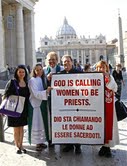
The Vatican has adopted what amounts to a “zero tolerance” policy against those Catholics who actively advocate for women’s ordination, particularly against anyone involved in the movement of Roman Catholic Womenpriests which, for the past three years, has ordained thirty-five women in the United States. This movement began in June, 2002, when seven women were ordained by some Catholic bishops in Austria. Later several of these women were ordained bishops by these same bishops. They, in turn, have ordained more women priests. From this has sprung an increasingly organized movement, which is developing the theological vision of church which they hope to generate and are laying down the formal rubrics for education and preparation for ministry of those aspiring to be ordained in their community.

The Vatican summarily excommunicated the initial seven women ordained in 2002. As more women were ordained it was at first silent and then decreed that anyone being ordained in this movement, as well as those supporting it, were automatically excommunicated. This saved them the trouble of addressing each of these women individually. However, they have escalated their campaign against women’s ordination in the last month in response to Maryknoll priest, Father Roy Bourgeois, who on August 9, 2008 in Lexington, Kentucky, concelebrated the mass where long-time friend, Sevre-Duszynska, was ordained. Father Bourgeois also preached the homily at this ordination mass, where he denounced the Church’s refusal to ordain women as a sin comparable to the sin of racism. “Sexism is a sin” he declared. Continue reading “The Vatican’s Spiritual Violence Against Women’s Ordination By Rosemary Radford Ruether”

Catholic Church Targets Proponent of Women’s Ordination; Feminist Theologian By Mary E. Hunt

The following is a guest post written by Mary E. Hunt, Ph.D., co-founder and co-director of WATER (Women’s Alliance for Theology, Ethics, and Ritual).

As a senior official for Pope John Paul II, Joseph Cardinal Ratzinger envisioned a leaner, meaner church, with conservative doctrine and compliant faithful. Now that he is Pope Benedict XVI, his dream is coming true. Other senior churchmen, apparently unaware of the scandal that pedophilia and episcopal cover-ups have wrought, go blithely about their business of disciplining priests, nuns, and theologians. What used to be a large tent of a church is now a tepee—soon to be a pup tent—if these gentlemen have their way. Catholics wonder where it will end.

Click here to read the full article by Mary E. Hunt. It appears in the online magazine Religion Dispatches.

Cross posted at WATER Voices – www.watervoicesblog.blogspot.com.

Will Women Priests Change the Church? By Mary E. Hunt

The following is a guest post written by Mary E. Hunt, Ph.D., co-founder and co-director of WATER (Women’s Alliance for Theology, Ethics, and Ritual).

A New Documentary, “Pink Smoke Over the Vatican,” starts the conversation…

Catholic women priests are an oxymoron for the Vatican. It considers them automatically excommunicated before the holy oil is dry on their hands. Other Catholics accept them as sacramental ministers and are delighted with the innovation. Still, others, myself included, want far deeper structural changes in the Catholic Church such that priesthood loses its baked-on charm and ministry becomes the expected task of adult members. This is an important theological conversation that the Vatican wishes would go away. Memo to them: it is just starting.

Read the full article by Mary E. Hunt on the online magazine Religion Dispatches.

Originally posted at WATER Voices – www.watervoicesblog.blogspot.com.