Of Human Life* By Carol P. Christ

Watching the last episode of the Australian series Brides of Christ in which Catherine leaves the sisterhood of the convent because of her disagreement with Humanae Vitae brought me right back to the Yale Roman Catholic chapel and the folk mass I attended regularly.  In 1968 just after the publication of Humanae Vitae, priest and co-graduate student Bob Imbelli preached a sermon on the doctrine of conscience, arguing that though it was incumbent on Catholics to think carefully about the papal encyclical on birth control, it was also the responsibility of every Catholic to follow her or his conscience on the matter.  In the episode, Sister Catherine encourages a Roman Catholic mother of six who has already self-induced more than one abortion to take the pill, but the woman decides she cannot go against the church’s teachings.  Catherine allows an editorial against Humanae Vitae to be published in the school newspaper even though she knows it will probably lead to the expulsion of one of her favorite students.

I had forgotten that Pope Paul VI issued the prohibition on birth control against the clear majorities of the Roman Catholic commissions instructed to study the matter.  In the episode, Sister Catherine, told by her bishop that she can no longer express her own opinions on birth control, tries to explain to her students that Roman Catholics cannot use birth control because it is against “natural law.”  This provokes one of the students to ask if people are not supposed to use birth control because animals don’t use it.  This question sparked an “ah-ha” moment for me.  Hmm, I thought, while “man” has invented birth control, “women” cannot use it because we are meant to remain “like the animals.” This debate really is about the question of whether women are human! Continue reading “Of Human Life* By Carol P. Christ”

Hildegard of Bingen to be Canonized and Named Doctor of the Church By Gina Messina-Dysert

Known as the “Sybil of the Rhine,” Hildegard of Bingen was a remarkable woman who produced multiple visionary writings and major theological works throughout her life (1098-1179).  During a time period when women received little respect, Hildegard was consulted by religious and political leaders and advised popes and kings.  Her contributions are many and include founding a convent, composing music, and writing about the medicinal uses of natural objects such as plants, trees, animals, and stones.

It was recently announced that Hildegard of Bingen will be canonized and declared a doctor of the church.  Hearing this I was among the many who were surprised by the news since I had assumed that Hildegard was already canonized, particularly since she has been called St. Hildegard and has had a feast day on September 17th since 1940 (although only within the Benedictine order in Germany).  Nonetheless, I have recognized Hildegard as a crucial woman in Christian history – as crucial as St. Catherine of Siena, St. Teresa of Avila, and St. Therese of Lisieux who have already been canonized.  So why the delay in granting this honor to Hildegard of Bingen? Continue reading “Hildegard of Bingen to be Canonized and Named Doctor of the Church By Gina Messina-Dysert”

Pink Smoke, Call to Disobedience, and a Holy Shake-Up: Is it Time to Convene the Third Vatican Council? By Michele Stopera Freyhauf

This past August I wrote about the canonical warning that Fr. Roy received and the issue surrounding the exercise of conscience over church teaching.  For a more detailed explanation of the warning and the background regarding the ordination of women, please see my prior article.

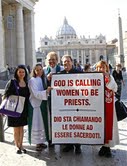
October 17th (this past Tuesday), Fr. Roy Bourgeois, Erin Saiz Hanna (Executive Director of Women’s Ordination Council), Therese Koturbash (Coordinator of Canada’s Catholic Network for Women’s Equality), Nicole Sotelo (Call to Action), Miriam Duignan (Womenpriests), and about 14 other representativesof various other Catholic organizations from around the world went to the Vatican to

present a petition containing 15,000 signatures supporting full and equal participation of women as deacons, priests, and bishops in a renewed church. The group was not permitted in St. Peter’s Square because of their signs; they did not have the proper permit.  Access was also denied to the Women who wore albs/stole because their dress was considered a form of protest.  “We love our family, the Catholic Church,” stated Miriam Duignan of Women-Priests.  “We feel obliged in conscience to make our carefully considered reasons known.  In doing so, we fulfill our canon law duty to speak out, as our present Pope has encouraged us to do.”  Koturbash states “even though canon law invites our Church leaders to hear from the faithful, our leaders are silent when we try to engage.” Continue reading “Pink Smoke, Call to Disobedience, and a Holy Shake-Up: Is it Time to Convene the Third Vatican Council? By Michele Stopera Freyhauf”

Interlocking Pieces and the Maleness of Jesus: Exegeting the “America’s Pope’s” Statement on Gay Marriage and Ordination of Women By Michele Stopera Freyhauf

On a 20/20 interview, posted August 21, 2011, Morley Safer interviewed the Archbishop of New York, Timothy Dolan.  Dolan is also referred to as “America’s Pope.”  In this article, Safer calls him a scholar and a “passionate defender” of issues that he considered to be “settled questions.”  These settled questions? Gay marriage and women’s ordination.

Gay Marriage: Incest, “Necessary Attributes,” and Interlocking Pieces

Dolan makes an unbelievable comparison of gay marriage to the desire to marry his mother:  “I love my mom, I don’t have the right to marry her.”  He further compared gay marriage to his desire to be a shortstop for the Yankees, which is not possible because he does not have “what it takes.”  Both analogies Dolan uses give a clear indication that he does not understand what a committed relationship looks like for a gay couple.  Many in society share this ignorance.  In fact during my daughter’s health class, at a public school no less, she was told that sex was only between a man and a woman because they fit together like a jigsaw puzzle.  Not only does this fail on words, it lays the foundation for bullying, repression of identity, sexual confusion, and problems for children who are members of a modern family.  Besides, last time I checked not all puzzles have interlocking pieces.   Continue reading “Interlocking Pieces and the Maleness of Jesus: Exegeting the “America’s Pope’s” Statement on Gay Marriage and Ordination of Women By Michele Stopera Freyhauf”

The Dark Night of a Theological Education By Cynthia Garrity-Bond

Yesterday I decided I would attend Sunday Mass.  I have been involved in some fairly weighty theological conversations with my friend, bringing to the surface awareness that I am restless and in a state of holy longing for the Absolute One. I do not usually attend conventional Mass. The exclusive language of the liturgy is like a cacophony of painful sounds, each one more abusive than the next.  But this morning I thought it would be different because I was different.  The hole in my heart was larger, more pronounced and in need for that which I could not name.

I should say that my academic studies have lifted me far from a loving encounter with Jesus or for that matter, any part of Christian orthodoxy, which is why my decision to attend mass is confusing.  In fact, through my initiation into theology as a discipline, I have become a paradox to myself.  On the one hand, I am informed on enough theological matters that I might be able to swoop a Jeopardy category of say, “Anything having to do with Christianity.”  But when it comes to articulating my beliefs with regard to such doctrines as the Virgin birth, divinity, miracles, prayer or, (gasp) the validity of the Bible, I’m stalled. Even more than that, I’m inclined to suspend most confessional statements about the Divine because, in spite of my education and degrees, I do not know what I think I should know. Continue reading “The Dark Night of a Theological Education By Cynthia Garrity-Bond”

Rape Culture and the Church By Gina Messina-Dysert

Rape culture – a culture where violence against women and victim blaming is the norm –  is alive and well in our society.   Women are taught from a young age that rape is the worst thing that could possibly happen in our lives.  As a patriarchal institution, the Church supports rape culture.  Although texts, traditions, and teachings can be a resource for women who have been victimized, they can also serve as a roadblock and encourage further victimization.

There has been a long history of women and girls being taught by the Church that their lives are of little value once their hymens are broken.  Citing the rape of Roman matron Lucretia, Church father Jerome stated that rape is the one exception for suicide. In fact, according to Jerome, “Although God is able to do all things, he cannot raise up a virgin after a fall.”*  Although he argued that at the time of the resurrection of the body every affliction and mutilation would be healed, Jerome claimed that not even the power of God could repair a broken hymen.  Likewise, Tertullian commended Lucretia for her suicide and claimed she was an example for Christian women.

Harmful ideas about women, rape, and victimization have been promoted by biblical rape texts and their interpretations.  These “rape texts” of the Bible have been utilized to typify how “real” rape victims behave and suggest that women who claim rape are suspect.  From the story of Ms. Potiphar (Genesis 39), that offers the image of a woman crying rape as one not to be trusted, to the story of Susanna (Daniel 13) that presents the notion that a rape victim should be silent, biblical texts set forth images of women and sexual violence that support rape culture. Continue reading “Rape Culture and the Church By Gina Messina-Dysert”

My Body Image: Between Perception and Incarnation By Cynthia Garrity-Bond

No matter what shape or size, the words “body image” conjure-up pictures of the self that are like looking into those funny mirrors which distort and expand the body.  With few moments of relative slimness in my life, I have struggled with a poor self-image. It started when I was a child, who while deeply wanted, was not the hoped for frail and delicate daughter my parents had imagined.  My mother, all 5’ 100 lbs was forever reminding me that I took after my father’s Swedish side of the family, more akin to “peasant stock,” you know, those larger boned women who could birth a baby one day and return to the fields the next—you get the picture.  This is the image I came to accept of my own body, which was far from the wispy, delicate girl I longed to be.

And then my baptism into feminism, with all its corrections of the androcentric world to which I belonged. Of the many hopes within feminism, it was the release from my own body image that I longed for.  I wanted to feel at home and at one with what I was, not what I hoped to be.  Truth be known, it has never happened.

A few years back in my Medieval Theology course we were examining the Catholic doctrine of the Resurrection of the Body through such thinkers as Irenaeus, Aquinas and Bonaventure. In what my instructor thought was an affirmation of the body, she interpreted the doctrine to mean that after death we will take on our bodies as they were in life, meaning, we would look pretty much the same as we did while tromping around on earth.  In contemplating her words I sought clarification.  “So” I asked, “the body I have now will be the body I carry with me throughout eternity?”  “Well, yes” my slight and thin professor responded. Letting her words sink in for a moment I finally responded with a resounding, WTF!”   I don’t want this body to haunt me in the next life, I want Ashley Judd’s, or Jennifer Aniston’s, hell, I’ll even consider an anonymous model from the LL Bean catalog, but not THIS body!” Continue reading “My Body Image: Between Perception and Incarnation By Cynthia Garrity-Bond”

Loving Harry Potter By Xochitl Alvizo

I went to the movies with a group of friends last Friday to watch the final Harry Potter movie, Harry Potter and the Deathly Hallows Part II. It was a great movie, fun and action-filled, and the energy of opening night only made it better. Afterward we all went out to eat and exchanged notes on our favorite scenes – talking about every little detail. At one point, one of my friends commented on the strong role women have in the Harry Potter movies/books. She said the story is carried by the women – that if it wasn’t for them Harry Potter would not exist. She made specific mention of Harry’s mom as having sacrificed her life for him. Lily dies so Harry can live.

This of course is when my brain comes to a screeching halt.

Women sacrificing their lives for others – I become suspicious and my defenses go up. Sacrifice = suffering. Suffering must not be glorified. Sacrifice must not be sacralized. I see red flags everywhere. Wait, though; haven’t those of us who are Christian-identified heard the opposite affirmed a million times? Jesus suffered and died – was sacrificed – for our sins. Further, Christians’ most sacred ritual, communion, includes reference to Jesus’ broken body and spilt blood. So, isn’t that what people do for love, sacrifice, as Harry’s mom did?

No. I don’t think that’s actually what people (or God) do for love. Continue reading “Loving Harry Potter By Xochitl Alvizo”

Will Women Priests Change the Church? By Mary E. Hunt

The following is a guest post written by Mary E. Hunt, Ph.D., co-founder and co-director of WATER (Women’s Alliance for Theology, Ethics, and Ritual).

A New Documentary, “Pink Smoke Over the Vatican,” starts the conversation…

Catholic women priests are an oxymoron for the Vatican. It considers them automatically excommunicated before the holy oil is dry on their hands. Other Catholics accept them as sacramental ministers and are delighted with the innovation. Still, others, myself included, want far deeper structural changes in the Catholic Church such that priesthood loses its baked-on charm and ministry becomes the expected task of adult members. This is an important theological conversation that the Vatican wishes would go away. Memo to them: it is just starting.

Read the full article by Mary E. Hunt on the online magazine Religion Dispatches.

Originally posted at WATER Voices – www.watervoicesblog.blogspot.com.