Grief, Grace, and the Eco-Feminist Legacy of Katherine Paterson’s Bridge to Terabithia, part 2 by Elanur Williams

Part 1 was posted yesterday.
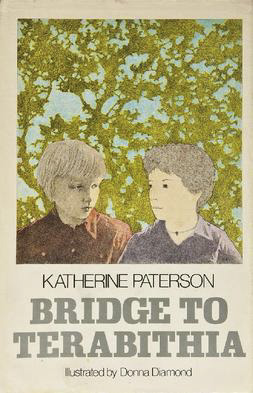
The Fridging Paradox

Jesse and Leslie’s autonomy is structurally threatened by the narrative’s conclusion, and Leslie’s sudden death invites a critique of the “fridging” trope, a term derived from the comic book industry describing the practice of injuring or killing a female character primarily to serve as a plot device for a male character’s emotional development. Named after a 1994 comic book scene in The Green Lantern where a hero discovers his murdered girlfriend in a refrigerator, the term critiques the tendency in fiction to treat female characters as disposable tools for male growth rather than as autonomous individuals with their own arcs.

In Bridge to Terabithia, this sacrifice unfolds in three critical movements:

  1. The Intersection of the Boundary: When the narrative notes, “The rain had been falling all night… the creek would be angry,” it signals the reassertion of the physical world. The creek acts as the boundary between the wild sanctuary and the dangerous, restrictive reality. By having the creek kill her, the text suggests that the “wild” or “feminine” space is inherently dangerous and incompatible with long-term survival.
  1. The Reduction to Catalyst: In the aftermath, the text frames Leslie’s existence through her utility to Jesse. He realizes “it was up to him to pay back to the world in beauty and caring what Leslie had loaned him in vision and strength.” This is the core of the “fridging” critique; Leslie is explicitly framed as a “loaned” object, and as a resource for Jesse, rather than a person with her own trajectory.
  2. The Post-Death Domesticization: Finally, Jesse assumes control: “He had to teach May Belle, for he was the king of Terabithia, and it was his duty to pass on the crown.” This shift in language marks the institutionalization of their anarchic space. By bringing May Belle in, Jesse settles the “frontier,” turning a radical, feminist space into a legacy for the next generation, effectively cementing Leslie as a relic of the past.

This tension is most visible in how the forest is described. When Leslie is alive, the forest is an active, creative force. Paterson describes how “Leslie had turned into a beautiful wild creature.” Yet, after she is dead, the forest becomes a site of mourning and memory, described as “still, and the creek was clear and cool.”

Would the novel have been more or less feminist if Leslie had lived? Does her death (within the context of a 1970s children’s book) actually provide the only way for a “non-conforming” girl to be fully accepted by the patriarchal structures of Lark Creek?

To view Leslie solely as a plot device is to overlook the novel’s sophisticated, often brutal, exploration of grief as a catalyst for moral maturity. While the “fridging” critique highlights a structural reliance on her death, one might argue Paterson is engaging in a deeper inquiry regarding the necessity of loss in the formation of the self. In this light, Leslie’s death serves not to diminish her agency, but to transition the novel from a fantasy of escapism into a somber, realistic lesson on the burden of growth. She is not merely a tool for Jesse’s development; rather, her death forces the permanent integration of her radical, imaginative spirit into the “real” world. By “loaning” him her vision, Leslie ensures her feminist influence survives her physical body, compelling Jesse to carry that disruptive, egalitarian force into a resistant, patriarchal landscape. She becomes an internalized mentor, suggesting that a true feminist impact is measured by how deeply one’s vision survives in those who remain. Terabithia ceases to be a secret getaway and becomes a foundation for the transformation of others.

It’s also important to keep in mind Paterson writes from a place of deep, personal vulnerability. She began the novel to help her son process the sudden death of his best friend. When we realize this, the “fridging” trope takes on a different hue. While the structural critique holds, it is also an attempt by an author to offer healing for her son.

The Secular Saint: Aesthetic Grace and Mentorship

Some may argue Miss Edmunds serves as the narrative’s secular saint of aesthetic grace. By treating Jesse’s art with profound respect, she acts as a bridge to a wider world, a living testament that one can exist within a rural community without being confined by its rigid gendered expectations. She provides institutional permission for Jesse to value his own sensitivity, effectively acting as the precursor to the creative sanctuary he will later build. While Leslie represents the collaborative, anarchic spirit of childhood, Miss Edmunds offers a glimpse of that same autonomy realized in adulthood. She is the professional, self-actualized woman of the story, and her presence proves to Jesse there is an alternative way to be, an existence defined by the pursuit of beauty and individual purpose.

Looking back, I can see how Leslie’s golden room and her expansive approach to faith taught me one of my first lessons in feminism, religion, and spirituality. It showed me that the borders we build, whether between countries, genders, or theological doctrines, are often artificial. Although the narrative’s reliance on “fridging” reveals a patriarchal constraint, the legacy of Leslie’s vision remains, and continues to inspire.

This piece is part of a series of explorations on children’s literature, spirituality and feminism by Elanur Williams. FAR has posted several of them.
Two pieces on The Chronicles of Narnia which you can read here and here.
Anne of Green Gables which you can read here.

Bibliography and Recommended Reading:

Escaping to Nature: Ecofeminism in the Children’s Book Bridge to Terabithia, by Anandayu Suri Ardini (2023):

https://www.researchgate.net/publication/372862789_Escaping_to_Nature_Ecofeminism_in_the_Children’s_Book_Bridge_to_Terabithia

BIO: Elanur Williams writes from Dublin, Ireland. She holds an MPhil in Children’s Literature and a MS Ed in Literacy Studies. She is a teacher who specializes in reading and writing instruction, as well as a poet whose work has appeared in Eunoia Review, the Ekphrastic Review, Halfway Down the Stairs, and Cosmic Daffodil, among others. Above all, she is inspired daily by her daughter, whose presence imbues her life with joy, magic, and a sense of limitless possibility.
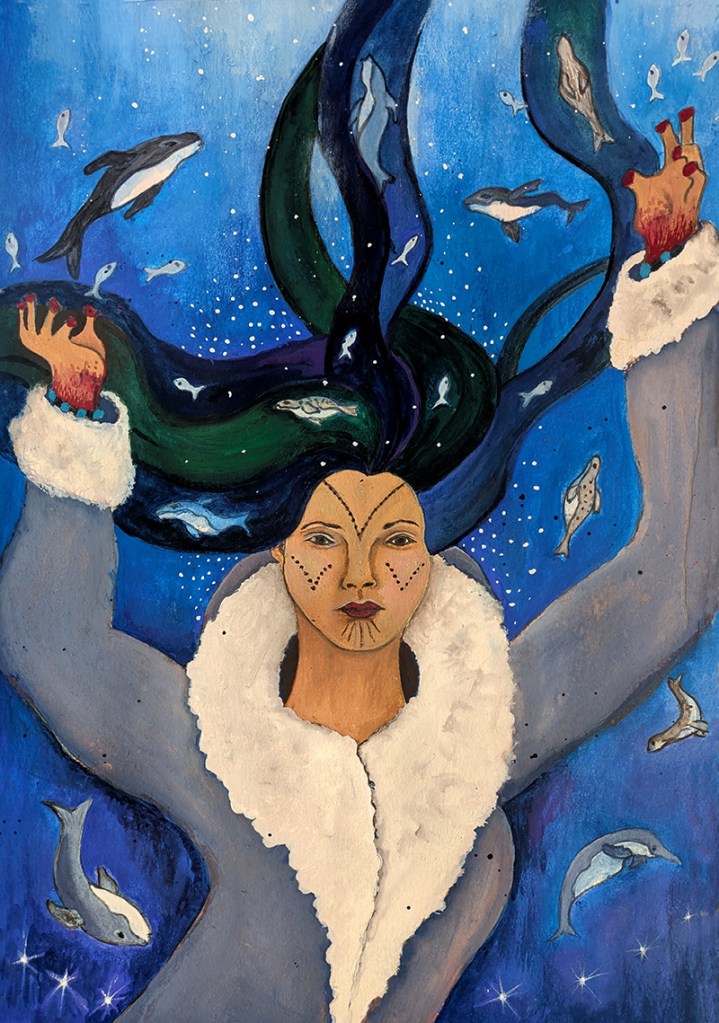
Sedna, Inuit Mother of the Sea by Judith Shaw


During the depths of winter, the tension between sacrifice and the joy of rebirth peaks. From Pagan celebrations of the Winter Solstice to Christian festivities marking Christ’s birth, this darkest time of year in the Northern Hemisphere is recognized as a moment when darkness nurtures light, promising the arrival of spring. It’s the perfect time to explore the story of the Inuit Sea Goddess, Sedna, whose tale encompasses sacrifice, transformation, and metamorphosis.

Sedan, Mother of the Sea, gouache on paper, by Judith Shaw
Continue reading “Sedna, Inuit Mother of the Sea by Judith Shaw”

Legacy Of Carol P. Christ: The Great Commandment for Women: Love and Care for Yourself as You Love and Care for Others

carol-christ

This post was originally published on Feb. 3rd, 2014.

A rabbi known as Jesus of Nazareth taught that you should  “love God with all your heart and your neighbor as yourself.”  Charles Hartshorne, philosopher of relationship and a twentieth century advocate of the “two great commandments,” added that it should be understood that this means that God wants you to love yourself too.

I quote Hartshorne’s midrash on the great teaching often because, sadly, too many women—and some men too–have been taught to love their neighbors at the expense of themselves, to care for others, but not to care as much for themselves.  Continue reading “Legacy Of Carol P. Christ: The Great Commandment for Women: Love and Care for Yourself as You Love and Care for Others”

Deconstructing and Reconstructing Love by Chasity Jones

Note: This is based on a podcast which can be heard here.

“Black love exists and Black women deserve love that does not require pain.”

What is love? What’s love got to do with pain and suffering? Are they related? Pain and love? Must one always be present with the other? In this blogpost I explore pain and suffering through a womanist perspective (centering the perspectives and lived experiences of Black women) and discuss how to live into wholeness and wellness. This is especially important because the Black community/women in particular’s experience in the US (and globally) has been and continues to be defined by pain and suffering. What are the theological implications?

How have Christian frameworks at associating love with sacrifice and pain justified the pain and suffering of Black women? How can we decolonize love so that liberated Black women are empowered to embrace a love that does not hurt first with false promises of rewards later in life or afterlife? Black women, pain does not equal love.

Continue reading “Deconstructing and Reconstructing Love by Chasity Jones”

Tzav: Holiness, the Situation in Ukraine, and Eating Animals by Ivy Helman

The parshah for this upcoming Shabbat is Tzav (Leviticus 6:1-8:36).  It details the investiture of Aaron and his sons into the priesthood and lays out the basics of various offerings (mostly, although not exclusively, animal sacrifices) and the rules regarding the eating of them.  As I’ve mentioned before on this site, I would like to complete at least one commentary on each parshah of the Torah.  Yet, there are only so many times that one can question the establishment of the temple, condemn animal sacrifice, and denounce the absence of women.  Yet, as we approach another Torah portion this week, Tzav , this is more or less what we have.  So, what do we do?

Tzav starts, as parshot from the book of Leviticus often do, with descriptions of various laws.  Here, the laws focus on various offerings including the grain, sin, peace, thanksgiving, and burnt.  Only the male members of Aaron’s family can eat the offerings.  Consumption of the offering increases the holiness of the consumer as long as the eating of the animals falls into the guidelines outlined within the text.  

The parshah ends with an explanation of how to consecrate Aaron and his sons.  The process lasts a total of seven days.  It includes residing at the entrance to the tent for the duration, offering various animals as sacrifices, eating copious amounts of said animals, the donning of specific ritual clothing, and multiple anointings of the men and the altar (often with blood).   

Continue reading “Tzav: Holiness, the Situation in Ukraine, and Eating Animals by Ivy Helman”

Holly Near’s Music and a Holistic Feminist Perspective of Peace by Elisabeth Schilling

It’s hard for me to be dignified and peaceful sometimes. To produce and sacrifice without rewards, making sure I’m not “sacrificing” in a way that quells my truth and power, making sure I look at dignity in a liberating way. Words continually need to be unpacked, and I do that. I know the work. According to the OED, it means “The quality of being worthy.” For me, ‘dignity’ is just being aware of your self-worth and celebrating that. It feels hopeful and romantic and raw. To sacrifice, to me, in the way I’m using it in this moment, is to be life-giving and co-creator; I think of it in the same way as what the earth does, so that it can continue. Like a leaf fallen to nourish its own soil.

The OED definition of ‘sacrifice’ I like is “The destruction or surrender of something valued or desired for the sake of something regarded as having a higher or more pressing claim.” We can decide what is more pressing. For me it is the ethic of generosity and production in a non-greedy way. I do not sacrifice in this more self-empowered, law-of-the-universe way I’ve recently come to understand much. But I would like to. Sometimes, though, I feel tired in my production, like I need more feedback, even if it is another woman willing to listen to me, which is why posting on FAR is so healing and life-giving because there is all of you.

I’m glad I have wisdom in my body. Even if “I” (my mind?) goes chaotic, feels overwhelmed and lost, my body has this natural intelligence to heal and regain balance if I can listen and get out of its way. That reminds me a lot of the earth—regions harmed by human mindlessness have been known to restore itself, even after radiation or toxic explosions, when humans leave for awhile. But if “I” equate myself with my mind, isn’t that also a part of the body? Wouldn’t the mind (the brain? the processes that help mental consciousness and thoughts arise?) then be wise, seeking balance? It just does not feel like it. So if anyone can weigh in on that. . . why so easy for my body-body but not my mind-body?

Continue reading “Holly Near’s Music and a Holistic Feminist Perspective of Peace by Elisabeth Schilling”

Bodies of More and Less Value by Oxana Poberejnaia

oxanaThere is a story in the collection called Avadanasataka (One Hundred Legends) of the Sarvastivadin school, one of the schools of early Indian Buddhism that did not survive to present day, relating one episode from the Buddha’s previous lives. The story is about king Padmaka who sacrificed his life to cure his subjects of a disease. Here is an academic article about this episode.

The Buddha was prompted to tell this story of his previous life in order to illustrate to his monks, once again, the workings of karma. All of the monks in the Buddha’s milieu were sick with a digestive disorder, while he remained well. The Buddha presented the story of king Padmaka as a proof that no good deed is ever lost and that what he had done then has an effect now in that the Buddha has good digestion.

Continue reading “Bodies of More and Less Value by Oxana Poberejnaia”

Ashes, Sacrifice, and Abundance by Melissa Browning

Melissa BrowningLast year I got my ashes at the airport. As I sat in that airport chapel, I halfheartedly listened to a (mostly terrible) litany that was proclaimed in between announcements for gate changes. I was leaving for another campus interview after having been home for only 24 hours since the previous one. The Christian season of Lent came during a time of stress and chaos in my life. That year, when I contemplated what I might give up for Lent, I could think of nothing. So much had been taken away that I had nothing left to give.

The season of Lent is often linked with the idea of sacrifice. Some people fast, others give up a favorite vice or a favorite food. As a feminist theologian, I spend a great deal of time thinking about the idea of sacrifice. I wonder how women who consider themselves part of Christian churches can be asked to sacrifice when we have already given away too much. Too often, our labor is welcomed but our voices are silenced. As a Baptist theologian and ordained minister who has sojourned in Catholic universities, I’ve felt this in my own tradition and in traditions that are not my own. Continue reading “Ashes, Sacrifice, and Abundance by Melissa Browning”

The Great Commandment for Women: Love and Care for Yourself as You Love and Care for Others by Carol P. Christ

carol-christA rabbi known as Jesus of Nazareth taught that you should  “love God with all your heart and your neighbor as yourself.”  Charles Hartshorne, philosopher of relationship and a twentieth century advocate of the “two great commandments,” added that it should be understood that this means that God wants you to love yourself too.

I quote Hartshorne’s midrash on the great teaching often because, sadly, too many women—and some men too–have been taught to love their neighbors at the expense of themselves, to care for others, but not to care as much for themselves.  Continue reading “The Great Commandment for Women: Love and Care for Yourself as You Love and Care for Others by Carol P. Christ”

AN ALTAR WITHOUT GOD? A “PLACE” FOR THE SACRED by Sara Frykenberg

The altar was not for particular spirits, but honored all the ‘spirits’ we brought with us to share: the spirits of the women and men in our stories, the memories imbedded in the items we gathered together and the spirit of every person present in the class that day.

Last week my students and I created a non-religious altar to conclude our class, Women, Religion and Spirituality.  We read about different feminist spiritual traditions in which women created altars to honor their ancestors, spirits or deities; and I thought it might be fun to practice our own form of literal physical creation.  I asked students to bring in inspiring items, pictures of people who’d helped them to grow or anything that honored what they considered sacred in their lives.  I also asked them to bring food to share, as no altar seems complete without food of some kind.  However, asking my students to participate in a course ritual, I also felt it was important to respect their very different beliefs… which resultantly, left me wondering how we would create an altar without God.

My religious experience taught me that altars were a place to surrender gifts in return for a greater gift of God’s blessing or love.  The church I attended as a child did have a literal, physical altar; but this raised table was only used monthly to present the communion bread and grape juice before it was passed through the pews.  Otherwise, I came to understand, one’s heart was the altar and we needed to present our sacrifices there.  Financial gifts needed to come from the heart, then put into the offering plate.  Gifts of time or action had to start in the heart, even when required by the youth group or spiritual authority; and resistance to giving these gifts also required sacrifice.  My resistance or lack of desire to sacrifice required that I leave my unwillingness at the altar so that I might become appropriately grateful.

At some point I started leaving too much at the altar; and like Abraham’s Daughter I said enough is enough.  I recognized myself in the sisters and brothers lying under the sacrificial sword, and I took back my heart.  My heart, I realized, hadn’t been the altar; it had been the offering and sacrifice. Continue reading “AN ALTAR WITHOUT GOD? A “PLACE” FOR THE SACRED by Sara Frykenberg”