Birthing God at the Edges of Life, Death, and Beyond: Reflections on Mary, Motherhood, and Kali Part I By Tracy Sayuki Tiemeier

Tracy Sayuki Tiemeier, Ph.D., is Assistant Professor of Theological Studies at Loyola Marymount University in Los Angeles, CA. She teaches and researches in the areas of women and religion, interreligious dialogue, comparative theology, Asian and Asian American theology, and Hindu-Christian studies. Tracy also co-chairs the Los Angeles Hindu-Catholic Dialogue.

I grew up in St. Louis, MO, in the decades following Vatican II. My parish, like many at the time, was an odd mash-up of old and new. Contemporary praise music co-existed with smells and bells, informal homilies by hip priests with solemn novenas. It was an exciting time to grow up Catholic. I was on fire for God, but the opportunities for ministry as a little girl were limited. Boys were taught to follow Christ and were groomed to be priests. They got to skip class to receive training as altar boys. We all knew that boys were special. Girls were taught to be like Mary.  While shut out of most ministries at the church, we were essential for the yearly May crowning. Every year, I prayed I would be chosen to crown Mary. I was never chosen; but I nevertheless became incredibly devoted to Mary, talking with her often and leaving little gifts outside my door for her to take to heaven. My favorite game was to pretend to be Mary.  Continue reading “Birthing God at the Edges of Life, Death, and Beyond: Reflections on Mary, Motherhood, and Kali Part I By Tracy Sayuki Tiemeier”

Mary’s Feast Rooted in Lesbian Goddesses Diana and Artemis By Kittredge Cherry

Kittredge Cherry

The following is a guest post written by Rev. Kittredge Cherry, lesbian Christian author and art historian who blogs about LGBT spirituality and the arts at the Jesus in Love Blog.  Her books include “Equal Rites” and “Art That Dares: Gay Jesus, Woman Christ, and More“.

August 15 was once the festival of the lesbian goddess Diana (Artemis), but it has been adapted into a feast day for the Virgin Mary.

Midsummer feasts have celebrated the divine feminine on this date since before the time of Christ.  Now devoted to Mary, August 15 carries the torch of lesbian spiritual power to a new generation.

Saint Mary, mother of Jesus, is honored by churches today in a major feast day marking her death and entrance into heaven.  Catholic and Orthodox churches call it the Feast of the Assumption or Dormition, when Mary was assumed into heaven, body and soul.

The Virgin Mary’s holiday was adapted — some would say appropriated — from an ancient Roman festival for Diana, the virgin goddess of the moon and the hunt.  Diana, or Artemis in Greek, is sometimes called a lesbian goddess because of her love for woman and her vow never to marry a man.  The ancient Roman Festival of Torches (Nemoralia) was held from Aug. 13-15 as Diana’s chief festival. Continue reading “Mary’s Feast Rooted in Lesbian Goddesses Diana and Artemis By Kittredge Cherry”

Qu(e)erying Our Lady By Xochitl Alvizo

I love art. I especially love certain women’s art – women such as Frida Kahlo, Cathy Ashworth, Sudie Rakusin, and Alma Lopez. To me, their art is a reflection of women’s strength, creativity, and beauty. Frida Kahlo, for example, expressed so many aspects of herself and her experience through her art. In it one can glimpse her passionate love for Diego Rivera, her continuous physical pain, her search for meaning, and the unending hopefulness she maintained throughout it all. Frida Kahlo’s art, like her person, was vibrant and full of life, colorful and yet broken. She expressed the wide spectrum of her experience not in words only but in color and images, texture, paint and print. As she put it, “I paint my own reality” – her own reality is what she knew and it is what she painted.

I rely on art to do what academics often cannot do well – what I cannot do well – which is to communicate the truths that rattle our being down to its deep core in ways that connect with others. There have been times in my academic life when I have encountered new insights that changed my life forever. Moments of being shaken and awakened at my very core by a truth that until then had eluded me. But such moments can be hard to share with others because they can be hard to translate to words, even if such moments have come to me by words. Learning about feminist theology and being shaken by the truths it spoke to me is one such encounter – and it was indeed an academic one that is often hard for me to put into words and explain to others. On the other hand, encountering Alma Lopez’s artwork was also a core rattling moment, but one which I can more easily share.

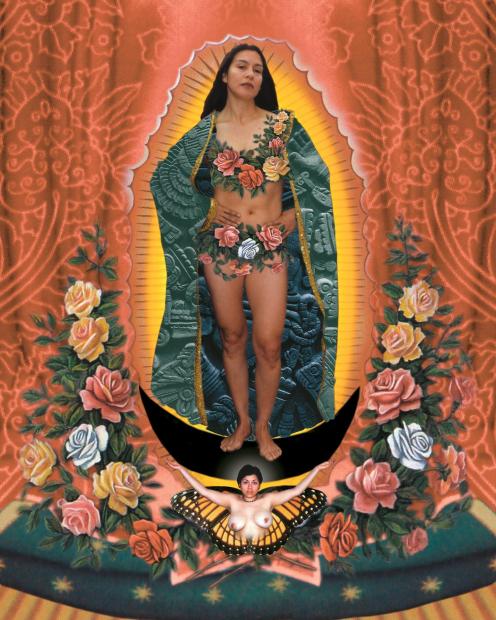
Our Lady - Lopez
“Our Lady” by Alma Lopez (1999)

Alma Lopez’s Our Lady is a digital art piece in which Our Lady of Guadalupe is depicted (embodied, really) in a more obviously female form than is traditionally expected. For this, every time her piece is on exhibit, Lopez receives a barrage of protest and harassment – as does the sponsoring institution. Accusations of obscenity, profanity, and blasphemy come her way.  But, why?

When I see Lopez’s Our Lady, I do not see blasphemy or obscenity, I see a celebration of the female and the sacred. I see the beauty of God’s queer incarnation – and I remember – I remember that the word became flesh and made her home among us. From the womb of a woman’s body, her life-giving body, the divine took human shape. Boundaries of sacred and profane forever blurred.

Alma Lopez, like Frida Kahlo, paints her own reality; she says this piece is a reflection of her relationship with Our Lady of Guadalupe, a divine image that has been part of her life since she was very young.  But I also think she reveals something more than just her personal relationship with Our Lady… Continue reading “Qu(e)erying Our Lady By Xochitl Alvizo”

Between Mother Mary and Mother God: It’s a Mystery!

“It’s a mystery!” was the repeated response my mother gave to me whenever I asked her theological questions that fell outside the realm of the Catholic Baltimore Catechism.  To be fair, my questions were usually a bit precocious for a young child, but who are we kidding, I was a rather strange and overly religious kid.  My idea of a good time was kneeling before our three-foot statue of the Virgin Mary as our family recited our Lenten rosary.  And while my brothers were contorting themselves into positions that would qualify for Cirque de Soleil, I was piously straight and focused.  Mary was my pathway to the big three, The Father, The Son and The Holy Ghost.  And while I knew I was suppose to desire the Three-in-One, they did not hold the same sway over me as the Mary who stood atop the world while crushing Satan in the form of a snake. My love for Jesus was more a sense of obligation for the unfair rap he had to endure while on earth, the Great Sacrifice for the sin of Adam and Eve.  My image of God as a not-so-nice-Father-to-his-only-Son sealed itself into my consciousness early on.  “Why,” I would ask my mother, “if God is love would he insist on such a bloody and painful sacrifice for a sin that honestly does not seem so bad.” You guessed it, “It’s a mystery!”  was her response.

But I have since come to learn that it’s not a mystery, but rather a matter of shifting the theological lens from an abusive Father to a God who has been totally misrepresented.  A God who is both unnameable and pronounceable.  Who offers us the mystery of God’s self in every single seen and unseen element of the earth and cosmos.  But still, that does not always work for me.  I need more.  In times of heartache or sorrow I need an image with skin and bones and a heart that is larger than my pain. I need a Creator God that will rock me back and forth, soothing my fears and yes, even caressing my face with cool breaths that remind me I will survive this latest insult to life.  In these times I know what God is not. I know God is not a rock, or a wispy tuft of air.  God is not the mighty King on high able to judge my enemies.  Nor is God a warrior who kicks ass over the unrighteous.  God is my Mother.  Maybe this is why Mary has always worked for me.  Maybe she never really was the mediator between Them and me, she is Them.  Theologically I may be on shaky ground, but the mystery between Mary as Mother and Mother God is one I know, not one I can defend. And it is one that continues to sustain and let me know that I am never too old to be held in the Mother’s embrace.