A warm summer sun smiles down upon the British coastline, the low tide reflecting jewels which are wash up and dispersed upon fine sand. A welcome breeze dances around a gathering of Goddess devotees encircling a small bonfire. Amongst them stands a banner and statue depicting and imitating Botticelli’s Venus and bouquets of roses. Just before the sun sets, those gathered lovingly collect these assembled artifacts, holding them aloft, and begin to process barefoot towards the sea.
Aphrodite-Venus’s banner and sculpted face shines in the low afternoon sunlight. As the procession slowly steps, weaves, and dances, towards the sea to the beat of a drum, the sun reaches further behind the hills, casting a long shadow upon the beach. The Goddess’s image dances with them, banner swaying and statue bobbing with the dance of its carrier. By the time the procession reaches the sea, the sun has dipped behind the now black silhouette of the hills bathing the beach ahead in dusky oranges and brilliant blues. At the shoreline, a priestess steps forward and turns the Goddess’s statue to face the procession, which has now fanning out into a semi-circle.
Mythology can be a helpful lens through which to view the march of history. The goddesses and gods are archetypes, illustrating the many facets of human experience for us, while at the same time lighting the path of connection between all Earth’s creatures and Earth herself – helping us understand ourselves and our place in this beautiful, yet often difficult, world of duality.
The seasons turn and again we reach the Winter Solstice – the longest night which marks the sun’s return to light in the northern hemisphere. Stag, in all his antlered majesty, symbolizes the return of the sun’s life-giving rays.
Seal – ever curious – stands up in the water gazing about with her dark, soulful eyes before diving again into the enigmatic, mysterious sea. Seal initiates us into wonder by her extraordinary presence filled with playfulness, adaptability and deep emotions.
Elephants amble along through forest and savannah in unity with each other, generally causing no harm. They have long symbolized intelligence, power, wisdom and loyalty.
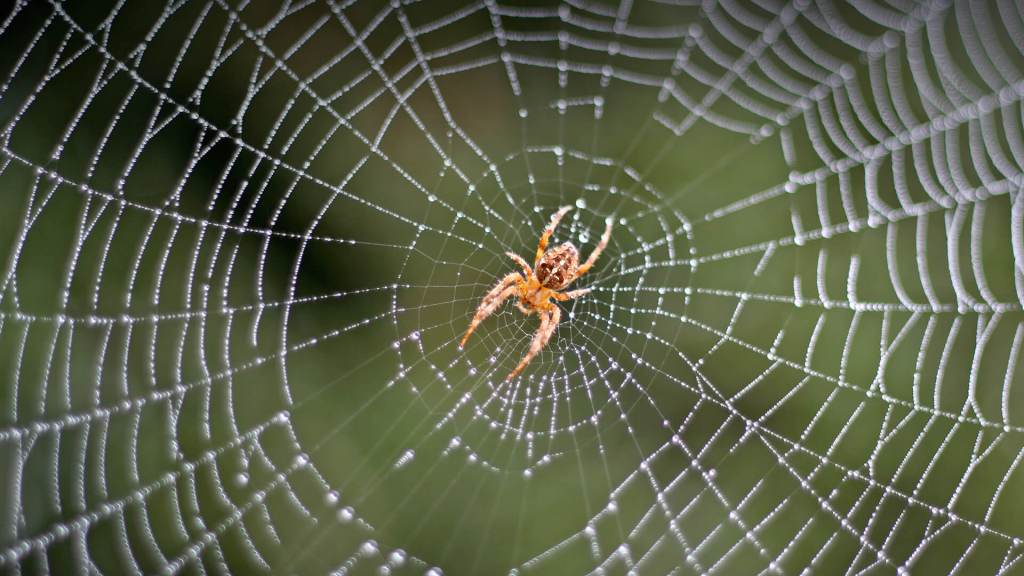
In addition to being viewed as a Creator Goddess and a Destiny Weaver, Spider is associated with many other aspects of life. Some of these aspects fall into what we would consider the light – the good – and others are dark dangers – the dark side of life.
Spider Wisdom by Judith Shaw
Patience, Resourcefulness/Protection, Good Fortune Though spiders have eight eyes they have very poor eyesight. Instead they have infinite patience, waiting quietly in their webs for prey.
Spider is credited with inspiring King Robert the Bruce of Scotland with its patience. A 14th century legend tells of a time when Bruce had suffered various military defeats against the English. While hiding in a cave he observed a spider trying and failing repeatedly to climb its silken thread. But it persevered and eventually reached its web. Bruce was inspired. He decided to persevere in his efforts, came out of hiding, and eventually won Scotland’s independence from England.
Spiders are important to our gardens. They eat more insects than both birds and bats.
Long ago people used spider webs to stop bleeding. Now science has discovered that spider webs contain Vitamin K – a coagulant which stops bleeding.
The Torah recounts a story of how Spider protected David, before he become King of Israel. As King Saul’s soldiers pursued him, David hid in a cave. A spider built a huge web across the cave entrance. The soldiers saw the cave but did not investigate, thinking that no one would crawl through a spider web to gain entrance.
Similarly a story from Islamic tradition depicts Mohammad hiding in a cave from pursuing soldiers. Here also a spider spun a web across the opening, protecting Mohammad.
A Hopi legend about Spider Grandmother tells how she protected a village by spinning a magical web over the whole village, which when doused with water gave protection from being burned down by its enemies.
Spider Woman of Dine (Navajo) mythology helps and protects her people. She helped them to destroy the monsters that roamed the land as they emerged from the third world into this world. She chose the top of Spider Rock in Canyon de Chelly – the Dine ancestral home – as her home. Children were warned that misbehaving would make Spider Woman angry. She would cast her web like a net, as some spiders do, to catch the naughty child, bring him up to her home and devour him. It was said that the top of Spider rock is white because of the bleached bones of those naughty children.
The Celts saw spider as a helper and believed that killing one would bring bad luck.
Spider appears frequently in Chinese legends as lucky beings, bringing happiness and wealth. Spider charms are worn for good luck.
Wisdom, Interconnection, Transformation A Hopi legend tells of Spider Woman helping Tiyo on his journey to the underworld. He begins with a visit to Spider Woman who gives him a serum to subdue his enemies. Then she accompanies him to the ‘Far-Far-Below River’ to offer advice during his trials. With her help Tiyo completes his journey successfully and returns to his people with greater wisdom and knowledge.
Egyptian Creator/Spider Goddess, Neith, often depicted veiled, wove this veil at creation to hide herself from humanity. As humans are not capable of understanding the fullness of divine mysteries the veil offers folds and strands that are thinner, allowing humans a glimpse at divine source and higher understanding.
African and some Native American stories portray Spider as a trickster god whose tales are part of a rich storytelling tradition which convey wisdom and moral lessons.
Spider symbolizes Maya (illusion) in Hindu Mythology. Vedic philosophy characterizes Spider as the weaver of the veil of illusion, hiding the ultimate truth of reality. In addition, Indra’s net, envisioned like a spiderweb with jewels at each vertex, illustrate the belief that all things are connected.
Though spiderwebs are stronger than steel, by weight they don’t usually last very long. Sometimes spiders destroy their own webs. Spider, with it eight (infinity symbol) legs and eyes symbolizes the infinite cycles of transformation as Spider continually creates, destroys and creates again, reflecting the essence of our natural world and its infinite cycles of birth, death and rebirth.
Dark Dangers – cunning, deception, intrigue, death Only a small number of spider species are dangerous to humans with venom that can cause localized pain to a person. Further, there are only about 25 spider species with venom that can cause serious illness in humans. And yet arachnophobia, the fear of spiders, is one of the most common fears worldwide.
Many folktales and myths warn of the dangers associated with Spider.
Athena, Greek Goddess of Wisdom and Handicraft was a skilled weaver. Arachne, a mortal and gifted weaver, got carried away with her talents and boasted that her work was better than that of Athena. Athena was furious and a contest was arranged between the two. Not only was Arachne’s weaving beautiful it also depicted the gods in a bad way. Athena destroyed Arachne’s work in a rage.
Arachne, ashamed to see what her arrogance had wrought, hung herself. Athena took pity on her – turning the rope into a web and Arachne into a spider. Through her death and transformation, Arachne was able to weave her beautiful tapestries for eternity.
Japanese mythology tells of the Spider Princess, Jorōgumo, who transformed into a beautiful woman and entraped men with her deception.
To Christians Spider symbolizes the Devil as the Devil prepares its trap for human souls like the spider prepares its web for prey.
When a spider is finished with its web many species roll it up and consume it.
In ancient Indian tradition Brahma, the creator of all things, was seen as a spider weaving the web that is our universe. Sacred text says that one day she will devour the web – our universe – and then weave another.
Divinatory Spider calls you to transform – to imagine your world anew. A time of creativity is at hand – a time of magic – a time to manifest your true destiny. Spider reminds you that with patience you can best reach your goal.
At the same time Spider calls you to recognize the dark side of life – the ways in which you or others might be deceptive, or engaged in intrigue.
Spider reminds you of the eternal cycles of life, death and rebirth.
Spider awakens your memory of the interconnection of all life, allowing you to integrate problem areas into a more wholistic perspective on life and reminding you of the system of interdependency in which we live.
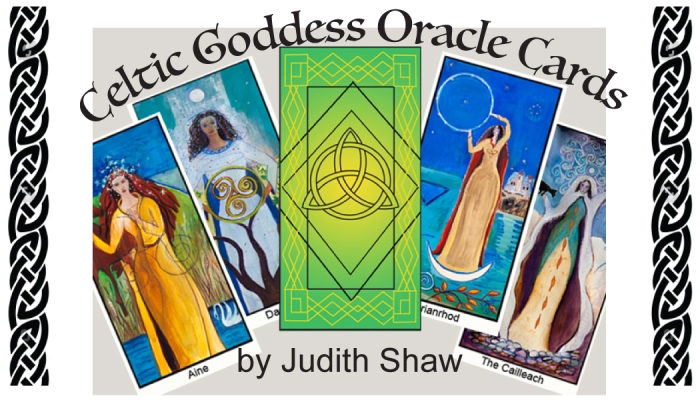
Judith’s deck of Celtic Goddess Oracle Cards is available now. You can order your deck from Judith’s website – click here. Experience the wisdom of the Celtic Goddesses!
Judith Shaw, a graduate of the San Francisco Art Institute, has been interested in myth, culture and mystical studies all her life. Not long after graduating from SFAI, while living in Greece, Judith began exploring the Goddess in her art. She continues to be inspired by the Goddess in all of Her manifestations. She is now working on her next deck of oracle cards – Animal Wisdom. Originally from New Orleans, Judith makes her home in New Mexico where she paints as much as time allows and sells real estate part-time. Give yourself the gift of one of Judith’s prints or paintings, priced from $25 – $3000.
Spider, the eternal weaver of webs, has symbolized creation since people first began storytelling. Cultures worldwide have associated Spider with the Creator Goddess, weaving – and through association with women as they were the weavers who spent endless hours creating the fabric to clothe their communities, and feminine power.
At first glance the ancient belief that bees were birthed from dead bulls seems odd. But if we delve deeply into pre-historical artifacts we discover the mythopoetic roots of this idea.
Just as each Roman man had his genius, or guardian spirit of masculinity, so did each woman have her juno, or guardian spirit of femininity. Juno ruled every woman’s life, every feminine occasion. In the civic life of Rome during both the Republic and the Empire, Juno stood with Jupiter and Minerva as the Capitoline triad that ruled the city. In one of her aspects, Juno was regina, “queen.” In another she was Juno Moneta, the “warner,” so called because the sacred geese of her temple once squawked so ferociously that the city was warned of a Gallic army outside the walls. Generals began to visit Juno Moneta’s temple for support, both popular and monetary, which is where we find an echo (“money”) of this goddess’s name today.
Bull, with its components of aggressiveness, stubbornness, virility, and ferocity, is emblematic of masculinity. But Bull is also associated with fertility, abundance, strength, and determination. Viewed by some cultures as a solar symbol – in the oldest myths, we find Bull connected to the moon.









 Feminism and Religion