This post was originally published on July 6, 2011. Xochitl’s very first FAR post!
I love art. I especially love women’s art – women such as Frida Kahlo, Cathy Ashworth, Sudie Rakusin, and Alma Lopez. To me, their art is a reflection of women’s strength, creativity, and beauty. Frida Kahlo, for example, expressed so many aspects of herself and her experience through her art. In it one can glimpse her passionate love for Diego Rivera, her continuous physical pain, her search for meaning, and the unending hopefulness she maintained throughout it all. Frida Kahlo’s art, like her person, was vibrant and full of life, colorful and yet broken. She expressed the wide spectrum of her experience not in words only but in color and images, texture, paint and print. As she put it, “I paint my own reality” – her own reality is what she knew and it is what she painted.
She appeared on a hill on December 9, 1531. She spoke to Juan Diego in his native tongue of Nahuatl; the language of the Aztecas. She asked for a church to be built at that very site in honor of her, the Virgin Mary. Juan Diego took the request to the local priest, but his story was not believed. On December 12, following further instructions from La Virgen, Juan Diego was able to find and pick roses not native to Mexico. He rolled them up in his tilma and returned to the priest. When he unrolled his tilma to present the roses, there on the tilma was the image of La Virgen de Guadalupe; she was as dark as the natives themselves.
Natives across Mexico and throughout the Americas endured the brutal realities of conquest, and experienced the relegation to second class citizens during the colonial period in Mexico. In particular, native women experienced oppression two-fold. This is evident in the fact that native men had privileges and opportunities within the public sphere of society which were denied to women, such as holding particular types of public service positions.
So how is it that millions of natives across the continent converted to Catholicism, the religion used by their oppressors to justify the horrors and atrocities inflicted upon them? The appearance of La Virgen to Juan Diego. She is seen as the blending of the Indigenous and European cultures. A Huffington Post article, Everything You Need to Know About La Virgen de Guadalupe, explains, “Her image has been used throughout Mexican history, not only as a religious icon but also as a sign of patriotism.” Indeed, she has appeared as a symbol even in the most pivotal of moments, such as the fight for Mexican independence and the Mexican Revolution. The authors of the study The Evolving Genre of ‘Our Lady of Guadalupe’: A Feminist Analysis, also note that she has become “. . .the ideal model for womanhood and motherhood.” Continue reading “La Virgen de Guadalupe: New Feminist Portrayals by Jose Duran”
A friend of mine once commented that my feminism is evident from the moment you step into my house. In reference to all the female images around my house, she noted that my space reflected a different way of being in the world. I had never thought of it actually, it was not a specifically conscious choice I made to be woman-centered in the books and artwork I displayed, I simply put up what I loved. But once she pointed that out to me, I appreciated the point it raised about what we surround ourselves with and what it reflects about the world we want to live in and help create. What do our spaces evoke for us? for others? Do they help spark the imagination, and if so, what toward?
While I have always been very conscious about how I create my home space, it has not been in the way my friend noted. I am hyper-organized at home. I am one of those people who love the expression “a place for everything and everything in its place.” It can be a difficult characteristic to live with let me tell you, as I tend not to be able to feel at home until things are all “in their place,” which I admit has made for a hard transition in these last few months! I always thought that organization was the most important part of what made a ‘home’ for me – that and having a guest room ready for welcoming visitors. But this last week, as I got a little time to organize my house a bit more, the importance of my artwork came front and center in a new way. Continue reading “Painting Our Own Realities in the New Year by Xochitl Alvizo”
I love art. I especially love certain women’s art – women such as Frida Kahlo, Cathy Ashworth, Sudie Rakusin, and Alma Lopez. To me, their art is a reflection of women’s strength, creativity, and beauty. Frida Kahlo, for example, expressed so many aspects of herself and her experience through her art. In it one can glimpse her passionate love for Diego Rivera, her continuous physical pain, her search for meaning, and the unending hopefulness she maintained throughout it all. Frida Kahlo’s art, like her person, was vibrant and full of life, colorful and yet broken. She expressed the wide spectrum of her experience not in words only but in color and images, texture, paint and print. As she put it, “I paint my own reality” – her own reality is what she knew and it is what she painted.
I rely on art to do what academics often cannot do well – what I cannot do well – which is to communicate the truths that rattle our being down to its deep core in ways that connect with others. There have been times in my academic life when I have encountered new insights that changed my life forever. Moments of being shaken and awakened at my very core by a truth that until then had eluded me. But such moments can be hard to share with others because they can be hard to translate to words, even if such moments have come to me by words. Learning about feminist theology and being shaken by the truths it spoke to me is one such encounter – and it was indeed an academic one that is often hard for me to put into words and explain to others. On the other hand, encountering Alma Lopez’s artwork was also a core rattling moment, but one which I can more easily share.
“Our Lady” by Alma Lopez (1999)
Alma Lopez’s Our Lady is a digital art piece in which Our Lady of Guadalupe is depicted (embodied, really) in a more obviously female form than is traditionally expected. For this, every time her piece is on exhibit, Lopez receives a barrage of protest and harassment – as does the sponsoring institution. Accusations of obscenity, profanity, and blasphemy come her way. But, why?
When I see Lopez’s Our Lady, I do not see blasphemy or obscenity, I see a celebration of the female and the sacred. I see the beauty of God’s queer incarnation – and I remember – I remember that the word became flesh and made her home among us. From the womb of a woman’s body, her life-giving body, the divine took human shape. Boundaries of sacred and profane forever blurred.



 She appeared on a hill on December 9, 1531. She spoke to Juan Diego in his native tongue of Nahuatl; the language of the Aztecas. She asked for a church to be built at that very site in honor of her, the Virgin Mary. Juan Diego took the request to the local priest, but his story was not believed. On December 12, following further instructions from La Virgen, Juan Diego was able to find and pick roses not native to Mexico. He rolled them up in his tilma and returned to the priest. When he unrolled his tilma to present the roses, there on the tilma was the image of La Virgen de Guadalupe; she was as dark as the natives themselves.
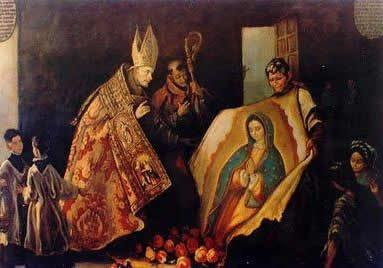 La Virgen de Guadalupe
 A friend of mine once commented that my feminism is evident from the moment you step into my house. In reference to all the female images around my house, she noted that my space reflected a different way of being in the world. I had never thought of it actually, it was not a specifically conscious choice I made to be woman-centered in the books and artwork I displayed, I simply put up what I loved. But once she pointed that out to me, I appreciated the point it raised about what we surround ourselves with and what it reflects about the world we want to live in and help create. What do our spaces evoke for us? for others? Do they help spark the imagination, and if so, what toward?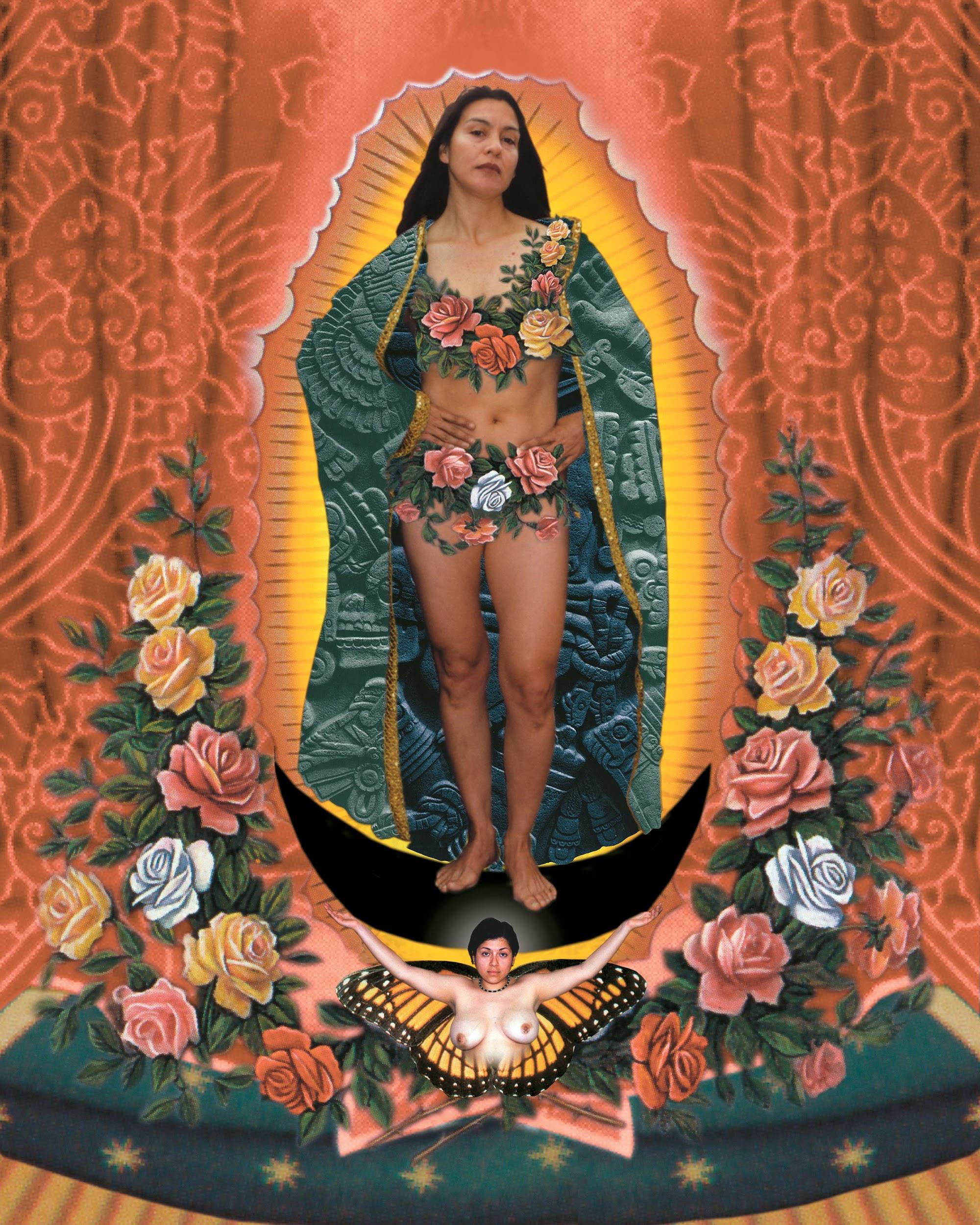
 Feminism and Religion