

Medusa and Athena: Ancient Allies in Healing Women’s Trauma by Laura Shannon

‘Rather than being a bleeding image of female disempowerment, Medusa may be read as…one of the most ancient European symbols of women’s spiritual abilities… [and] an empowering image of feminine potential.’

–Patricia Monaghan, O Mother Sun! (1994:244)

The name Medusa means ‘sovereign female wisdom,’ ‘guardian / protrectress,’ ‘the one who knows’ or ‘the one who rules.’ It derives from the same Indo-European root as the Sanskrit Medha and the Greek Metis, meaning ‘wisdom’ and ‘intelligence.’ (1) Metis, ‘the clever one’, is Athena’s mother. Corretti identifies Athena, Metis, and Medusa as aspects of an ancient triple Goddess corresponding respectively to the new, full, and dark phases of the moon. (2) All three are Goddesses of wisdom, protection, and healing.
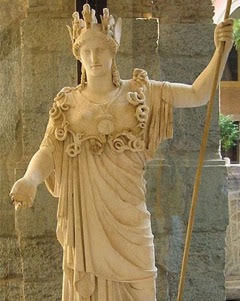
Athena with Gorgoneion in her heart. 5th C BCE.

Athena and Medusa are particularly linked: indeed, one may have been an aspect of the other, ‘two indissociable aspects of the same sacred power.’ (3) Their many common elements include snakes, wings, a formidable appearance, fierce eyes and powerful gaze. The serpent, like the Goddess, has been cast as an embodiment of evil in patriarchal retellings; yet as Merlin Stone points out, serpents were ‘generally linked to wisdom and prophetic counsel’, associated with ‘the female deity’ and ‘entwined about accounts of oracular revelation…throughout the Near and Middle East.’ (4) According to Ovid, the poisonous vipers of the Sahara ‘arose from spilt drops of Medusa’s blood.’ (5) Although this is presented as a further sign of Medusa’s horrifying character, the original Berber inhabitants of North Africa – where Herodotus reports that the Medusa myth began – viewed snakes as bringers of luck and portents of joy. (6)

Despite Medusa’s fearsome appearance, she herself does not personify evil or demonic forces. According to Miriam Robbins Dexter, Medusa is a manifestation of the Neolithic serpent/bird Goddess of life, death, and regeneration. (7) Jane Harrison explains that the ancient Goddess wore the Gorgon mask to warn the uninitiated away from her rites (8), most likely mysteries of the great cosmic cycles of heaven and earth. Patricia Monaghan sees the snakelike rays streaming out from Medusa’s countenance as a sign of a solar Goddess (9), while Joan Marler, citing her connection with Hecate, identifies Medusa more with the moon than the sun (10); either way, Medusa is a heavenly deity ruling over the powers of the cosmos and the rhythms of time. Continue reading “Medusa and Athena: Ancient Allies in Healing Women’s Trauma by Laura Shannon”
OF POWER, GOOD COUNSEL, AND WISDOM by Daniel Cohen

In the Jewish and Christian traditions, Wisdom (Hochma in Hebrew, Sophia in Greek) is a female figure who is an aspect of deity. This has been forgotten for many years, but people are beginning to re-discover Her.

There was a time when Power and Good  counsel walked hand in hand. That was the springtime of the world. In those days men and women honoured each other and honoured also the living world. The sun, moon and stars, the winds, the waters, and even the rocks themselves were known to be alive. In those days Death was no enemy, but a friend to be welcomed when She made the invitation to visit Her country.

But Good Counsel became pregnant, and Power began to be afraid. He feared first that the coming child would take Good Counsel away from him. And then he feared that their child would so well combine the features of the two of them that it would in due course put him down from his place.

Power devised a plan. He opened his mouth to its widest, and pushed Good Counsel in, swallowing her whole. He now felt free of his fears. He began to claim that all the good counsel in the world now belonged to him, and so he declared that it was only fitting he should rule all the world. Though many opposed his claim, he persuaded, and sometimes bullied, others into believing that this opposition was due to bad counsel. And so, though many grumbled and secretly worshipped elsewhere, he set himself up as ruler of the world. Continue reading “OF POWER, GOOD COUNSEL, AND WISDOM by Daniel Cohen”

How a Woman Became a Goddess: Athena by Laura Loomis

A large part of my fascination with Goddesses has to do with images of female power in cultures that were (and are) overtly patriarchal.  Power has a tricky balance:  when it’s being abused, the struggle is to find a way to overcome the oppressor without becoming one yourself.  But to paraphrase Erica Jong, the best oppressors don’t beat you – they get you to beat yourself.  I have been thinking about this as I watch Democrats hand power over to Republicans ever since coming back into control of the government.

Which brings me to Athena.

Athena may have had her origins as a Cretan or North African mother Goddess.  But by classical times in Greece, she was firmly established as the virgin Goddess of wisdom, household crafts, and war and peace.  It’s said that Zeus, like his father and grandfather before him, feared that his child would be more powerful than himself.  So when Metis was pregnant with Athena, he challenged her to a shape-shifting contest.  She took the form of a fly, and Zeus swallowed her.  (I don’t know why he swallowed that fly…)   Continue reading “How a Woman Became a Goddess: Athena by Laura Loomis”

A CLASH OF CULTURES IN OUR GENES by Carol P. Christ

I carry the exact replica of MDNA handed down from mother to daughter since the depths of the last Ice Age 17,000 years ago.  My father carries  the YDNA of the Indo-Europeans handed down from father to son since the time when his male ancestors invaded Europe about 5000 years ago.   

My female ancestors moved with the seasons as they gathered fruits and nuts, roots and greens to feed their families. Some of them may have blown red ochre around their hands to leave their marks in ritual cave-wombs.

Mitochondrial DNA is passed down exclusively from mothers to their children. My MDNA “T2b” was given the name “the clan of Tara” by Bryan Sykes in The Seven Daughters of Eve.  According to Sykes the earliest female ancestor with this gene lived about 17,000 years ago, perhaps in Tuscany. Continue reading “A CLASH OF CULTURES IN OUR GENES by Carol P. Christ”