The Ganga, Yamuna, Saraswati, Kaveri, and Godavari are all goddesses. In contrast, the mountains- Meru, Kailasa, Himalaya are male gods or their celestial abodes. Perhaps this is not just a coincidence but a deliberate gendered imagination that reveals how patriarchal structures flow through the very geography of the sacred.
Indian rivers are predominantly personified as women, with the lone masculine river, Brahmaputra serving as a subversive exception that divulges the somewhat gendered logic of sacred geography.
The Containment of Divine Power
Ganga, the most revered river goddess in India, is born in the heavens, but her descent to earth is mediated by Shiva. His matted locks absorb her torrent, lest her power shatter the earth. Ganga’s sacredness is based on her containment. Feminine energy is revered, but only if domesticated by a male god.
According to the Great Indian Cultural Lexicon, being light-skinned or “fair” translates to being “lovely.” A look at commercials that promise a make-over, courtesy of Fair and Lovely skin lightening cream will attest to this. [1] The definition, of course, applies to women, for that is where a woman’s identity begins and ends – within the realm of physical appearances. When the product first came out some three decades or so ago, it was mostly about being able to draw the attention of a (very often ordinary-looking) guy; the fairness/ beauty rule does not apply to men.[2] These days, things have “progressed”; the attention has shifted from the need to getting hitched to finding success in the workplace, as these messages scream out:
The last one is especially cringe-worthy. The lengthy commercial, meant to be a public service message of sorts, targets women in villages and smaller towns, and goes into great detail about issues of women’s empowerment, about how they ought to think of a career now that they are done with college rather than go the usual marriage route. One of the young ladies, Manju, aspires to be a Collector, a high-ranking government official, a post usually limited to males. She works hard, and she also gets Fair and Lovely to work hard, as she happily lets us know. She eventually achieves her dream, all thanks to Fair and Lovely, of course. You decide what the audience is to get from this. Continue reading “Fair and (Therefore) Lovely by Vibha Shetiya”
In 2003, I picked up a collection of essays on little known Ramayanas. Buried within was a poem by Pathabhi Rama Reddy. Pathabhi, a rebel of Telugu literature, defied not just conventional rules of grammar but also those of popular thinking, best exemplified by his poem, “Sita,” the subject of this post.[1]
Rama’s harsh treatment of Sita in the Ramayana epic when he first doubts her purity, compelling her to undergo a trial-by-fire, and then banishing her despite the fact that she had proved her loyalty to him, has attracted criticism from all quarters – how could the “perfect man” behave so callously towards his own wife who had been Ravana’s helpless victim? The fluidity of the story has ensured a visibility for Sita, no doubt. Continue reading “Wifehood Redefined: The Twentieth Century Sita by Vibha Shetiya”
We have been hearing a lot about Kali and Durga lately, manifestations of the great goddess (“Kali Ma,” by Jassy Watson, July 3; “What Would Durga Do?” by Barbara Ardinger, August 2). Nancy Vedder-Shults’ three-part series on Kali (August-October, 2014) too helped shed light on an often misunderstood deity. Both Kali and Durga personify the power or shakti within women, a force that can be empowering and terrifying at once. Kali represents uncontrolled female energy, whereas Durga is portrayed as one in control of her abundant power. These images, especially the one of Kali are double-edged; they can prove problematic for women insofar as – from the male perspective – they confirm the fact that women possess an alarming energy, especially a sexual one, which in turn justifies the need for men to subdue them.
Sita’s abduction by Ravana. Artist: Raja Ravi Verma
Within this context, I would like to talk about Sita, who, one could argue, is the antithesis of the two. Sita is the gentle wife of Lord Rama, hero of the Ramayana, a two-thousand year old Sanskrit epic. In the Ramayana, Rama, the crown-prince of Ayodhya, is exiled to the forest for fourteen years. His loyal and faithful wife, the princess and goddess Sita, insists on accompanying him to the wilderness. There, the demon king, Ravana kidnaps her leading to a battle between Rama and Ravana. Almost a year and thousands of casualties later, Rama succeeds in slaying Ravana and reclaiming Sita.
But alas, Rama rejects his wife in the presence of the hundreds of onlookers, eagerly awaiting the reunion of the couple, on the grounds that her chastity was suspect; after all, says Rama, surely Ravana couldn’t have resisted her ravishing beauty? If she is to be worthy of Rama, Sita has to undergo a trial by fire to prove that she had indeed remained chaste throughout her captivity. Although she passes with flying colors, Rama eventually gives in to gossip and banishes her to the wilderness a few years later – while she is pregnant with his twins – where she is left to die (she, however, does not). Continue reading “And Then There Was Sita by Vibha Shetiya”


 According to the Great Indian Cultural Lexicon, being light-skinned or “fair” translates to being “lovely.” A look at commercials that promise a make-over, courtesy of Fair and Lovely skin lightening cream will attest to this.
  In 2003, I picked up a collection of essays on little known Ramayanas. Buried within was a poem by Pathabhi Rama Reddy. Pathabhi, a rebel of Telugu literature, defied not just conventional rules of grammar but also those of popular thinking, best exemplified by his poem, “Sita,” the subject of this post.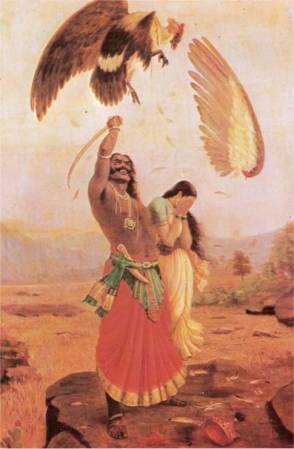
 Feminism and Religion