The Legacy of Carol P. Christ: Good Theology is Feminist Theology

The was originally posted on July 21, 2014

carol christ

Judith Plaskow and I are just now completing the draft of the manuscript of the book we have been working on for the past 2 ½ years. It has a new title: Two Views of Goddess and God for Our Time.* I have been thinking of little else for the past few weeks. An editor who is considering our book said that she was hoping we could address our book to an audience larger than the feminist theology community. Thinking about this, a light dawned: if feminist theology is right that traditional theology denies the full humanity of women, then good theology must be feminist theology. Our work is not tangential to the theological mainstream, but is at its center.

This is the book in its final form.

We have revised the Introduction and Conclusion to the book with the assumption that our work should appeal not just to other feminists, but to a wide range of intelligent readers and thinkers. The fact that we were asked to participate in a dialogue about the nature of God in Tikkun magazine’s Summer 2014 inspires us to hope that we are right that feminist theology is becoming part of the progressive theological mainstream.

Continue reading “The Legacy of Carol P. Christ: Good Theology is Feminist Theology”

Legacy of Carol P. Christ: IS EVIL PART OF THE NATURE OF REALITY AND DIVINITY?

This was originally posted on March 31, 2014. We are posting this on Sunday instead of Carol’s usual Monday in order to accommodate other scheduled posts this week.

carol-christ

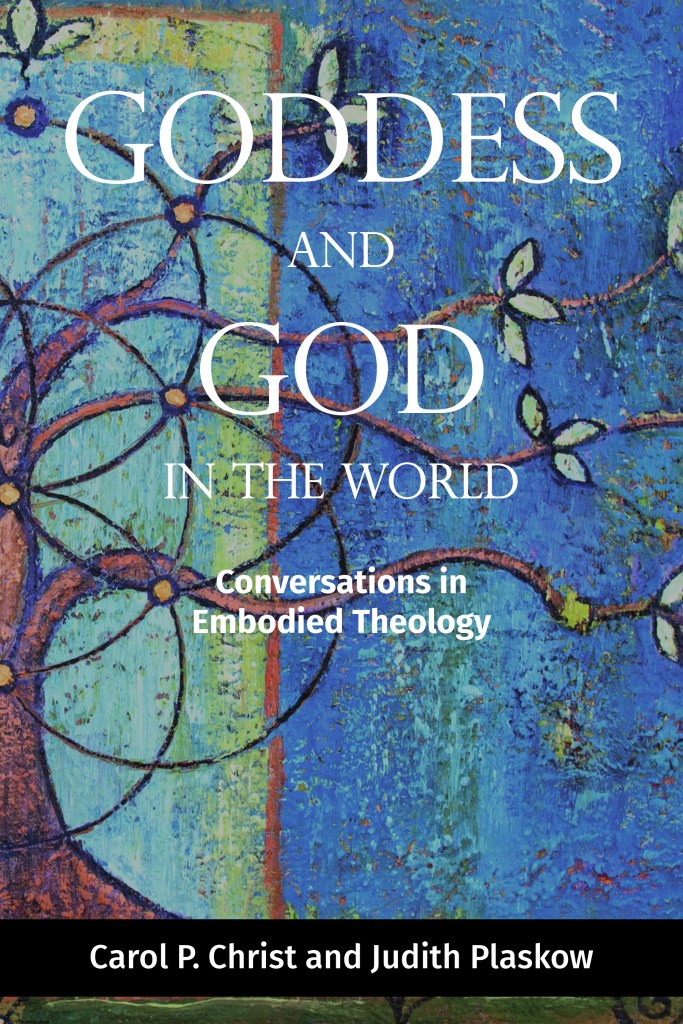
 What is the origin of evil? Is it innate in human nature or even in the nature of the universe? Judith Plaskow and I discuss this question in our forthcoming book Goddess and God in the World and this is a chance to listen in our conversation.

I am responding to Judith’s allegation that in imagining Goddess as loving and good I am fantasizing an ideal deity who exists apart from the evil-and-good world that we know. Judith speaks of an “evil impulse” in human beings which she considers to be innate in human beings and in the nature of reality. Judith says that my “defense” of the goodness of God comes down to “the traditional free will defense.” She also questions my view that human beings can 

I argue that it does not because the traditional free will defense imagines an omnipotent God who existed before the creation of the world. Then I continue:

I think what you meant to say is that like those who invoke the traditional free will defense of the omnipotent God, I attribute humanly chosen evil entirely to human beings—and not to Goddess or God.

Continue reading “Legacy of Carol P. Christ: IS EVIL PART OF THE NATURE OF REALITY AND DIVINITY?”

Legacy of Carol P. Christ: IS GODDESS “WITH US” OR “IN CONTROL” OF EVERYTHING? THE “THEOLOGICAL MISTAKE” OF DIVINE OMNIPOTENCE

carol-christ

This post was originally published on Feb. 24th, 2014.

How do we make sense of loss, great loss, and everyday disappointment? Some would tell us that “everything has a purpose” or that whatever happens “must be the will of God.”  I have found that these answers to questions raised by life as we know it often do more harm than good.  Yet they have a sticking power–we hear them all the time, sometimes even from other feminist seekers.

From the beginning feminists in religion rejected “the God out there” who rules the world from a throne in heaven. Most of us have insisted that “God” is more “in” the world than “beyond” or “outside it.” However we have not always been consistent in our convictions. When feminists are confronted with untimely death or great evil or just not getting what we think we want, we can sometimes be overheard to wonder, “Why did God (or Goddess) let that happen?” This question is based in the assumption that God or Goddess is omnipotent and rules the world from outside it. This is the theological idea I intend to question today.

The “zero fallacy” is a term philosopher Charles Hartshorne used to explain the “theological mistake” known as divine omnipotence.  Hartshorne pointed out that if God is omnipotent, then God has “all” or “100%” of the power. If this is so, then human beings and all other beings have “zero” power.  But if we have zero power, then do we even exist?  Continue reading “Legacy of Carol P. Christ: IS GODDESS “WITH US” OR “IN CONTROL” OF EVERYTHING? THE “THEOLOGICAL MISTAKE” OF DIVINE OMNIPOTENCE”

The ‘Current’ of Patriarchy: Feminization of Rivers in Indian Mythology by Dhruv Kabra

The Ganga, Yamuna, Saraswati, Kaveri, and Godavari are all goddesses. In contrast, the mountains- Meru, Kailasa, Himalaya are male gods or their celestial abodes. Perhaps this is not just a coincidence but a deliberate gendered imagination that reveals how patriarchal structures flow through the very geography of the sacred.

Indian rivers are predominantly personified as women, with the lone masculine river, Brahmaputra serving as a subversive exception that divulges the somewhat gendered logic of sacred geography.

The Containment of Divine Power

Ganga, the most revered river goddess in India, is born in the heavens, but her descent to earth is mediated by Shiva. His matted locks absorb her torrent, lest her power shatter the earth. Ganga’s sacredness is based on her containment. Feminine energy is revered, but only if domesticated by a male god.

Continue reading “The ‘Current’ of Patriarchy: Feminization of Rivers in Indian Mythology by Dhruv Kabra”

Legacy of Carol P. Christ: What Was Your Childhood Religious Tradition And Do You Still Follow It?

This post was originally published on Nov. 26th, 2012

Recently, in an interview with the Women’s Living History Project of Claremont Graduate University, I was asked: What religious tradition did you identify with as a child and how did it impact your childhood? and: Is your tradition the same today that you had when growing up?

I was surprised that the interview questions didn’t ask anything about feminism, experiencing exclusion in patriarchal religions, or belief.  My religious and political convictions, which are intertwined, have alienated me from family members.  Therefore, I was suspicious of questions that seemed to have been formulated by someone for whom religion and family go together, and for whom believing or not believing (!) did not seem to be an important issue.

After expressing criticism of the questions, I agreed to work with them.  My answer to the first question was that I did not have a single religious tradition as a child. I had four.  Continue reading “Legacy of Carol P. Christ: What Was Your Childhood Religious Tradition And Do You Still Follow It?”

Legacy of Carol P. Christ: “The Divine Mystery”?

carol-christ

This post was originally published on Nov. 11th, 2013

“The mystery of God in feminist theological discourse” is the subtitle of Elizabeth Johnson’s widely read She Who Is. The notion that God is “a mystery” is rarely questioned in feminist theologies. But maybe it should be.

Although it is true that the finite cannot encompass the infinite, and that all knowledge is rooted in particular standpoints, I do not agree that the first and last thing to be said about the divine power is that it is “a mystery.” Indeed as I will argue here, speaking about God as “a mystery” obscures more than it “reveals.”

christina's loveThe notion that Goddess or God is “a mystery” is rooted in notions of “a God out there” that most spiritual feminists reject. Goddess or God “in” the world is, I suggest, not unknown, but known, not hidden, but revealed–in the beauty of the world and in ordinary acts of love and generosity.

The notion that God is “a mystery” is a well-worn trope in Roman Catholic theology. Protestants make similar claims when they speak of  the hiddenness of God Continue reading “Legacy of Carol P. Christ: “The Divine Mystery”?”

From the Archives: Tree of Life: The Festival of the Trees in an Age of Treefall by Jill Hammer

This was originally posted on January 22, 2019

Almost every day, I walk in Central Park.  There are certain trees there I’ve come to know: the gnarled cherry trees by the reservoir, the bending willows and tall bald cypress by the pond, the sycamores that drop their bark each summer, the hawthorn not far from Central Park West.  Lately I’ve been taking photos of the trees to try to capture their essence, their posture in the world.  The trees around me feel like friends, which is what an ancient midrash (interpretation/legend) called Genesis Rabbah says about trees: that they are friends to humankind.  To me, they’ve always been a central manifestation of Mother Earth.

Currently, the national parks in the United States have no staff because of the government shutdown. Some people have taken the opportunity to cut down the rare and endangered Joshua trees in the Joshua Tree National Park—just for fun, I guess, or as a trophy of some kind.  Meanwhile, President Bolsonaro of Brazil recently has indicted that he wants to remove protection for the rainforest, in order to allow development.  It appears that my friends the trees have enemies.  Sometimes the enmity is for personal/corporate gain, and sometimes the enmity seems to have no reason at all.

Continue reading “From the Archives: Tree of Life: The Festival of the Trees in an Age of Treefall by Jill Hammer”

Legacy of Carol P. Christ: GODDESS WITH US: IS A RELATIONAL GOD POWERFUL ENOUGH?

This was originally posted on Sept 2, 2013

Last week I wrote about Protestant Neo-Orthodoxy’s deification of male power as power over.  This week I want to ask why the relational Goddess or God* of process philosophy has not been more widely embraced, both generally and in feminist theologies.

Could it be that a relational God just isn’t powerful enough? Are some of us still hoping that an omnipotent God can and will intervene in history to set things right?  Do we believe an omnipotent God can save us from death?

Process philosophy provides an attractive alternative to the concept of divine power modeled on male power as domination.  According to leading process philosopher Charles Hartshorne, the power to coerce, power as power over and domination, is not the kind of power God has.

The concept of divine power as omnipotent (having all the power) leads to what Hartshorne called “the zero fallacy.”  If God has all the power and can dominate in all situations, then the power of individuals* other than God is reduced to zero.  In effect, this means that individuals other than God do not really exist, but at most are puppets whose strings are pulled by the divine power.

Continue reading “Legacy of Carol P. Christ: GODDESS WITH US: IS A RELATIONAL GOD POWERFUL ENOUGH?”

Legacy of Carol P. Christ: “THE DIVINE MYSTERY”?

This was originally posted on November 11, 2013

christina's love

“The mystery of God in feminist theological discourse” is the subtitle of Elizabeth Johnson’s widely read She Who Is. The notion that God is “a mystery” is rarely questioned in feminist theologies. But maybe it should be.

Although it is true that the finite cannot encompass the infinite, and that all knowledge is rooted in particular standpoints, I do not agree that the first and last thing to be said about the divine power is that it is “a mystery.” Indeed as I will argue here, speaking about God as “a mystery” obscures more than it “reveals.”

Continue reading “Legacy of Carol P. Christ: “THE DIVINE MYSTERY”?”

Legacy of Carol P. Christ: “God is Not a Man, God Is Not a White Man”

This was originally posted February 1, 2016

“The pictures that line the halls speak volumes about the history of racism and sexism and they shape the future in powerful ways.”–Simon Timm

The author of these words recently posted a short video on Youtube entitled “Mirror Mirror on the Wall: The Legacies of Sexism and White Supremacy at Yale Divinity School.”* The video begins with a catchy little ditty with the words, “God is not a man, God is not a white man.” It tracks paintings and photographs of professors and other luminaries in the field of theology on the walls of the Yale Divinity School. By Timm’s count: 99 white males, 6 women, and 3 blacks. The single black woman is counted in both categories.

Continue reading “Legacy of Carol P. Christ: “God is Not a Man, God Is Not a White Man””