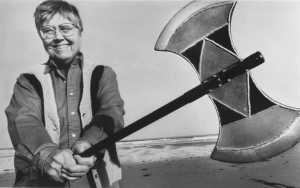
This is What a Catholic Looks Like By Kate Conmy

The following is a guest post written by Kate Conmy, MA, Membership Coordinator for the Women’s Ordination Conference.  Kate celebrates spiritual activism, feminism, and human rights.  She currently works as the Membership Coordinator for the Women’s Ordination Conference and lives in Washington, DC.  She can be contacted at Kconmy@womensordination.org.

In my last semester as a Religion student at Mount Holyoke College I sat in my Feminist Theology seminar with only one question for our guest speaker: “Why are you still a Catholic?” A question I rarely dared to ask myself as I spent most of my studies concentrating on Buddhism, traveling abroad to Dharamsala, India, interning with the Buddhist Peace Fellowship in Berkeley, even learning Tibetan; by most observable assessments I had swapped the pew I grew up in for a zafu.  But Mary Hunt reminded me in such a simple and smart way that Catholicism is about community building and justice seeking. She said: “This is what a Catholic looks like. We have a responsibility to speak this language.”

In that moment I realized I had been resisting something that has always belonged to me. Raised in a Jesuit-educated Catholic family in Upstate, New York I felt less confirmed within the church, and more convinced that we were celebrating a god that was too small. One of the great mysteries for me growing up in a church-going family was the personal and religious reconciliation the Catholics I knew negotiated, sometimes weekly to make sense of their faith.  The dissonance between what was practiced during Mass, and what Catholicism meant at the dinner table seemed an exhausting spiritual dance of ambivalence.  It wasn’t until I began to identify as a feminist theologian that my spiritual worlds converged in a moment of satori: ambivalence is a virtue!  The sisters and daughters of Mary Daly gave me permission to re-claim my Catholicism with all of my questions as an extraordinary action of faith.  Ambivalence means courageously engaging the sacred to foster critique, conversation and innovation in the pursuit of knowing God. Just as Carter Heyward writes, “To love God is to un-do evil,” I so strongly believe that God must manifest as an expression of creative justice whereby inclusivity, “right-relation,” and the elimination of discrimination are central on the path toward a higher liberation. I graduated feeling empowered by women, activists, and radicals who claimed their faith and the responsibility to speak a language beyond the binary in order to celebrate the wisdom of all human and divine goodness.  Continue reading “This is What a Catholic Looks Like By Kate Conmy”

Mary Daly: Radical Elemental Feminist and Sinner By Gina Messina-Dysert

While some argue that Mary Daly was too radical, I have been greatly influenced by her contributions to the field of feminism and religion.  I can still remember the first time I read a piece of her work.  It was during my undergraduate career at Cleveland State University in a course entitled “Women and Religion.”  I was immediately impacted and wanted to know more about this bold, strong and courageous woman, and although I had already considered myself a feminist, it was in that moment I recognized the existence of patriarchy in religion.  Shortly thereafter I applied to a graduate program in religious studies and became better acquainted with Daly’s work and the intersection of feminism and religion.

While I must admit that I am troubled by some of Daly’s claims and disagree with some of her contentions, I have also been significantly influenced by her foundational work in feminist theology, her demand for women’s liberation and Spinning of new tales and new ideas.  Daly called for women to have the courage to be, to experience a new fall out of patriarchal systems and into a new being that allows women to discover their capabilities, the dynamic power women possess within themselves.

According to Mary E. Hunt, co-founder and co-director of the Women’s Alliance for Theology, Ethics and Ritual (WATER), “Her contributions to feminist theology, philosophy, and theory were many, unique, and if I may say so, world-changing. She created intellectual space; she set the bar high. Even those who disagreed with her are in her debt for the challenges she offered…She always advised women to throw our lives as far as they would go. I can say without fear of exaggeration that she lived that way herself.”[1]

While I never had the opportunity to meet Mary Daly, I have no doubt been inspired by her brilliance, courage, wit, and spirit.  My feminist and theological views have been shaped through her influence. I have been able to spiral into freedom and rename and reclaim my own experiences; I have found my own creative power.  Thank you for having the courage to sin big Mary Daly.

“There are and will be those who think I have gone overboard. Let them rest assured that this assessment is correct, probably beyond their wildest imagination, and that I will continue to do so.” – Mary Daly