Archives from the FAR Founders: We Are Responsible for Asking the Questions by Caroline Kline

This was originally posted on FAR July 3, 2102 (a version of this was originally posted at Patheos) This is part of a project to highlight the work of the four women who founded FAR: Xochitl Alivizo, Caroline Kline, Gina Messina, and Cynthia Garrity-Bond

Twelve years ago, a conversation with my then-boyfriend turned to the Mormon ideal of husbands presiding over wives. I couldn’t understand why such language was necessary in a relationship of equals. My boyfriend speculated, among other things, that it might simply mean that the man was ultimately more responsible for the family’s success than the woman.

We explored that idea for a bit, but the more we talked about it the sicker I felt. As this dark feeling came over me, I first articulated to myself a truth I would later often return to: that I am fully human, fully responsible before God, an agent in my own right, and an equal partner in the truest sense of the word. My future husband would need to see me as such for any marriage to survive. And God must see me as such as well.

Continue reading “Archives from the FAR Founders: We Are Responsible for Asking the Questions by Caroline Kline”

“We Knocked” :: A Review of Mormon Feminism by Caryn D. Riswold

caryn2Mormon feminists experience what most feminists of faith have heard at some point. Utter dismissal of the possibility of their existence.

We know several variations:

You can’t be Christian and feminist.

There’s no such thing as a Catholic feminist.

You can’t seriously be Jewish and feminist.

You can’t possibly be Muslim and feminist.

To be Mormon and feminist? Preposterous.

In response, scholars, activists, and writers within each tradition have had to document their history, make their theological case, and engage their scriptures as robustly as any conservative traditionalist would. In order to achieve meaningful institutional change, unimpeachable work and confident testimony is required. Continue reading ““We Knocked” :: A Review of Mormon Feminism by Caryn D. Riswold”

Faith Doesn’t Need Walls: A Conversation with Kate Kelly by Kate Stoltzfus

Kate.Stoltzfus-1When Kate Kelly faced excommunication from the Church of Jesus Christ of Latter-Day Saints in June 2014, much of the world took notice. The D.C.-based human rights lawyer garnered wide-spread attention for founding Ordain Women, a movement to push for advocacy of female ordination in her Mormon faith. A ripple of press from The New York Times to The Huffington Post chronicled Kelly’s waves of activism and its subsequent consequences: excommunication in absentia on June 23 by her former church leaders in Virginia.

While the press has since died down, the momentum remains. Church leaders denied Kelly’s first appeal against the charge in October 2014, but Kelly remained hopeful of her plan to appeal a second time to the church’s First Presidency when she spoke to WATER (Women’s Alliance for Theology, Ethics, and Ritual) a month later. Continue reading “Faith Doesn’t Need Walls: A Conversation with Kate Kelly by Kate Stoltzfus”

Women’s Ordination and the Mormon Church by Margaret Toscano

Me April 2011 3Caroline Kline’s March 26 post, “Mormons Who Advocate Women’s Ordination,” marks a new direction in the Mormon feminist movement. As she describes, the website Ordain Women was launched on March 17 by a few dozen Mormon women and men who state: “As a group we intend to put ourselves in the public eye and call attention to the need for the ordination of Mormon women to the priesthood.” By the end of March, 44 people (37 women and 7 men, including a Mormon bishop) have posted profiles with photos where they describe their relationship to Mormonism and why they think women should be ordained. I understand from the organizers of this site that a number of others have submitted profiles for posting and that the site has had close to 100,000 hits. On the corresponding Facebook page, however, only 363 people have given Ordain Women a “Like” sign.

While supporters may appear to be a small group in comparison to the 14 million Mormon (aka LDS) church members worldwide, it is a significant number for a grassroots movement like this. As a Mormon feminist who has publicly advocated for the ordination of women since 1984, this is the first time I have seen more than a handful of people willing to state publicly their belief that women should be ordained. In the past, women’s ordination has always been the dividing issue among Mormon feminists. All Mormon feminists want women to have more voice in the Church, more decision-making power, more visible authority and equality. Very few have wanted to be ordained into the male-priesthood structure of the Church, though more have claimed a private, spiritual priesthood.

And yet, as I have always argued, there is no way that Mormon women can be equal to Mormon men as long as they are denied access to priesthood ordination and offices because the priesthood structure controls all resources, discourses, and practices. In some ways this issue is even more crucial in the LDS Church than in other religious traditions because the Mormon organization is based on a lay priesthood where all active boys and men have priesthood. What this means is that grown women have less practical and religious authority than their 12-year old sons. Continue reading “Women’s Ordination and the Mormon Church by Margaret Toscano”

Fanpire by Tanya Erzen

A girl treats the Twilight series as a holy book, emulates the behavior of the vampire family at its center, and makes a pilgrimage to Forks, WA, the setting of the books.  This could just be a run-of-the-mill Twilight fan.  After all, Twilight, a young adult romance between the exceptionally clumsy 16-year old human Bella Swan, and a vampire named Edward Cullen who has been seventeen since 1918, is beloved by millions of women and girls.   Thirteen million copies of the books have been sold in the United States; 116 million copies, worldwide, with translations into thirty-seven languages. The film adaptations are some of the highest-grossing movies of all time. Continue reading “Fanpire by Tanya Erzen”

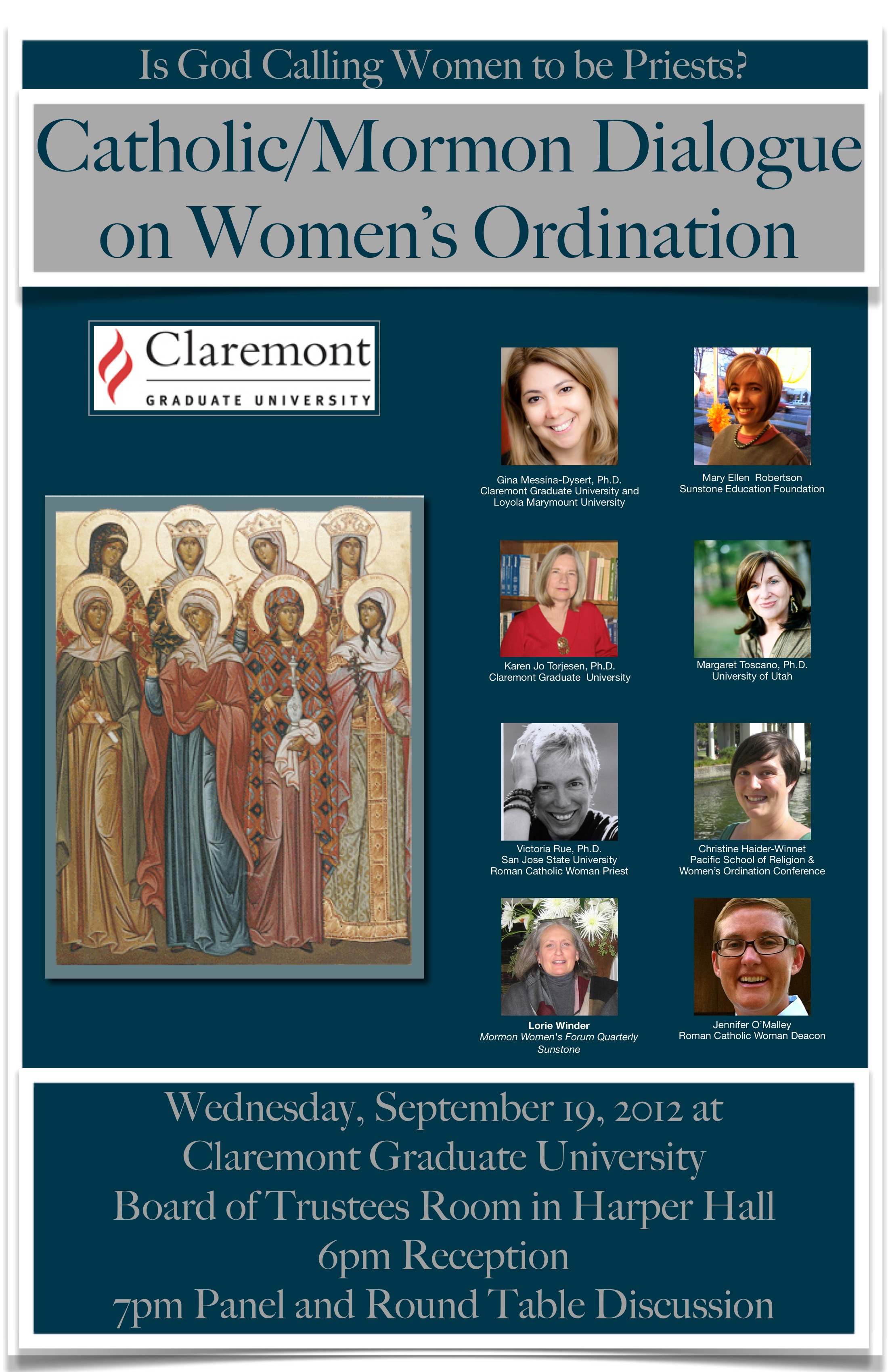
Catholic/Mormon Dialogue on Women’s Ordination

The Catholic/Mormon Dialogue on Women’s Ordination at Claremont Graduate University will take place Wednesday, September 19, 2012.  It is an incredibly relevant topic today and particularly interesting with a Mormon/Catholic presidential ticket before us.

It makes sense to bring Catholics and Mormons together to dialogue about this issue.  Women’s ordination in both Churches is considered a taboo topic and one that if discussed in public can lead to excommunication.  Certainly the women who will stand publicly to address this issue and share their passion and conviction for the need to ordain women are courageous and committed to the recognition of the full humanity of every woman and every man.  Continue reading “Catholic/Mormon Dialogue on Women’s Ordination”

We Are Responsible for Asking the Questions by Caroline Kline

(a version of this was originally posted at Patheos)

Twelve years ago, a conversation with my then-boyfriend turned to the Mormon ideal of husbands presiding over wives. I couldn’t understand why such language was necessary in a relationship of equals. My boyfriend speculated, among other things, that it might simply mean that the man was ultimately more responsible for the family’s success than the woman.

We explored that idea for a bit, but the more we talked about it the sicker I felt. As this dark feeling came over me, I first articulated to myself a truth I would later often return to: that I am fully human, fully responsible before God, an agent in my own right, and an equal partner in the truest sense of the word. My future husband would need to see me as such for any marriage to survive. And God must see me as such as well.

As a person who insists on the inherent equality of men and women, I continue to have questions about women’s place in Mormon theology and in the structural organization of the Church. Continue reading “We Are Responsible for Asking the Questions by Caroline Kline”

Heavenly Mother and Theological Jealousy by Brooke Nelson

It was a sad day for me when I realized that I could never, no matter how hard I tried, be the Virgin Mary.

Putting aside her biggest claim to fame, I sincerely doubted that I was born immaculately, had never sinned (even in thought) or would be happy married to a much, much older man whom I didn’t get to pick. Growing up in a Roman Catholic household, however, the Virgin Mary was really the only model available for girls like me. When I realized I could never be her, I found myself wondering about who I could be. Was there even a place for people like me in a theological system that held up unobtainable goals as my only option?

That is when I started envying the Mormons. Continue reading “Heavenly Mother and Theological Jealousy by Brooke Nelson”

Modesty Codes in Pentecostalism and Mormonism by Amanda Pumphrey

“You look like a lesbian.” “Why do you want to look like a man?” “Hey, boy head!” These were just some of the responses I got from friends and family when I decided to cut off my hair. The gendered connotations that come with how one decides to wear one’s hair are an overarching signifier of the dominant culture’s obsession with normative appearances. Many religious institutions and congregations uphold normative understandings of appearance and dress. Growing up in a conservative town in rural South Georgia and being raised within a Pentecostal tradition came with many challenges regarding gender, sexuality, and dress.

In an earlier post on FAR, I described my experiences with my church and my community regarding sexuality in “Sexual Ethics and Southern Belles.” In this post, I want to further explore those thoughts to discuss modesty codes within my own Pentecostal denomination, The Church of God, and within the LDS Church. Both Mormonism and The Church of God promote modesty codes that are ultimately harmful to girls and women.  Continue reading “Modesty Codes in Pentecostalism and Mormonism by Amanda Pumphrey”

It’s not easy being a full-time female missionary for the Mormon Church by Rachel Hunt

Before I was born, but after I was conceived, my father had a dream. In this dream, he knew that I would be a great missionary. And because of this knowledge, (and because he a. didn’t see me in the dream and was b. Mormon*) he thought I would be a boy.

To my mom’s credit, she reminded my dad, “Girls can be great missionaries too,” and to my dad’s credit, he was not disappointed when I did indeed turn out to be a girl. He also never let go of his impression that I would be a great missionary. Perhaps because of this story, perhaps because of hearing his (and my brothers’) mission stories, I grew up sincerely wanting to serve a mission.

It wasn’t until high school that someone first told me that I shouldn’t go on a mission because I was a girl. The words were spoken by my female leader, with the explanation that men were to go on missions and women were to get married. My best friend and I were upset, because we were adamant that we were going, but we brushed it aside, letting it add flame to our desire.  Continue reading “It’s not easy being a full-time female missionary for the Mormon Church by Rachel Hunt”