
From the Archives: Creating Space: Mosques Affirming All Bodies, Minds, and Hearts by Laury Silvers

This was originally posted on December 31, 2013

Silvers, Bio Pic FRBlog

In my first blog for Feminism and Religion, I discussed the cognitive and embodied dissonance that some Muslims experience as a result of historically (not eternally) gendered ritual forms. I ended with a promise to share with readers the ways in which el-Tawhid Juma Circle mosques try to create space to break free of those forms. Our mosques affirm all human beings as spiritually, socially, and ritually equal and try to break down the social hierarchy of ritual and theological leadership by opening up a space for all bodies, minds, and hearts to lead and follow as equals among each other.

Breaking out of cognitive and embodied dissonance requires cognitive and embodied habituation to what Amina Wadud names, “The Tawhidic Principle.”  Meaning, the space must be one in which human beings can embody divine oneness by recognizing that their relationships with each other are on the horizontal plane and refrain from mediating between any other individual and God on the vertical plane.  Wadud has described it as a triangle in which God is at the top with self and other at the two points beneath. Each has an individual relationship with God and a relationship of reciprocitous community with each other. Wadud argues that to mediate between another and God is nothing other than idolatry because the mediator forces another to accept that satisfying his expectations is the same as satisfying God.

Continue reading “From the Archives: Creating Space: Mosques Affirming All Bodies, Minds, and Hearts by Laury Silvers”
From the Archives: Censored Angel: Anthony Comstock’s Nemesis. A Novel by Joan Koster

This was originally posted on October 10, 2024.

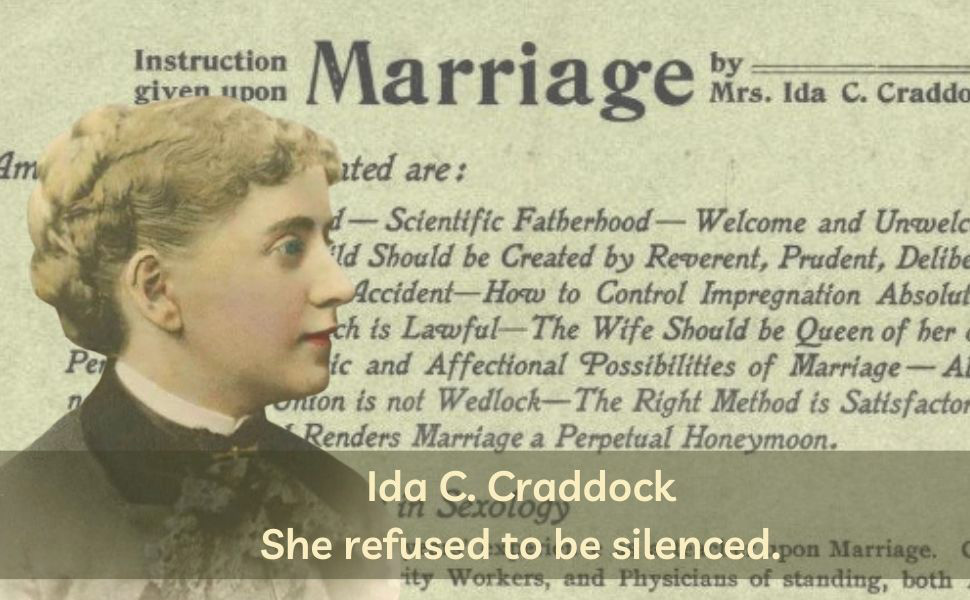
Moderator’s Note: With the Trump administration getting closer and closer to re-establishing the Comstock Laws in their efforts to stop all abortions in the United States, we felt it important to repost this story. It is about Ida Craddock, her life and her efforts to stand against Anthony Comstock. Joan Koster wrote a powerful book about her. This post today is also a prelude to tomorrow’s post which will discuss a new movie Sex Radical that will be premiering this month about Ida Craddock’s life.

“I would lay down my life for the cause of sex reform, but I don’t want to be swept away. A useless sacrifice.” Ida C. Craddock, Letter to Edward Bond Foote, June 6, 1898

In 1882, Ida C. Craddock applied to the all-male undergraduate school of University of Pennsylvania. With the highest results on the entrance tests, the faculty voted to admit her. But her admission was rejected by the Board of Trustees, who said the university was not suitably prepared for a female. (U of P only became co-ed in 1974)

With her aspirations blocked, Ida left home determined to leave her mark on women’s lives by studying and writing about Female Sex Worship in early cultures. At the time, little information was available to women about sexual relations. To do her research, Ida resorted to having male friends take books forbidden to females, such as the Karma Sutra, out of the library for her.

An unmarried woman, she turned to spirituality and the practice of yoga, a newly introduced practice to the American public at the time, as a way to learn about sex. In her journals, she describes her interaction with angels from the borderlands, and in particular, her sexual experiences with Soph, her angel husband through what was likely tantric sex.

Continue reading “From the Archives: Censored Angel: Anthony Comstock’s Nemesis. A Novel by Joan Koster”

Censored Angel: Anthony Comstock’s Nemesis. A Novel by Joan Koster

“I would lay down my life for the cause of sex reform, but I don’t want to be swept away. A useless sacrifice.” Ida C. Craddock, Letter to Edward Bond Foote, June 6, 1898

In 1882, Ida C. Craddock applied to the all-male undergraduate school of University of Pennsylvania. With the highest results on the entrance tests, the faculty voted to admit her. But her admission was rejected by the Board of Trustees, who said the university was not suitably prepared for a female. (U of P only became co-ed in 1974)

With her aspirations blocked, Ida left home determined to leave her mark on women’s lives by studying and writing about Female Sex Worship in early cultures. At the time, little information was available to women about sexual relations. To do her research, Ida resorted to having male friends take books forbidden to females, such as the Karma Sutra, out of the library for her.

An unmarried woman, she turned to spirituality and the practice of yoga, a newly introduced practice to the American public at the time, as a way to learn about sex. In her journals, she describes her interaction with angels from the borderlands, and in particular, her sexual experiences with Soph, her angel husband through what was likely tantric sex.

Continue reading “Censored Angel: Anthony Comstock’s Nemesis. A Novel by Joan Koster”

Navigating Arousal and Desire: What do you fantasise about?

Sexuality is a complex topic that blends the personal with the collective and the mundane with the sacred. We often engage with it privately, yet it is intertwined with broader cultural values and beliefs. This makes navigating sexual fantasies a delicate balance of desire, respect and consent.

In today’s world, especially with movements like #MeToo gaining traction, there’s a heightened awareness around the importance of boundaries—both physical and psychological—in the realm of sex and fantasy.

This post explores how we can engage with sexual energy in ways that respects both our own and other’s integrity, that don’t “steal” from others, nor diminish ourselves.

It starts with the power of consent in fantasies, discusses 4 steps to navigate desire without acting on it, and introduces the possibility of archetypal fantasies.

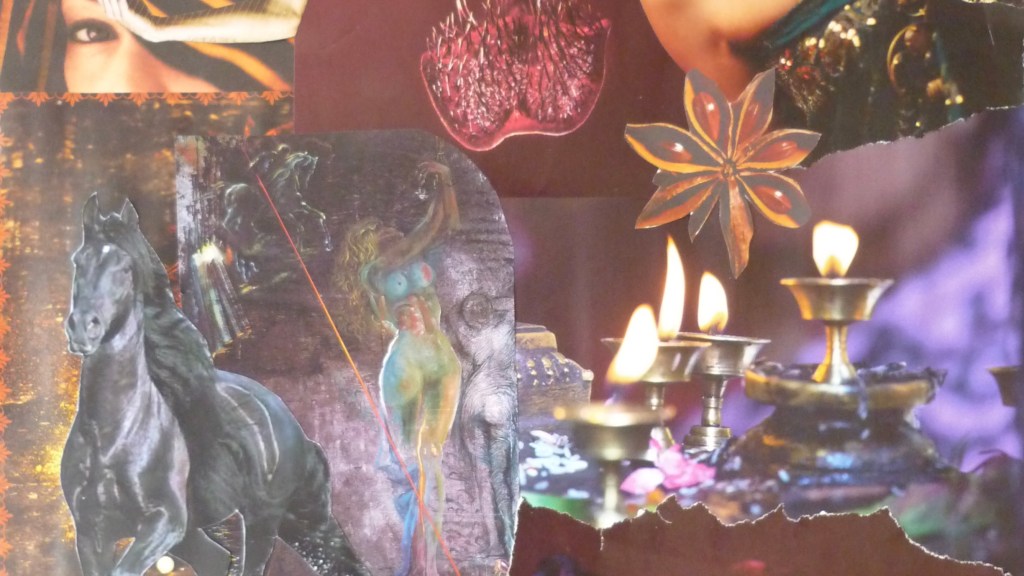
Detail of Passion. Collage by Eline Kieft (2.9.12)
Continue reading “Navigating Arousal and Desire: What do you fantasise about?”

The Courage to Go Your Own Way by Caryn MacGrandle

My eleven-year-old daughter is regularly called a lesbian in the conservative Southern town that we live.  Not because she has identified her gender, but because she does not dress the same as all of the other girls or wear any makeup.  She wears linen baggy pants with casual t-shirts.  And it is not as if the other girls are dressed more formally than her, but there is a ‘prescribed’ casual look that involves Lululemon and expensive sports casual clothing bought at stores like Dick’s Sporting Goods.

My daughter doodles a skeleton on her hand, and the girl next to her calls her ‘emo’ akin to pariah in the culture.  The boy on the other side says, ‘why don’t you just go kiss a girl already.  Faggot.’      

My heart breaks when I hear her tell me these things.

‘Keep carving your own way.  Fly,’ I silently entreat her.

Continue reading “The Courage to Go Your Own Way by Caryn MacGrandle”

From the Archives: Genderqueering by John Erickson

Moderator’s note: Today’s blogpost was originally posted March 24, 2015. You can visit the original post here to see the comments.

This post is a response to a recent blog entry titled “Who is Gender Queer?” on this site from Carol Christ. It was posted yesterday. I want to thank my friend, advocate, and upcoming scholar Martha Ovadia for reasons only she knows!  Stay brave, speak up, be heard!

Leelah Alcorn, Ash Haffner, Aniya Knee Parker, Yaz’min Shancez

It is terrifying to know that something is wrong but not be able to speak truth to power.

Continue reading “From the Archives: Genderqueering by John Erickson”

Feminist Parenting About Sexuality Part 4: What to tell my daughters by Trelawney Grenfell-Muir

In this blog series, we have discussed:

—The importance of admitting how painful this subject is

—Reminders that I am NOT saying all men are bad or maleness is bad, because men and maleness are truly inherently beautiful and divine

—The necessity of facing honestly just how scary and horrifying the epidemic of violence against females is in our world today

—The truly evil, vicious destruction pornography is causing to female bodies and male psyches in training many, many males to rape and abuse females, and grooming females to normalize and comply with rape and abuse by males

Continue reading “Feminist Parenting About Sexuality Part 4: What to tell my daughters by Trelawney Grenfell-Muir”

Pleasure, Touch, and Spirituality by Chris Ash

Sitting in front of the computer, I slowly and intentionally insert earbuds, click to start my favorite writing playlist, and open up Microsoft Word. I feel the tips of my fingers resting lightly on the keys, and notice the slight give of each printed square, glossy in the middle from months of 80 words per minute. I lightly tap my fingers on the keys, not pressing enough to type a letter, body motionless except my fingers, watching the absolute stillness of the screen, exploring the edge between pressure and performance with slow, shallow breaths, finally noticing the moment when the edge is breached, the key catches, and a letter appears on my screen, taking it in with satisfaction.

This is how all my writing starts, with a ritual of simple pleasure and partial attempt at channeling. My partner recognizes this move when he sees it. It’s one I repeat throughout the writing process, as I’m waiting (hoping) for the next words to come to me. I’ll stop, lift my head and close my eyes, and allow my fingers to wiggle lightly over the keyboard as if inviting the unseen to move through me and write my piece. If that still doesn’t produce words, I might run my hands from thigh to knee, fingers pressing with increasing depth into denim-covered flesh. Or I might bring my hands up to my face, fingers resting on my hairline, palms lightly covering my eyes, as I experience the instant soothing of darkness and warming effect over closed eyelids, connecting to the me-within so she can help me bring forth missing concepts. Continue reading “Pleasure, Touch, and Spirituality by Chris Ash”

Sex is a Feminist Issue: An Interview with Rev. Dr. Beverly Dale by Jera Brown

Sex is a feminist issue. Harmful perspectives on sex and our physical bodies have been used to disempower and invalidate the sexuality of women, LGBTQIA folks, and people of color. It runs through our theology and cultural traditions within the church.

I run a personal blog which speaks positively about sex and queerness. And when folks find it, frequently, their first questions to me is what other resources are out there that teach a better Christian perspective? I often tell them to start with The Incarnation Institute for Sex and Faith.

IISF offers “inclusive, science-friendly, sex-positive” educational programming for church leaders and lay people. Founder Rev. Dr. Beverly Dale, affectionately known as “Rev Bev,” is ordained through the Christian Church (Disciples of Christ) and currently teaches courses on sexuality and religion at Lancaster Theological Seminary.

The institute recently released a four-part web series, Reading the Bible with Sex-Positive Eyes, which includes the topics: “Introduction to Christian Sex Negativity: The Beginnings,” “Discerning Truth, Discerning Culture,” “Sex in the Bible: The Good, The Bad & the Ugly,” and “Sex: Whether, When, and How.”

I interviewed Rev Bev about the new series.

Continue reading “Sex is a Feminist Issue: An Interview with Rev. Dr. Beverly Dale by Jera Brown”

Tall Order by Sarah Kiefer

I saw an interesting headline the other day entitled: “Olympic Gymnast Hits Back at Body-Shaming.” I immediately thought, “Wow not again.” The fact that body-shaming is even an expression is a disheartening commentary on the society we live in today. Women’s bodies have long been the subject of casual objectification in our culture and in the media. The fact that people think it’s ok to comment on a woman’s body, in whatever fashion pleases them, blows my mind. Not only is it disrespectful, but it comes from the problematic way society equates a woman’s worth with her beauty.


People have diverse ideas of beauty, and different cultures value different physical qualities, but this does not mean that those who don’t live up to the ideal should be shamed. In the article, Gymnast Aly Raisman relates an experience at an airport where a female employee recognized her and mentioned one of the reasons was “because of her muscles.” A male colleague then stated “Muscles? I don’t see any muscles” and “continued to stare” making Raisman feel uncomfortable. She then took to twitter to relay the events stating: “I work very hard to be healthy and fit. The fact that a man thinks he can judge my arms pisses me off.  I am so sick of this judgmental generation.” Continue reading “Tall Order by Sarah Kiefer”