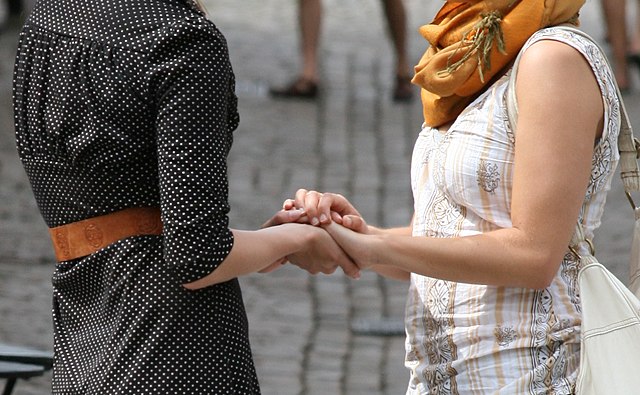
Mathias Klang from Göteborg, Sweden, Wikimedia Commons
After I experienced a sudden shattering break in a friendship with a woman writer/editor that I loved (that I believed would endure any personal difficulty) I was unable to process the event. I wrote a short poem to express my disbelief in which I likened this betrayal to the cutting down of this woman’s tree and left it at that. Silence is a killer of soul. There is no place to go.
The profound rupture of this woman thread felt catastrophic (I have never had a woman friend like her), and in retrospect I still see and experience our friendship in this light. At the time my life was in crisis. I had other consuming worries. Because I had learned at my mother’s knee that silence is literally the end of the road the bottomless chasm that separated us did not lessen in intensity, but I lived on.
Six years later that rupture has been healed. How did this happen? My friend, who happens to be something of a genius, intellectual, professional editor writer/poet wrote a book that she offered to anyone who wanted to read it for free. This act of great generosity was so typical of this woman’s behavior that it galvanized me into action. I took the risk and contacted her directly asking for a copy. I don’t recall just what I said except that I wished we could be friends again, never believing the impossible would happen but it did.
In Part One I began the examination of nine requisites of friendship. The first three are love, reciprocity, and honesty and trust. In Part Two, I continue the examination of the final six: world-traveling, commitment, reconciliation, loyalty, fun and play, and graciousness.
4) World-traveling. Maria Lugones’s prescription for truly knowing and loving another is to travel with them to those places where they are most at home, playful, and at ease. This may mean knowing them in their homes, meeting their families, or literally traveling to their countries, knowing them in what may be cultures and languages different from our own. This has been especially important for me as I’ve sought friendship with those whose identities are different from mine – the lesbian community in the ‘80s, the indigenous community. It has been a vital part of my friendships to travel and be with friends, and create friendships, in those places where they thrive, find meaning, and are most fully themselves.
It has been over a year now that I haven’t been actively a part of my interfaith community. I find that especially odd since I graduated last May from the Claremont School of Theology with a Masters in Religious Leadership. I had hopes that I would be empowered by new education to go out and do more for my community, be invited to be a guest speaker at local houses of worship, or sit on panels; all the things I used to do more frequently and now have all stopped.
I am mostly to blame. Although my personal life has definitely changed with the birth of my son, two new businesses for my husband and me, and the ongoing pressure I put on myself to study for the bar exam any free moment I get (I really don’t have any leisure time to study, but thinking about it takes a lot of energy!), and now expecting my second child, I stopped attending my monthly meetings– whether it be with the Interfaith Youth Council of Orange County, the Muslim-Jewish forum of Los Angeles, or my own beloved organization “I Am Jerusalem.”
While I sit and write this post, Christmas celebrations are concluded and I prepare, with the rest of the world, to embark on a new year; a year with my idealistic hopes and want for a better future for humanity. So for New Year’s I am taking out my golden lamp and making three big wishes: peace, kindness, and dialogue in the Catholic Church.
Peace
“True peace is not a balancing of opposing forces. It’s not a lovely façade which conceals conflicts and divisions…. peace calls for daily commitment.” – Pope Francis
Peace transcends governments and countries. Peace should be a daily commitment that each one of us lives every day and practiced in each of our relationships. Looking forward to a new year, I hope to put this into practice and we will see a shift in politics and attitudes that reflect an ideal of peace and reconciliation – not just nationally, but communally.
With peace also comes reconciliation. Fighting takes too much energy. Making a point to reconcile with that relative or friend that you had a falling out with is a goal that has the potential to bear fruit and be restorative.
Kindness
“Kindness is the language which the deaf can hear and the blind can see.” – Mark Twain
With peace and reconciliation comes kindness. This wish is a large request and one that the Pope calls us to embrace. A kindness is required that reaches the poor and oppressed, that reaches non-Catholics including atheists, and, that touches every race, class, and orientation. We do not have the right to judge – a sentiment that the Pope continues to reiterate.
According to Julia Baird, “even scientists are now touting the physical and psychological benefits of kindness, compassion, and selflessness. Multiple studies now show: a single act of kindness can trigger dozens more … and repetitive acts of kindness can make people happier, and less depressed.” This is not a new revelation, but a reminder of the benefits of kindness – a reminder we need to carry into the New Year.
We should, however, remember help the homeless, the children, and the oppressed. This group of people is often ignored the news media, but lack of attention to a problem does not diminish it. According to the Pope, scandals are the news of today, but the children without food are not news worthy. According to Pope Francis, we should not “interfere in the lives of others” in a way that is malicious, like gossiping or being boastful. This behavior brings hurt, bitterness and envy. Kindness is necessary for a better future for all of humanity.
Dialogue with the Catholic Church
“Fifty years ago, Vatican II spoke of communications. Let us listen to, dialogue with, and bring Christ all those we encounter in life.” – Pope Francis
Let us not focus on rituals and rules in the Church; rather, we need to focus on the people of the Church. People,
after all, make up the Church – not brick and mortar. Because of this, we need to focus on dialogue – a dialogue with each other, regardless of belief or life choices. This dialogue should be rooted in a positive attitude and carried out with love and humility. It should include a focus that reaches out to facilitate peace. This dialogue should also include the discussion of women’s roles in the Church. There are so many things to discuss. The Church is a human church. With the invitation to dialogue and re-address so many of the untouched or misinterpreted teachings of Vatican II, might we move forward and rebuild this Catholic Church on the shoulders of one who served the poor, loved everyone, and gave of himself?
What are your wishes for the new year? I would love to hear from you.
From my family to yours, may you have a peace-filled, prosperous, and delightful 2014.
Michele Stopera Freyhauf: Doctoral Student in the Department of Theology and Religious Studies and a Member of the Centre for Catholic Studies at Durham University as well as an Instructor at John Carroll University’s Department of Theology and Religious Studies, Adjunct Professor in Religious Studies at Ursuline College and the University of Mount Union. Michele has an M. A. in Theology and Religious Studies from John Carroll University, and did post-graduate work at the University of Akron in the area of History of Religion, Women, and Sexuality. She is also a Member-at-Large on the Student Advisory Board for the Society of Biblical Literature and the student representative on the Board for Eastern Great Lakes Biblical Society (EGLBS). Michele is a feminist scholar, activist, and author of several articles including “Hagia Sophia: Political and Religious Symbolism in Stones and Spolia” and lectured during the Commission for the Status of Women at the United Nations (2013). Michele can be followed on Twitter @msfreyhauf and @biblicalfem. Her website can be accessed here and is visible on other social media sites like LinkedIn and Google+


 It has been over a year now that I haven’t been actively a part of my interfaith community. I find that especially odd since I graduated last May from the Claremont School of Theology with a Masters in Religious Leadership. I had hopes that I would be empowered by new education to go out and do more for my community, be invited to be a guest speaker at local houses of worship, or sit on panels; all the things I used to do more frequently and now have all stopped.

 Feminism and Religion