Sojourner Truth, the photos by Beth Bartlett

Moderator’s Note: We inadvertently left out the photos from Beth’s posts on Sojourner Truth. The photos, all by themselves, pack an emotional punch and so we want to be sure they can be seen. These are Beth’s photos from Sojourner Truth Legacy Plaza in Akron, Ohio

You can see Beth’s posts here. Part 1 and Part 2

close- up of statue

Sojourner Truth: Part Two: The Speech and the Sojourner Truth Legacy Plaza by Beth Bartlett

Part one was posted yesterday.

Most of us are quite familiar with Sojourner Truth’s “Ain’t I a Woman?” speech as recorded by Frances Gage several years later, with its powerful “ain’t I a woman” refrain.  However, the actual speech as transcribed at the time by Marius Robinson, while similar in content, does not contain the refrain. Rather, Truth simply states that she is “a woman’s rights” woman.[i]  It is unlikely that she spoke in the southern dialect Gage used in her transcription, since Truth grew up knowing only Dutch, eventually learning English as spoken in New York, and probably spoke with a Dutch accent. Much of the content in the Gage version was fabricated – such as the statement that she bore thirteen children, when she only had five children, though she did cry out in a mother’s grief when she learned that her only son, Peter, had been illegally sold south to Alabama.[ii]

Continue reading “Sojourner Truth: Part Two: The Speech and the Sojourner Truth Legacy Plaza by Beth Bartlett”

Sojourner Truth: Part One: Her Life by Beth Bartlett

On May 29th, 1851, a striking, 6’ tall, African American woman rose to speak at the Women’s Rights Convention being held in Akron, Ohio. There Sojourner Truth gave her famous “Ain’t I a Woman Speech.” 

Originally named Isabella, and known as “Bell,” Truth was born into slavery in 1797, the second youngest of James (“Bomefree” – Dutch for “tree”) and Elizabeth (“Mau-mau Bett”) who were enslaved by a wealthy Dutch man, Johannes Hardenbergh, Jr., who had a large estate in Ulster County, New York, which was inherited by his son, Charles, when Truth was just an infant. Upon the death of Charles, at the young age of nine, she was sold at auction to John Nealy, where she “suffered ‘terribly-terribly’ with the cold”[i] and beatings. In her own words, “He whipped her till the flesh was deeply lacerated, and the blood streamed from her wounds – and the scars remain to the present day.”[ii] She prayed for deliverance, and soon after was sold to a fisherman and tavern owner, Martinus Schriver, where she led “a wild, out-of-door kind of life,” carrying fish, hoeing corn, foraging roots and herbs for beer.  Only a year later she was sold again to John J. Dumont, where she lived out the remainder of her enslavement until her emancipation by the State of New York in 1828. She described her life there as “a long series of trials” which she did not detail “from motives of delicacy,  . . . or because the relation of them might inflict undeserved pain on some now living”[iii] whom she regarded with esteem. Knowing the conditions of enslaved women, we can deduce what those trials entailed. Despite her affections for a man on a neighboring estate, who was beaten to death for visiting her when she was sick, she was forced to marry a much older man, Thomas, also enslaved by Dumont, with whom she bore five children. Because Dumont reneged on his promise to free her, she walked away with her infant daughter in 1827 and was taken in by the Van Wegener family where she lived for the next year. 

Continue reading “Sojourner Truth: Part One: Her Life by Beth Bartlett”

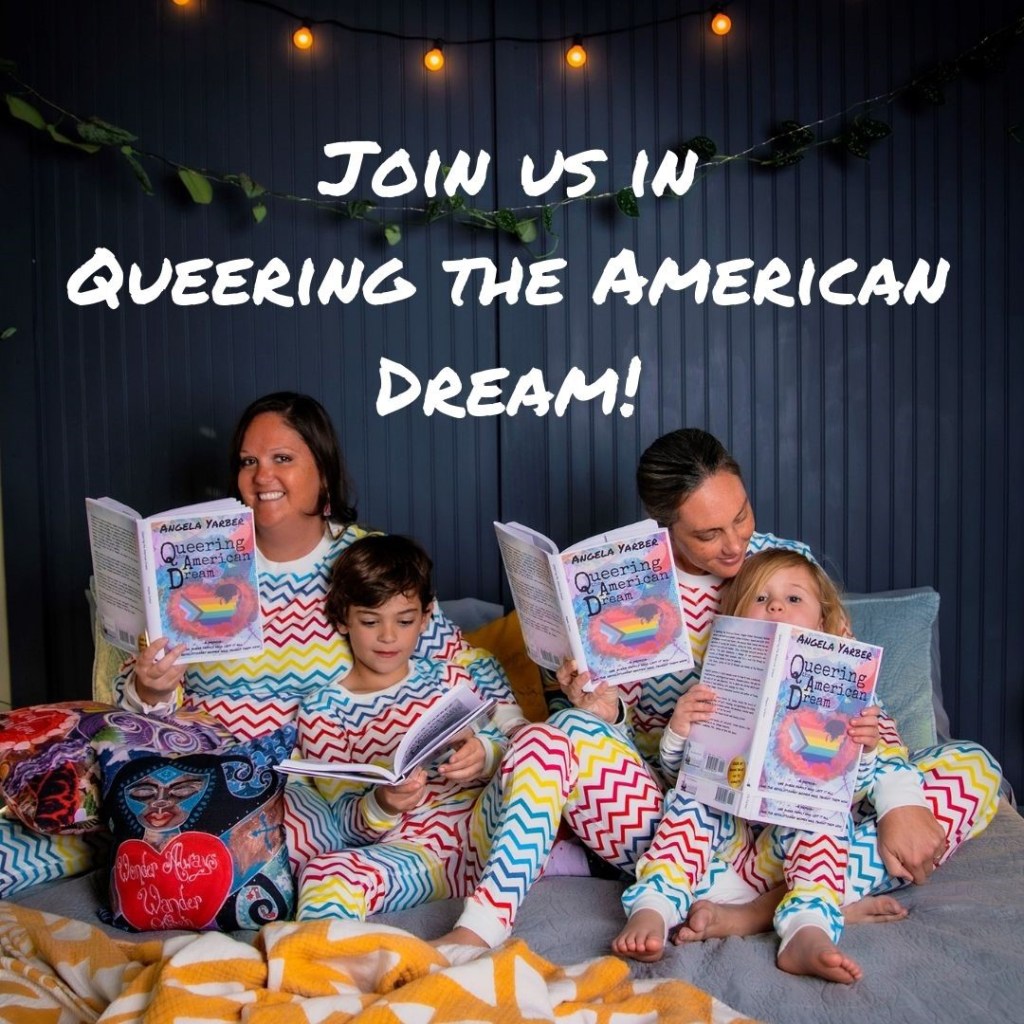
Queering the American Dream by Angela Yarber

As Florida politicians try to ban teachers from including LGBTQ+ issues in the curriculum, admonishing them, “Don’t Say Gay” at school, I’m shouting “GAY!” from the rooftops. Because I’m celebrating the release of my eighth book and first memoir, Queering the American Dream. It’s my queer family’s story of leaving it all and the revolutionary women who taught us how.

Our story began the day the Supreme Court ruled our marriage legal and ended the moment my younger brother’s addiction spiraled into a deadly overdose. In-between were eighteen months of full-time travel with a toddler in tow. Criss-crossing the American landscape, my wife and I came face to face with jaw dropping natural beauty on the one hand, which contrasted with the politics, policies, and people who continued to discriminate against marginalized families like ours on the other. At each stop along the way, a different revolutionary woman from history or mythology guided our footsteps, reminding us that it’s not simply our family who dared to queer the American dream, but a subversive sisterhood of saints who have upended the status quo for centuries. From Vermont to Hawai’i, and everywhere in between, the beauty of the American landscape bore witness to a queer clergywoman whose faith tradition was not enough to sustain her. But the revolutionary women were.

Continue reading “Queering the American Dream by Angela Yarber”

The Need for Intersectionality: Repainting Sojourner Truth by AngelaYarber

angelaI’ve long held that feminism, in order to be true and engaged and practical, must be intersectional. Such is also the case, I believe, for LGBTQ rights. The work of justice for women and LGBTQs people must also include justice for other marginalized groups. Because many LGBTQ people are also women, people of color, people with disabilities, Muslims, immigrants, and others marginalized for identities other than their sexuality. Paying attention to these intersections—of sexuality, gender, race, class, ability, religion—and acknowledging that many people have multiple intersecting identities for which they are oppressed is vital to the work of justice.

These thoughts remained at the forefront of my mind as I recently marched in one of the sister marches of the Women’s March in my home of Hilo, Hawaii. I heard many straight, white, cisgender women claim that women are not oppressed while mocking the march as irrelevant. I heard some gay men purport that such a march was unnecessary. And I wondered. Are not women of color also women? Muslim women? Immigrant women? Women with disabilities? Queer women? Further, are not women also part of LGBTQs? Are not there LGBTQ people of color? LGBTQs who are Muslim? LGBTQs who are immigrants? LGBTQs with disabilities? Of course there are. And even if there are not, are not our quests for liberation and rights and legal validity interrelated, mutually dependent, might I even say intersectional? Continue reading “The Need for Intersectionality: Repainting Sojourner Truth by AngelaYarber”

Painting Sojourner Truth By Angela Yarber

This month, I am reminded of the importance of Jacquelyn Grant’s work on womanist Christology.  In White Women’s Christ and Black Women’s Jesus, Grant reviews the white feminist discussion of the so-called problem of Jesus’ maleness, while beginning to construct a womanist response to this incarnational conundrum.  She states, “It is my claim that there is a direct relationship between our perception of Jesus and our perception of ourselves.”[1]

Beginning with Mary Daly, feminists have responded to Jesus’ maleness in a variety of ways.  Daly argues that because the person of Jesus is male, the male is recognized and celebrated as the superior being.  Because of this, the male Jesus is to be rejected or exorcised because Jesus’ gender identity contributes to patriarchy and does not hold salvific power for women.  Rather than rejecting Jesus altogether, Rosemary Radford Ruether asks the seminal question, “Can a male Jesus save woman?” Continue reading “Painting Sojourner Truth By Angela Yarber”