
The Legacy of the Goddess: Heroines, Warriors and Witches from World Mythology to Folktales and Fairy Tales by Rachel McCoppin

This is part 1 of a two part posing. Part 2 will be posted tomorrow.
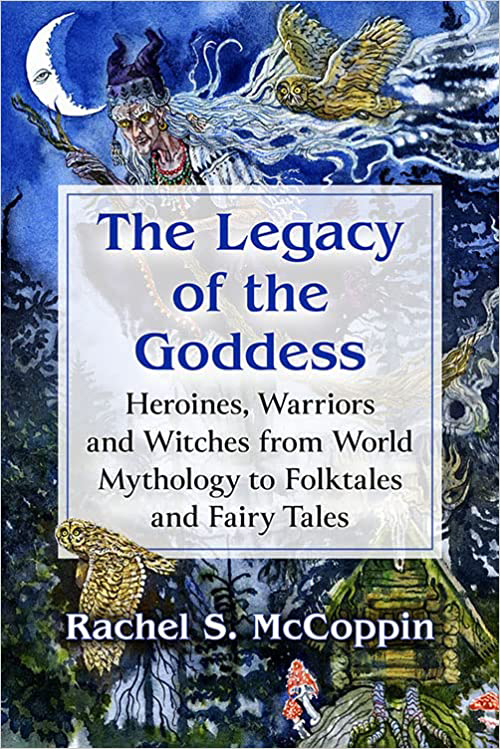
In this blog post, I would like to take the opportunity to discuss my new book, entitled: The Legacy of the Goddess: Heroines, Warriors and Witches from World Mythology to Folktales and Fairy Tales. This book argues that hundreds of folktales and fairy tales from around the world have preserved elements related to goddess worship from the sacred myths of many ancient civilizations.

Powerful goddesses were worshipped in most global cultures for centuries, until, in many regions, episodes of diffusion, conquest, colonialism, etc. caused the worship of these goddesses to be revised, lessened, or in some cases eliminated. To “preserve at least part of the reverence of goddesses, as well as the memory of the powerful religious and social roles women once held as representatives of goddesses”, hundreds of folktales and fairy tales were created, “told, and retold, most often by women storytellers” to impart goddess ideology (McCoppin, 2023, p. 5). Thus, many folktales and fairy tales portray myriad examples of powerful female characters who portray important messages connected to the goddesses and sacred women of ancient mythology.

Continue reading “The Legacy of the Goddess: Heroines, Warriors and Witches from World Mythology to Folktales and Fairy Tales by Rachel McCoppin”
Calling All Biblical Wise Women by Rabbi Jill Hammer, PhD

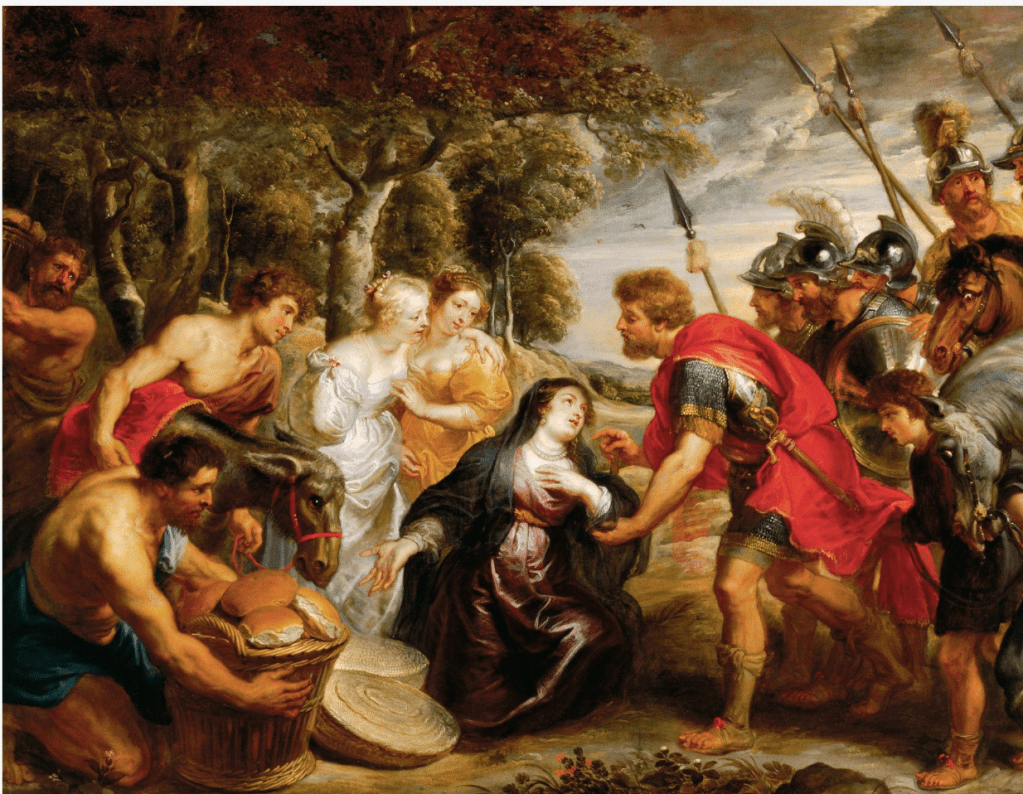
The meeting of David and Abigail by Peter Paul Rubens circa 1630

In these days when so many are afraid and aching for the people of Ukraine, and concerned about the lasting impacts of this war around the world, I cannot help thinking of the wise women of ancient Israel. These wise women, unafraid of confronting dangerous men, used their intelligence and storytelling skill to defuse violent situations between powerful adversaries and restore peace. May their wisdom be felt in the world now. 

The institution of “wise woman” appears several times in the Bible. In the Book of Samuel, a wise woman (chachamah in Hebrew, from chochmah, wisdom) steps in when there is a war, or political conflict, to promote peace. In II Samuel 14, after King David’s son Amnon rapes David’s daughter, Tamar, the king does nothing. Tamar’s full brother Absalom takes matters into his own hands and kills Amnon, then flees to another country.  David grieves for Absalom but won’t send for him. The wise woman of Tekoa appears before King David, pretending to be a woman whose sons fought, and one killed the other. The story she tells helps to reconcile King David with his son Absalom, at least temporarily.  

Continue reading “Calling All Biblical Wise Women by Rabbi Jill Hammer, PhD”

Angrboða, Her Children, and Our Shadow Selves by Deanne Quarrie

In the land of the Northern Europeans, the very first beings were the giants and giantesses. I call them the Jötunn folk for they come from the realm of Jötunheimr. One story that I find particularly fascinating is that of Angrboða and her three children. She is known as the Hag of Iron Wood, one of the witches of Iron Wood who are a group of giantesses that gave birth to fierce wolves. Angrboða took Loki as her consort, and as a product of that union, gave birth to Fenrir, Jormungandr, and Hela.

Angrboða was called Hag, but this comes to us in the same way as Hagia, meaning wise. She was the tribal wise woman of the Nine Clans of Iron Wood, often referred to as the chief of chieftains. The Iron Wood Clan were known to be werewolves – some staying in animal form, others shapeshifting at will to other forms, some were feathered and some scaled. Continue reading “Angrboða, Her Children, and Our Shadow Selves by Deanne Quarrie”