

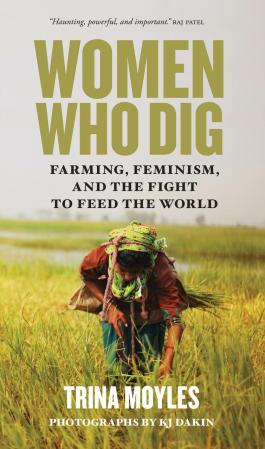
Here in the north, it is harvest time when the deep and ancient relationship between women and farming once again brings forth the food on which life depends. Women have been co-creating with the Earth to feed themselves and their families and communities for many thousands of years. In fact, the world’s oldest agricultural tool may be a 300,000 year old stick possibly used by women to “harvest wild tubers for food and medicine” (p. xx) according to Women Who Dig: Farming, Feminism, and the Fight to Feed the World by Trina Moyles with photos by KJ Dakin.
In her beautiful and enlightening book, Trina weaves together stories and stunning color photographs about the lives and work of women small farmers in Uganda, Guatemala, Nicaragua, the United States, Canada, India, the New Congo refugee settlement in Uganda, and Cuba. Together the profiles demonstrate that, despite sometimes overwhelming odds, women are feeding themselves, their families, and their communities through sustainable small farming practices that are good for both our nutrition and well being as well as the planet.
Continue reading “Women Who Dig by Trina Moyles – Book Review by Carolyn Lee Boyd” Two recent posts,
  Feminism and Religion