Lessons in Community at the Lily Pond by Carolyn Lee Boyd

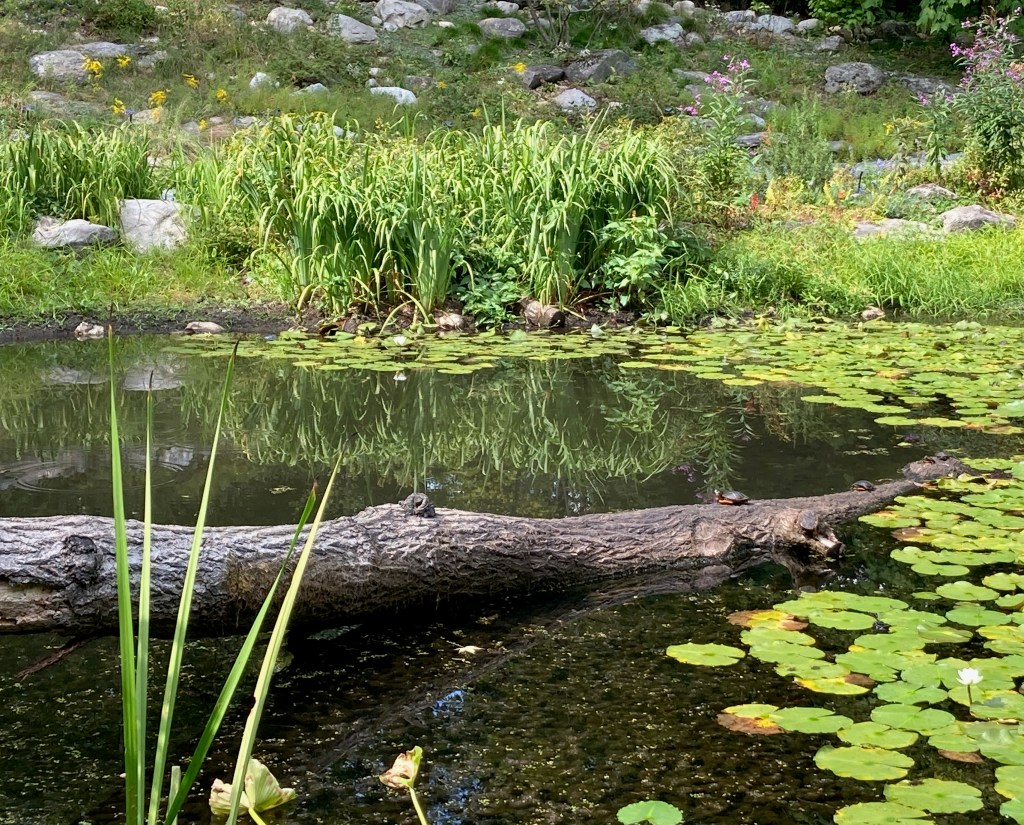
Turtle family on a log
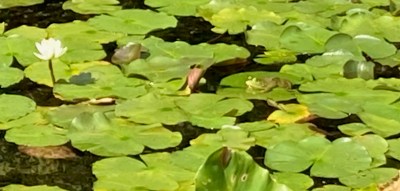
Frog on a lily pad

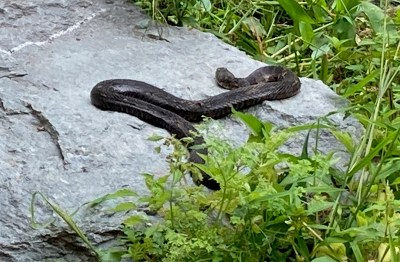
On a recent tranquil Sunday afternoon I was wandering around a lily pond in a nearby botanical garden, fully immersed in that liminal time between summer’s outbursts of nature’s abundance and the peaceful contentment of fall. The late goldenrod and delicate white wood asters danced a hued duet in the wind among the turtleheads and cardinal flowers, while hydrangeas shifted from white to the vibrancy of their last red passion. The lilies in the pond poked their heads above the water while frogs lay in repose on the pads. They were joined on nearby logs by a family of turtles, parents on one side and two babies on the other, close enough for security but far enough to enjoy some independence. A long dark brown watersnake was curled up unmoving on a boulder. All seemed to be basking in the sun, napping now and then. Around the pond were wanderers like me and human caretakers, silently tending to wildflowers and trees and occasionally stopping to watch if one of the beyond-human inhabitants plopped into the water for a little late afternoon swim. 

watersnake on a rock

Of course, I also knew that the peacefulness of this snapshot moment would not last forever because what do watersnakes eat? Frogs, fish and other beings that live around ponds. And what do frogs and fish eat? Insects, snails, and other beings, and so on up and down the food chain. But even this is part of the wholeness of the pond, as each being fulfills its place in the cycle of birth, life, death, and rebirth so that all of us can, in our own time, enjoy these short times of contentment living on the face of our magnificent planet.

Continue reading “Lessons in Community at the Lily Pond by Carolyn Lee Boyd”

Living in an Ever-Changing Co-Creative Universe by Carolyn Lee Boyd

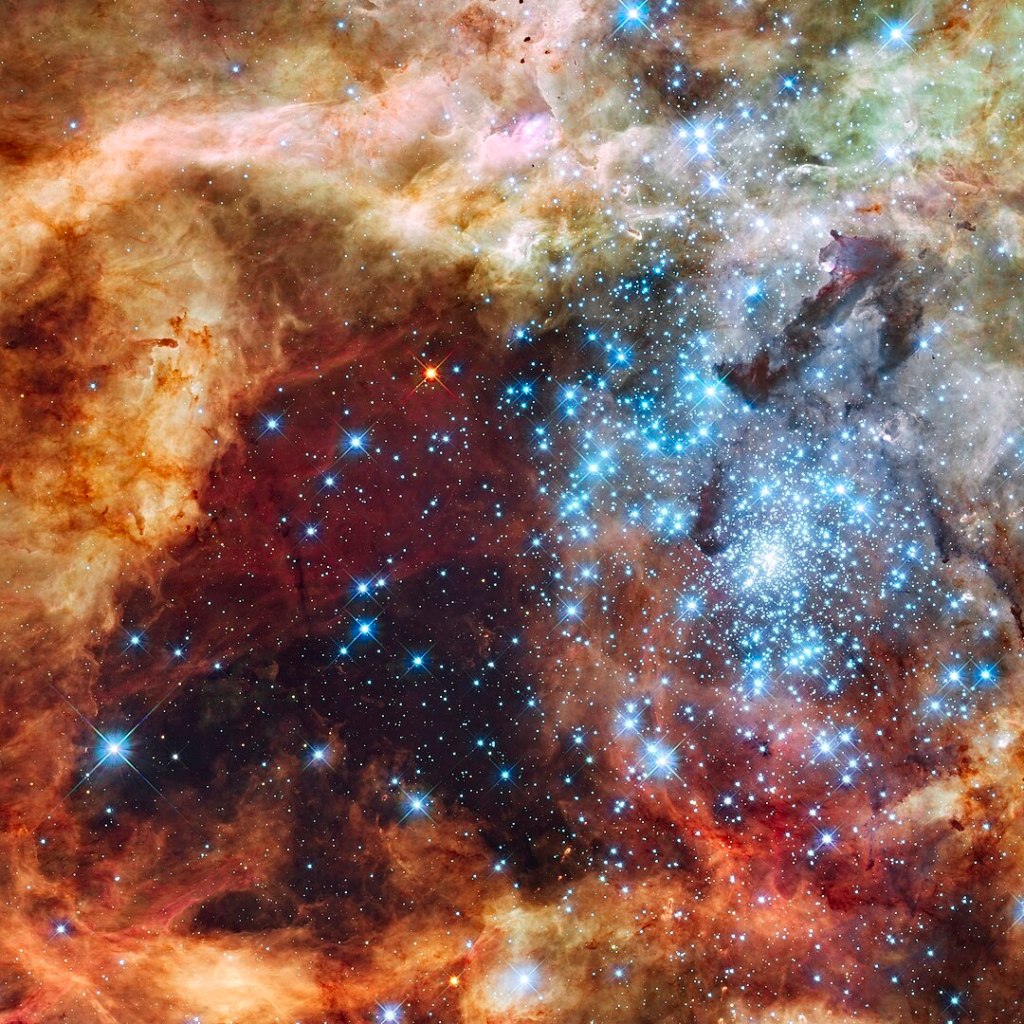
Grand Star Forming Region. These stars are only a few million years old.

Imagine living in a co-creative universe where all beings, including the Divinity and humans, are ever co-evolving reality in a way that nurtures life. What kind of a world would that be? Feminist theologian and FAR contributor Carol Christ brilliantly describes how these ideas, part of an approach called process philosophy, deeply resonate with Goddess thealogy in her 2003 book She Who Changes: Re-Imaging the Divine in the World

She writes “process philosophy states that all life in is process, changing and developing, growing and dying, and that even the divine power participates in changing life. Humans and other beings are not things (substances or essences) situated in empty space, as has often been thought by philosophers and scientists, but are active processes ever in relation and transition…” (3). In fact, “the whole universe is alive and changing, continually co-creating new possibilities of life” (45). Further, “Process philosophy asserts that feeling, sympathy, relationship, creativity, freedom, and enjoyment are the fundamental threads that unite all beings in the universe, including particles of atoms and the divinity” (3). 

Continue reading “Living in an Ever-Changing Co-Creative Universe by Carolyn Lee Boyd”

The Grandeur of Fragility by Carolyn Lee Boyd

Lake Ruban. Jacques-Cartier National Park. Quebec, Canada. By LBM1948 – Own work, CC BY-SA 4.0, https://commons.wikimedia.org/w/index.php?curid=72309690

Water is mighty.  Water was the birthplace of all life on our planet. Water regulates the world’s climate cycles and makes it possible for the matrix of life to exist. Twenty-thousand years ago, ice moved across the Earth creating the planet’s landscape of mountains, lakes, rivers, lakes and oceans that bring us awe in their majestic beauty.

Water is also fragile. Water evaporates and disappears from our sight during the laziest summer day.  Frozen water, ice, can shatter into shards at the slightest tap. With just a few degrees of extra warmth even great glaciers disintegrate and slide into the ocean. Water is elemental to much of our species and planet’s fragility, whether there is too much of it in a flood, or not enough in a drought. In just a couple of centuries, humans have endangered water all over the globe through pollution and other actions. 

Continue reading “The Grandeur of Fragility by Carolyn Lee Boyd”

Bright Circle: Five Remarkable Women in the Age of Transcendentalism by Randall Fuller, Book Review by Carolyn Lee Boyd

“As I sat there, my heart overflowed with joy at the sight of the bright circle…for I know not where to look for so much character, culture, and so much love of truth and beauty, in any other circle of women and girls” – unidentified woman from Margaret Fuller’s “Conversations” (1)

In the early 19th century, the five women of Fuller’s book — Margaret Fuller, Elizabeth Palmer Peabody, Mary Moody Emerson, Sophia Peabody Hawthorne, and Lydia Jackson Emerson — built many of the foundations of both American feminism and the philosophical movement known as transcendentalism, among many other American “firsts.” Yet, they are almost unknown to most people today.

Continue reading “Bright Circle: Five Remarkable Women in the Age of Transcendentalism by Randall Fuller, Book Review by Carolyn Lee Boyd”
From the Archives Imagine a World of Beauty for Beauty’s Sake by Carolyn Lee Boyd

This was originally posted Oct 18, 2023

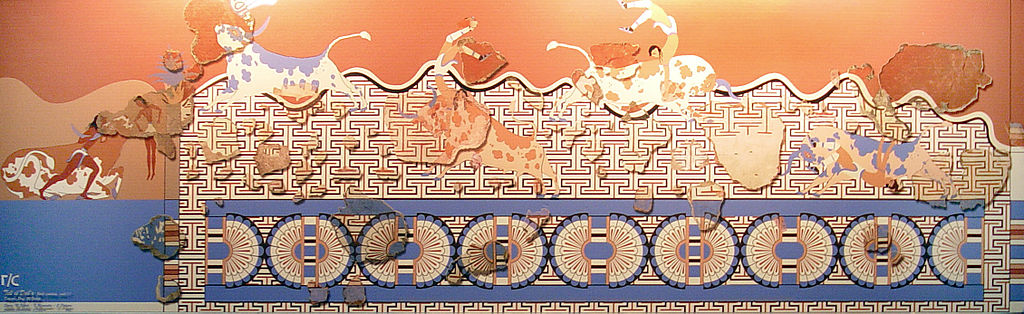
Reconstructed Minoan Frescoe: Martin Dürrschnabel, CC BY-SA 2.5 <https://creativecommons.org/licenses/by-sa/2.5&gt;, via Wikimedia Commons

Imagine a world where beauty is revered just for bringing pleasure and joy; where buildings abound in graceful, naturalistic, lively renderings of animals and plants; where the human body is magnificent art; where everyday objects for all are ornamented with complex, graceful imagery. Imagine a world where “beauty” is not a narrowly defined style of attractiveness or an attribute of works created by a small elite, but a revelation of life’s joy created by all, an expression of delight in the Earth, and a bridge to the worlds within us. If we look back across human history, we will find all these expressions of “beauty for beauty’s sake,”

From our earliest millennia, “where you find humans, you will find art,” says pre-historian Jean Clottes (Marchant). People carved zig zags in shells 500,000 years ago (Handwerk). About 164,000 years ago, people left behind in South African caves ochre and pierced shells, perhaps for jewelry (Marchant). Artists created the oldest cave paintings yet found, stunning in their realism and movement, in Spain 65,000 years ago (Handwerk).

Continue reading “From the Archives Imagine a World of Beauty for Beauty’s Sake by Carolyn Lee Boyd”

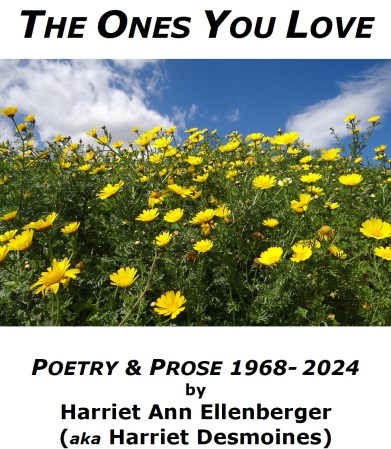
The Ones You Love, Poetry and Prose 1968-2024 by Harriet Ann Ellenberger (aka Harriet Desmoines), Book Review by Carolyn Lee Boyd

The Ones You Love, Poetry and Prose 1968-2024 is a half-century retrospective love letter from Harriet Ann Ellenberger to friends, family, and lovers; lesbian and overall feminism; lesbian feminist literature and theater; Nature; and those who have been victimized by war. Infusing the book is her overarching love of freedom, not only for herself, but for women, for humanity, and for the Earth.  Harriet has been using her authorial and editorial gifts for her entire adult life to move our planet away from extinction into new ways of being, and has now collected her best writings, both prose and poetry, into a single volume. The book is both a brilliant, truthful, unglossed portrait of herself as well as a glimpse into feminism, and lesbian feminism in particular, over decades through one woman’s experience. She often notes in introductions to various pieces that she no longer completely agrees with what she wrote so long ago, but she does not edit out these views, (speaking of her “younger fiery-feminist self,” she says “I’m proud of her courage and proud of the work she undertook” (11)) which offers us a better understanding of both her own progression of thoughts and ideas as well as what issues and points of view were of concern at the time. 

Of her most well-known achievement, she writes, “On July 4, 1976, the 200th anniversary of the American Revolution, Catherine Nicholson and I published the first issue of Sinister Wisdom, which has since become the longest-lived lesbian literature and arts journal in the world” (11). She explains the journal’s expansive perspective: “We exist in the interface between a death culture and the faint beginnings of a culture of — not humans — but life-lovers, a culture that embraces animals, plants, stars and those women who choose the future at the risk of their ‘sanity’ and security” (17). This is a vision she has carried with her ever since. 

Continue reading “The Ones You Love, Poetry and Prose 1968-2024 by Harriet Ann Ellenberger (aka Harriet Desmoines), Book Review by Carolyn Lee Boyd”
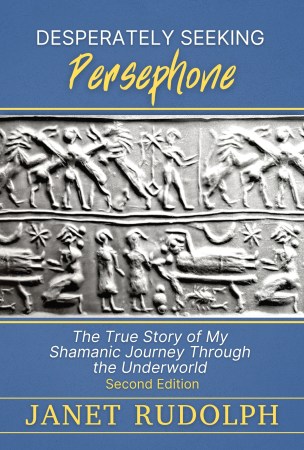
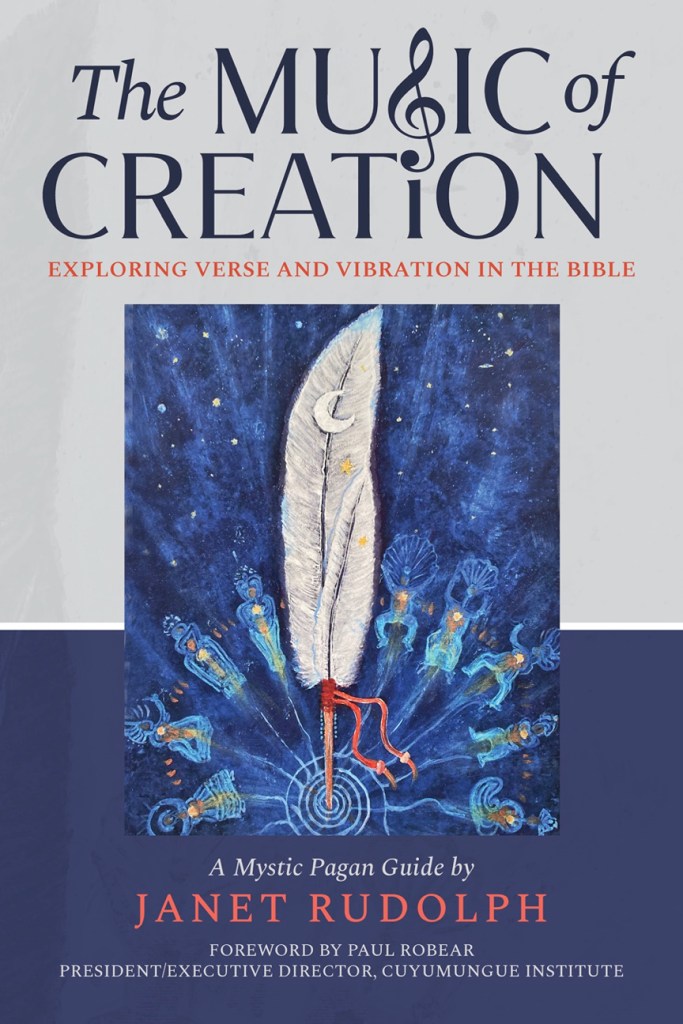
Desperately Seeking Persephone by Janet Rudolph, Book Review by Carolyn Lee Boyd, Part Two

In Part One of this review (posted yesterday), we learned how Janet descended into the Underworld, like Inanna and Persephone, after child abuse and rape, and how she began a decades-long journey back to our own world, healed and empowered. To learn more about her return from the Underworld and how she became the shaman and author she is today, I invite you to join the journey in Part Two as we continue to explore “Signposts” that marked her ascent.

Signpost #3. Be aware, be free, be focused, be here, be loved, be strong, be healed.

Janet’s teachers at the Mystery School had brought together shamanic traditions from throughout then world. Among them was Huna, or Hawaiian Adventure Shamanism as practiced by Serge Kahili King. A summary of Huna is shown in a mantra: Be aware, be free, be focused, be here, be loved, be strong, be healed (114) and “focus on the gifts that come to us through adversity” (116). 

Continue reading “Desperately Seeking Persephone by Janet Rudolph, Book Review by Carolyn Lee Boyd, Part Two”

Desperately Seeking Persephone by Janet Rudolph, Book Review by Carolyn Lee Boyd, Part One

The myths of the descents of the Sumerian Inanna and the Greek Persephone to the underworld have fascinated and inspired women for millennia with their violence and betrayal, leaving behind all you love and that hold you up, and facing your deepest fears, even death. We recognize our own traumas in their struggles and seek guidance as to how to navigate our ascents back to wholeness and well being in their stories.

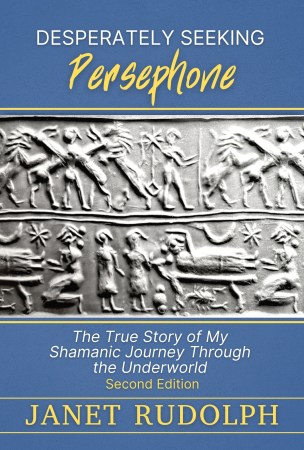
After her own experience of childhood abuse and stranger rape as a young woman, Janet Rudolph, one of FAR’s co-weavers, also pored over the myths in hopes of finding a helpful account of their journey home. “Once I had tumbled metaphorically, literally and mythically into the thorny quagmire of the underworld, it was devilishly hard to escape. I felt lost. I needed a guide, a role model to find my path outward”(xii). The problem is, Janet says, “The stories of their return are glossed over. There is no detailed story called From the Great Below Back to the Great Above” (15). Until now in Janet’s recently re-published book, Desperately Seeking Persephone.

Continue reading “Desperately Seeking Persephone by Janet Rudolph, Book Review by Carolyn Lee Boyd, Part One”

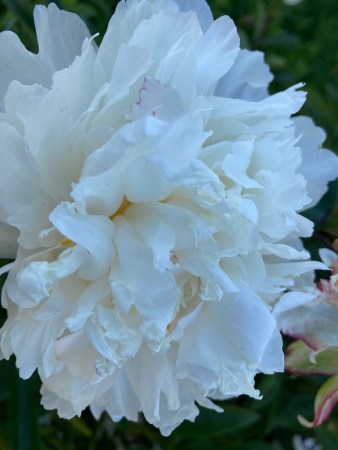
Peonies by Carolyn Lee Boyd

I was born into this life laughing
Embarking on what seemed to me to be
A heavenly sojourn on a blessed planet. 
In my first memory, I lay among the exuberant peonies bursting into
Moonlit white, beguiling pink, raucous blood crimson from tiny buds.
Clasping hands, the peonies and I held Earth’s beauty tight 
In dawn’s ever-brightening kiss of the sun.

At that instant I did not yet know all I had sacrificed for my birth.
Did I remember gamboling contentedly in the Otherworld’s fairy light
While waiting to emerge into fragile flesh on 20th century Earth?
Did I know that the price for this mortal human life would be 
Pain, hunger, violence, anger, bereavement, and death?

Continue reading “Peonies by Carolyn Lee Boyd”

The Nature of Reality Is Relationship by Carolyn Lee Boyd

Water drops on spider web, US Fish and Wildlife Service, Public Domain.

According to the Universe, the true nature of reality is relationship. In fact, at the level of quanta, the smallest objects in the cosmos, we don’t even exist outside of our relationships1. How different this is from our common 21st century understanding of ourselves as inherently alone in our bubbles of existence, our societies conceived of as a collection of individuals all wrestling each other for the basics of life. What if we took this truth about quanta to heart on our human level? What if we began to think of ourselves as not primarily alone, but rather as a node in a web of connection, an essential part of a greater, even universal, whole? How might our lives and societies be different? When I experience Goddess myths and traditions and look at some of the societies from which they rose, I seem to catch a glimpse of what this change in perception might be like in our daily lives.

Continue reading “The Nature of Reality Is Relationship by Carolyn Lee Boyd”